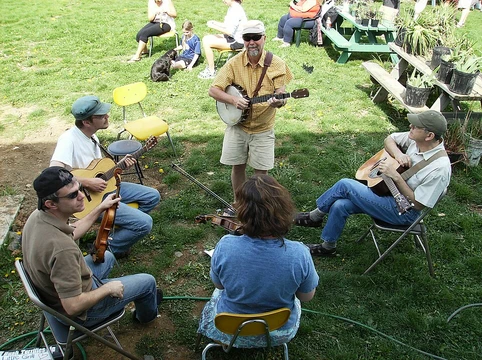
Tennessee Ramblers (Tennessee band)
East Tennessee old-time string band with pioneering female guitarist.

The Tennessee Ramblers were an American old-time string band from East Tennessee, originally consisting of William 'Fiddlin' Bill' Sievers on fiddle, his son James 'Mack' Sievers on banjo and vocals, daughter Willie Sievers on guitar, and cousin Walter McKinney on steel guitar. Active from the 1920s through the 1940s, they gained initial fame as a backing band in fiddle contests at Market Hall in Knoxville, Tennessee, and later performed at fairs and gatherings around the eastern United States. They recorded several sides for Brunswick/Vocalion in 1928 and 1929, and Willie Sievers' guitar solos from those sessions are among the first by a female lead guitarist in Country music.
- formed
- 1922
- origin
- East Tennessee, United States
- genre
- Old-time string band
- key_members
- William Sievers, James Sievers, Willie Sievers, Walter McKinney
- notable_recordings
- Cackling Pullet, Fiddler Contest, Preacher Got Drunk and Laid His Bible Down, Ramblers March, Garbage Can Blues
- years_active
- 1922–1954
Quick Facts
- Background
- group_or_band
- Alias
- Sievers Ramblers
- Origin
- Clinton, Tennessee, U.S.
- Genre
- Old-time
- Years Active
- 1922–1954
- Label
- Brunswick/Vocalion
- Past Members
- William Sievers / James "Mack" Sievers / Willie Sievers / Walter McKinney / Jerry Taylor / J.T. Jones
Facts from the source article.
Lore & Background
William Sievers was born in Elza, Tennessee (now part of Oak Ridge) in 1875 and worked as a barber in nearby Clinton. His grandfather and mother were fiddle players, and most everyone in the family played an instrument. William's wife, Myrtle McKinney, occasionally sang with the band in its early years. James Sievers began playing banjo with his cousin Walter McKinney in 1913, learning technique from a north Anderson County banjo player named Steve Cole. Willie initially took piano lessons but quit after her instructor told her she would only learn by playing by ear; she took up guitar and later won several contests. The two siblings developed a lifelong interest in Hawaiian music while also learning old-time music from their father.
The Tennessee Ramblers formed in 1922. James chose the name one night while driving to a show in Virginia. Throughout the 1920s, they played at venues across the eastern United States and appeared on radio stations including WNOK in Knoxville, WLW in Cincinnati, and WFJC in Akron. At fiddler conventions held by Frank Murphy at Market Hall in Knoxville, they were often paired with fiddlers Charlie Bowman and Earl Johnson. In February 1928, they recorded their first record at a Brunswick session in Ashland, Kentucky, producing 'Cackling Pullet,' 'Fiddler Contest,' and 'Preacher Got Drunk and Laid His Bible Down.' In August 1929, they recorded 'Ramblers March' and 'Garbage Can Blues' at the St. James Hotel in Knoxville. A follow-up session in April 1930 produced no released recordings, but Willie is believed to have supplied a brief guitar solo on a recording by fiddler Uncle Jimmy Thompson.
In 1931, Walter McKinney left the group and moved west, replaced by mandolin player Jerry Taylor. In 1938, J.T. Jones joined. The band continued playing at gatherings including a large concert in St. Petersburg, Florida in 1932, and various venues in downtown Knoxville. The Tennessee Ramblers disbanded with William Sievers' death in 1954. The following year, James and Willie formed a Hawaiian music group called Mack's Novelty Hawaiians, which played regularly in downtown Knoxville through the 1970s. Willie Sievers appeared briefly in the 1985 documentary Louie Bluie.
Reader's Guide
The Tennessee Ramblers are significant as a representative old-time string band from East Tennessee that bridged traditional fiddle contest music and early commercial recording. Their recordings for Brunswick/Vocalion in 1928 and 1929 capture a moment when regional string bands were being documented for national distribution. The band's most notable legacy is Willie Sievers, whose guitar solos on those recordings are among the first by a female lead guitarist in Country music. This places her as an early female instrumentalist in a genre then dominated by male performers. The band's later shift to Hawaiian music under Mack's Novelty Hawaiians reflects the broader trend of Hawaiian music's popularity in the United States during the mid-20th century. Their inclusion in the 1997 compilation Rural String Bands of Tennessee and Willie's appearance in the documentary Louie Bluie have helped preserve their memory. The Tennessee Ramblers exemplify the family-based string band tradition that flourished in the Appalachian region and contributed to the foundations of country and old-time music.
Did You Know?
- Willie Sievers' guitar solos recorded with the Tennessee Ramblers in 1928 and 1929 are among the first by a female lead guitarist in Country music.
- The band's name was chosen by James Sievers one night while driving to a show in Virginia.
- William Sievers worked as a barber in Clinton, Tennessee, and his grandfather and mother were fiddle players.
- Willie Sievers appeared briefly in the 1985 documentary Louie Bluie, performing alongside Blues musician Howard Armstrong.
More in Old-time bands 1-24
Spotted an error? Know more?
This is a living reference — every entry is fact-audited, and reader corrections feed straight into our audit queue. Suggest an edit · See this site's audit record