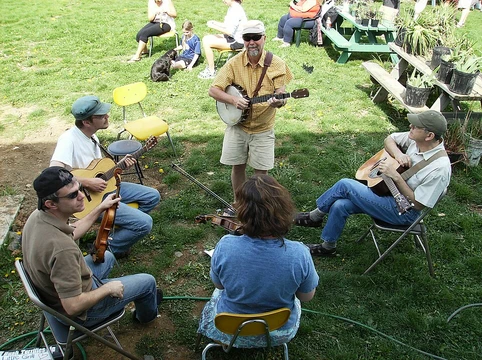
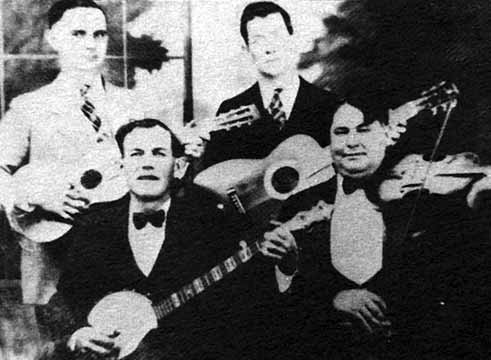
Georgia Yellow Hammers
1920s old-time quartet from Gordon County, Georgia.

Emblem is the work of the People's Mujahedin of Iran. SVG by MrPenguin20 · Public domain
The Georgia Yellow Hammers were a 1920s old-time string band and vocal quartet from Gordon County, Georgia. The core lineup included Charles Moody, Jr. on guitar, Bud Landress on banjo, Phil Reeve on guitar, and Bill Chitwood on fiddle, though all members likely played multiple instruments. According to Tony Russell’s notes for the 2004 compilation *Old Mountain*, the personnel on “The Picture on the Wall” (Victor 20943, recorded August 9, 1927) were Landress on fiddle and lead vocals, Reeve on guitar and vocals, C. Ernest Moody on banjo-ukulele and vocals, and Clyde Evans on guitar and vocals.
The band frequently collaborated with Andrew and Jim Baxter, an African American duo from Curryville, Georgia—also in Gordon County and the hometown of musician Roland Hayes. This interracial partnership was unusual for the era. Andrew Baxter’s distinctive fiddle style appears on an early recording of the band’s favorite “G-Rag.” The Yellow Hammers released one of the best-selling records of 1920s Southern music with the 1927 single “The Picture on the Wall” / “My Carolina Girl.” That same year, an integrated recording session with the Baxters took place in Atlanta, Georgia—a rare occurrence even into the mid-to-late 20th century. Andrew and Jim Baxter were themselves a well-known duo in northwest Georgia.
The Georgia Yellow Hammers are recognized nationally as a significant old-time band from the 1920s. Their early recordings can still be heard on platforms like YouTube. The song “Drifting Too Far From The Shore,” written by member Charles Moody, has been covered by artists including Jerry Garcia, Emmylou Harris, Phil Lesh & Friends, and Hank Williams, and appears in many gospel hymnals.
- origin
- Gordon County, Georgia, United States
- genre
- Old-time string and vocal quartet
- active_years
- 1920s
- notable_members
- Charles Moody, Jr., Bud Landress, Phil Reeve, Bill Chitwood
- known_for
- Collaboration with African American musicians Andrew and Jim Baxter; top-selling 1927 record 'The Picture on the Wall' / 'My Carolina Girl'
Lore & Background
The Georgia Yellow Hammers often played with Andrew and Jim Baxter from Curryville, Georgia, also in Gordon County. Andrew Baxter's unique style of fiddle is heard on an early recording of a band favorite entitled 'G-Rag'. The Baxters were African Americans, which was an unusual collaboration for the time period. The 1927 recording session with the Baxters took place in Atlanta, Georgia, and was a rare integrated session, uncommon even through the mid to late 20th century. Andrew and Jim Baxter were a well-known duo for the time in their own right around Northwest Georgia.
Reader's Guide
The Georgia Yellow Hammers released one of the top-selling records of 1920s southern music with 1927's 'The Picture on the Wall' / 'My Carolina Girl'. Their songs can still be heard from early recordings on sites such as YouTube. The song 'Drifting Too Far From The Shore', written by member Charles Moody, has been covered by artists including Jerry Garcia, Emmylou Harris, Phil Lesh & Friends, Hank Williams, and many others, and is a standard in many gospel hymnals. The Calhoun High School football stadium in Calhoun, Georgia, is named after guitar player and founding member Phil Reeve. The band's legacy endures as an important old-time group from the 1920s.
Did You Know?
- The Georgia Yellow Hammers recorded with African American musicians Andrew and Jim Baxter in a rare integrated session in Atlanta, Georgia, in 1927.
- The song 'Drifting Too Far From The Shore', written by member Charles Moody, has been covered by artists including Jerry Garcia, Emmylou Harris, Phil Lesh & Friends, and Hank Williams.
The Quartet and Its Members
The Georgia Yellow Hammers were an old-time string and vocal quartet hailing from Gordon County, Georgia, active during the 1920s. The core lineup featured Charles Moody Jr. handling guitar, Bud Landress on banjo, Phil Reeve also on guitar, and Bill Chitwood on fiddle. The group likely embraced a flexible, multi-instrumentalist approach, as members appear to have swapped roles across sessions. Evidence of this fluidity appears in Tony Russell's liner notes for the 2004 Old Mountain compilation CD, where the personnel on the August 9, 1927 Victor 20943 pressing of "The Picture on the Wall" lists Landress on fiddle and lead vocal, Reeve on guitar and vocal, C. Ernest Moody on banjo-ukulele and vocal, and Clyde Evans on guitar and vocal. This alternate roster suggests the quartet was not a fixed unit but a rotating collection of skilled musicians from the same tight-knit community, drawing on whatever combinations of strings and voices best suited each recording date.
Playing Across the Color Line
The Yellow Hammers maintained a close musical partnership with Andrew and Jim Baxter, a duo based in Curryville, Georgia, also within Gordon County. The Baxters were already well known as a standalone act throughout Northwest Georgia, and their collaboration with the Hammers produced some of the most commercially successful southern recordings of the 1920s. Their joint 1927 release, "The Picture on the Wall" paired with "My Carolina Girl," became one of the top-selling records in the region's music scene. The session that captured these tracks took place in Charlotte, North Carolina, and was a rare integrated recording date. At a time when racial segregation in the music industry was the norm, and would remain so well into the mid and late twentieth century, this cross-racial collaboration stood out as genuinely unusual. Andrew Baxter's distinctive fiddle work is preserved on the band's rendition of "G-Rag," showcasing a style that set him apart from other regional players. Notably, Curryville itself had a rich musical heritage, having also been the home of the celebrated vocalist Roland Hayes.
A Song That Outlived the Band
Although the Georgia Yellow Hammers recorded only a handful of sides during the late 1920s, their musical footprint has proven remarkably durable. The group is now nationally recognized as a significant old-time ensemble of the 1920s era, and their early recordings remain accessible to new generations through platforms like YouTube. Perhaps their most enduring contribution is "Drifting Too Far From The Shore," a composition penned by member Charles Moody. That single song has been covered by an extraordinary range of artists spanning genres and decades, including Jerry Garcia, Emmylou Harris, Phil Lesh & Friends, and Hank Williams, among many others. It has also found a permanent place in numerous gospel hymnals, ensuring its presence in worship settings far removed from its old-time string-band origins. Beyond the recordings, the band left a physical mark on their home community: the football stadium at Calhoun High School in Calhoun, Georgia, bears the name of founding member and guitarist Phil Reeve, a tribute that keeps his legacy visible to students and townspeople every season.
The Recorded Catalog
The Yellow Hammers' surviving discography, though modest in length, captures a vivid snapshot of 1920s southern string-band music. Their catalog includes a mix of gospel-inflected numbers, social dance tunes, and narrative songs. Titles such as "Mary, Don't You Weep" and "I'm S-A-V-E-D" reflect the spiritual and evangelical traditions woven through old-time repertoire, while "Pass Around the Bottle" and "Fourth of July at a County Fair" (1927) evoke the communal, celebratory atmosphere of rural Georgia gatherings. "Going to Ride That Midnight Train" and "Peaches Down in Georgia" carry the storytelling and regional pride typical of the era. The 1927 sessions also yielded "Tennessee Coon" and "My Carolina Girl," the latter of which, paired with "The Picture on the Wall," became a commercial hit. The final known recording, "Picture on the Wall," appeared in 1928. The August 9, 1927 session on the Victor label (catalog number 20943) also produced the collaborative "G Rag" with Andrew Baxter. Together, these sides form a compact but richly textured portrait of a community's musical life at a pivotal moment in American popular music.
Gallery


Frequently Asked Questions
Who are the Georgia Yellow Hammers?
They were a rural string band and vocal quartet that recorded in the 1920s out of Gordon County, Georgia. Their sound blended fiddle, guitar, banjo, and close-harmony singing typical of the old-time tradition.
Who played in the Georgia Yellow Hammers?
The core group included Charles Moody Jr. on guitar, Bud Landress on banjo, Phil Reeve on guitar, and Bill Chitwood on fiddle, though members frequently swapped instruments. Personnel also shifted between sessions, with names like C. Ernest Moody and Clyde Evans appearing on some recordings.
What is the Georgia Yellow Hammers' most famous record?
Their 1927 Victor release pairing "The Picture on the Wall" with "My Carolina Girl" became their best-selling disc. The track was recorded in August 1927 and featured Landress on fiddle and lead vocals alongside Reeve, Moody, and Evans.
What's the deal with the Georgia Yellow Hammers and the Baxters?
The band worked alongside African American musicians Andrew and Jim Baxter, a collaboration that stands out in the segregated recording landscape of the 1920s. This partnership gave their catalog a distinctive cross-cultural flavor uncommon for the period.
Why do old-time fans care about the Georgia Yellow Hammers?
They represent one of the better-documented rural Georgia string bands from the 1920s, preserving a specific regional style of fiddle-and-guitar music with quartet vocals. Their surviving Victor recordings remain a reference point for scholars and players studying the old-time tradition in the upper South.
More in Old-time bands 1-24
Spotted an error? Know more?
This is a living reference — every entry is fact-audited, and reader corrections feed straight into our audit queue. Suggest an edit · See this site's audit record