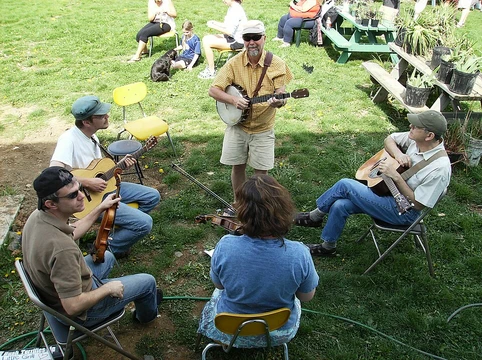
Binkley Brothers' Dixie Clodhoppers
Early Nashville string band and Grand Ole Opry regulars.

The Binkley Brothers' Dixie Clodhoppers were an American Old-time string band active from the 1920s to the late 1930s. The group consisted of brothers Amos Binkley on banjo and Gale Binkley on fiddle, along with Tom Andrews on guitar and Jack Jackson on guitar and vocals. They were among the first bands to record commercially in Nashville and performed regularly on the Grand Ole Opry until 1938.
- born
- Amos Binkley (1888), Gale Binkley (1893), Tom Andrews (1901), Jack Jackson (1908)
Lore & Background
Amos and Gale Binkley were born in Cheatham County, Tennessee, and worked as jewelry repairmen before starting to play for WSM in 1926. They later joined with guitarist Tom Andrews, a Franklin-born railroad worker and farmer, and Jack Jackson, a Wilson County farm equipment builder. The group was named 'Binkley Brothers' Dixie Clodhoppers' by Opry founder George D. Hay, who favored rural-sounding names for the barn dance format.
In September 1928, the band attempted to record for Victor Records at the YMCA building in Nashville, but Victor's A&R agent Ralph Peer deemed their vocals too 'rough.' Peer added singer Jack Jackson to the lineup, and on October 2 the band made its first recordings. The group continued on the Opry through the 1930s, and by the early 1930s Jackson—known as the 'Strolling Yodeler'—was one of the most popular singers on Nashville-area radio.
The band's repertoire included 'I'll Rise When the Rooster Crows,' derived from the 1881 song 'Dem Golden Shoes,' and the folk song 'Give Me Back My Fifteen Cents,' both recorded at their 1928 Victor sessions. When the Binkley Brothers left the Opry in 1938, they were replaced by Bill Monroe and the Bluegrass Boys.
Reader's Guide
The Binkley Brothers' Dixie Clodhoppers hold significance as early pioneers of commercial country music recording in Nashville. Their 1928 Victor sessions, though initially rejected for rough vocals, resulted in the first recordings by a Nashville-based string band after the addition of Jack Jackson. The group's regular appearances on the Grand Ole Opry from 1928 to 1938 helped establish the show's format and rural aesthetic. Their recordings, including 'I'll Rise When the Rooster Crows' and 'Give Me Back My Fifteen Cents,' preserve early Old-time string band music and have been reissued on compilation albums. The band's departure from the Opry in 1938 marked a transition, as they were replaced by Bill Monroe and the Bluegrass Boys, signaling a shift in the genre. Their legacy lies in their role as early Nashville recording artists and Opry regulars, contributing to the development of country music's commercial and broadcast traditions.
Did You Know?
- The group's name was given by Opry founder George D. Hay, who preferred rural-sounding names.
- Amos and Gale Binkley worked as jewelry repairmen before performing on WSM.
- Victor Records A&R agent Ralph Peer initially rejected the band's vocals as too 'rough' before adding Jack Jackson.
- Jack Jackson was known as the 'Strolling Yodeler' and became one of the most popular singers on Nashville-area radio.
From Workbench to WSM: The Making of a String Band
The Binkley Brothers' story begins in Cheatham County, Tennessee, where Amos (born 1888) and Gale (born 1893) grew up. By the mid-1920s, the two brothers were earning a living as jewelry repairmen—a far cry from the stage they would eventually command. In 1926, they began performing on Nashville's WSM radio, marking the start of their musical career. Their sound was built around Amos's banjo and Gale's fiddle, a classic old-time pairing. The duo soon expanded, welcoming Thomas William "Tom" Andrews, a Franklin-born guitarist who had previously worked for the L&N Railroad and later as a farmer, and Jonas "Jack" Jackson, a Wilson County native known for building farm equipment, who contributed guitar and vocals. By 1928, the four-piece group had become one of the first bands to record commercially in Nashville, cementing their place in the city's early recording history.
Ralph Peer's Veto and the October 2 Sessions
In September 1928, the Binkley Brothers walked into the YMCA building in Nashville to cut sides for Victor Records. The session, however, ended in a creative rebuke. Victor's A&R man Ralph Peer listened to the group's vocal work and concluded it was simply too "rough" for his commercial standards. Rather than scrap the project, Peer made a pragmatic fix: he brought in Jack Jackson, a singer from Lebanon, Tennessee, to smooth out the vocal delivery. The result was transformative. On October 2, 1928, the reconfigured band made its first official recordings. Among the tracks captured that day were "I'll Rise When the Rooster Crows," a tune derived from the 1881 song "Dem Golden Shoes," and the folk number "Give Me Back My Fifteen Cents." Both songs would later appear on the 2000 County Records compilation Nashville – The Early String Bands, Vol. 1, preserving the group's sound for new generations of listeners.
The Clodhopper Name and a Decade on the Opry
Opry founder George D. Hay had a distinct taste for band names that evoked rural, down-home imagery, fitting the barn-dance atmosphere of his show. It was Hay who christened the group "Binkley Brothers' Dixie Clodhoppers," a moniker that stuck for the entirety of their career. The band became a fixture on the Grand Ole Opry, performing regularly from their 1926 WSM debut through their 1938 departure. By the early 1930s, the group's popularity had grown considerably, with Jack Jackson—affectionately dubbed the "Strolling Yodeler"—emerging as one of the most in-demand vocalists on Nashville-area radio. The Binkley Brothers' sound, anchored by Amos's banjo, Gale's fiddle, and the twin guitars of Andrews and Jackson, represented the quintessential old-time string band format that defined the Opry's early years. Their repertoire blended traditional folk material with original compositions, all delivered with the unpolished energy that made them a crowd favorite.
Passing the Torch: 1938 and the Monroe Succession
When the Binkley Brothers' Dixie Clodhoppers disbanded in 1938, their departure marked the end of an era on the Grand Ole Opry. The slot they vacated was filled by Bill Monroe and the Bluegrass Boys, a succession that underscores the direct lineage between the Binkley Brothers' old-time string band style and the bluegrass genre that would soon dominate American roots music. Monroe's group inherited the same four-piece instrumentation—fiddle, banjo, and guitars—that the Binkleys had popularized on the Opry stage. Though the Binkley Brothers' commercial recording output was limited to their 1928 Victor sessions, their influence on Nashville's musical infrastructure was substantial. They were among the very first bands to record in the city, helping establish Nashville as a recording destination. Their tracks endure on modern compilations, and their story—two jewelry repairmen who became Opry regulars—remains a testament to the grassroots origins of the American string band tradition.
Frequently Asked Questions
Who are the Binkley Brothers' Dixie Clodhoppers?
They were a four-piece American old-time string band that operated from the 1920s into the late 1930s. The group's name came from brothers Amos and Gale Binkley, who anchored the ensemble on banjo and fiddle respectively.
Who were the members of the Binkley Brothers' Dixie Clodhoppers?
The quartet consisted of banjoist Amos Binkley, fiddler Gale Binkley, guitarist Tom Andrews, and Jack Jackson, who handled guitar and lead vocals.
What made the Binkley Brothers' Dixie Clodhoppers notable in recording history?
They are credited as one of the earliest string bands to lay down commercial recordings in Nashville. Their studio work in the 1920s and '30s helped set a template for the city's growing recording scene.
Did the Binkley Brothers' Dixie Clodhoppers perform on the Grand Ole Opry?
Yes, they were regular performers on the Opry stage, appearing there until 1938. Their consistent presence made the Opry one of the band's most recognizable platforms during that era.
Why do old-time fans still talk about the Binkley Brothers' Dixie Clodhoppers?
Their early Nashville recordings and long Opry run made them a foundational reference point for the string-band tradition. Fans often cite them when tracing how old-time music transitioned into commercial country recording.
More in Old-time bands 1-24
Spotted an error? Know more?
This is a living reference — every entry is fact-audited, and reader corrections feed straight into our audit queue. Suggest an edit · See this site's audit record