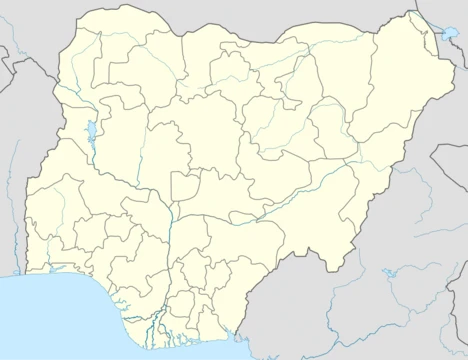
Taraba State
State in north-eastern Nigeria, named after the Taraba River.

via Wikipedia: Taraba State · see source
Taraba is a state in northeastern Nigeria, carved out of the former Gongola state on August 27, 1991, under the military regime of General Ibrahim Badamasi Babangida. Its name comes from the Taraba River, which flows through the southern part of the state, and it is often called "Nature's Gift to the Nation." The capital is Jalingo, and the state is home to roughly 80 different ethnic groups, each with its own language.
The state was formed by merging three former divisions: Wukari, Mambilla, and Muri. It shares borders with Nasarawa, Benue, Plateau, Bauchi, Gombe, and Adamawa states, as well as the Northwest Region of Cameroon. Major rivers include the Benue, Donga, and Taraba, all originating in the Cameroonian mountains and draining northward before joining the Niger River.
Taraba has an average annual temperature of 33°C, with the hottest months being March and April, when highs reach about 40.44°C. It receives roughly 100.64 millimeters of rainfall per year, with heavier rains in August, and average relative humidity is around 54.98%. In April 2023, flooding affected many homes and commercial buildings in the state.
The state is divided into 16 local government areas: Ardo Kola, Bali, Donga, Gashaka, Gassol, Ibi, Jalingo, Karim Lamido, Kurmi, Lau, Sardauna, Takum, Ussa, Wukari, Yorro, and Zing. Its government consists of a democratically elected governor and a House of Assembly. The governor is chosen through a modified two-round system, requiring a plurality of votes and at least 25% of votes in two-thirds of the state's local government areas to win outright; otherwise, a runoff is held.
Healthcare facilities include Courage Hospital, Federal Medical Centre, Gateway Hospital, General Hospital in Bali, Sauki Hospital and Maternity, Totus Hospital and Maternity, Albert Healthcare Company, Federal University Teaching Hospital in Wukari, Taraba Specialist Hospital, Kwararafa Hospital and Maternity, Federal Polytechnic Bali Medical Centre, First Referral Hospital, and Biyama Hospital.
Languages spoken across the state, listed by local government area, include Akum, Bukwen, Esimbi, Fali of Baissa, Jiba, Njerep, Tha, Yandang, Yotti, and Ywom. Major ethnic groups are the Jukun, Jenjo, Fulani, Mumuye, Mambilla, Kuteb, Karimjo Wurkun, Tiv, Yandang, Ndola, Ichen, Tigon, and Jibu. The northern part is mostly Fulani, Mumuye, and Sho; the south is primarily Jukun, Wurkum, Tiv, Chamba, Kuteb, and Ichen; the central region is mainly Fulani, Mambilla, Ndola, Tigon, Jibu, Wurbo, and Daka.
Educational institutions include Federal Polytechnic in Bali, Federal University in Wukari, Kwararafa University in Wukari, Taraba State University, College of Education in Zing, Taraba State College of Health Technology in Takum, and Taraba State Polytechnic in Suntai.
Transportation relies on federal highways like A4 and A8, plus major roads such as Bachumbi Road, Wukari-Ampei Road, and Garin Kunini-Zing Road. Jalingo Airport serves the state. The economy is largely agricultural, with cash crops like coffee, tea, groundnuts, and cotton, as well as maize, rice, sorghum, millet, cassava, and yam. Livestock—cattle, sheep, goats, poultry, rabbits, and pigs—are raised extensively, especially on the Mambilla Plateau and along the Benue and Taraba valleys. In February 2024, the World Bank in Nigeria announced plans to empower 5,200 female livestock farmers in the state. Fishing is a year-round activity along the Benue, Taraba, and Donga rivers. Other occupations include pottery, cloth-weaving, dyeing, mat-making, carving, embroidery, and blacksmithing. Natural resources for industrial and commercial use include barytes, bauxites, graphite, limestone, gypsum, kaoline, feldspar, mica, pyrite, uranium, and gemstones, along with agro-raw materials like maize, millet, and sorghum.
- created
- 27 August 1991
- capital
- Jalingo
- nickname
- Nature's Gift to the Nation
- population_ethnicities
- about 80 distinct ethnicities
- annual_avg_temperature
- 33°C
- annual_rainfall
- 100.64 mm
- number_of_LGAs
- 16
Verified Timeline
Lore & Background
Taraba state was formed from an amalgamation of three former divisions: Wukari, Mambilla, and Muri. It is bordered by Nasarawa, Benue, Plateau, Bauchi, Gombe, and Adamawa states, as well as the Northwest Region of Cameroon. The main rivers are the Benue, Donga, and Taraba, which begin in the Cameroonian mountains and drain almost the entire state before linking with the Niger River. The state's primary ethnic groups include the Jukun, Jenjo, Fulani, Mumuye, Mambilla, Kuteb, Karimjo Wurkun, Tiv, Yandang, Ndola, Ichen, Tigon, and Jibu. The northern part is mostly Fulani, Mumuye, and Sho; the southern part is primarily Jukun, Wurkum, Tiv, Chamba, Kuteb, and Ichen; the central region is mainly occupied by the Fulani, Mambilla, Ndola, Tigon, Jibu, Wurbo, and Daka people. Agriculture is the major occupation, with cash crops including coffee, tea, groundnuts, and cotton, and livestock such as cattle, sheep, and goats reared in large numbers.
Reader's Guide
Taraba State holds significance as a culturally and ethnically diverse region in north-eastern Nigeria, created in 1991 to reflect the distinct identities of its three former divisions. Its nickname 'Nature's Gift to the Nation' underscores its natural resources, including minerals like barytes, bauxite, limestone, and uranium, as well as agro-raw materials such as maize, rice, and timber. The state's economy is heavily agricultural, with farming, livestock rearing, and fishing along its major rivers forming the backbone of livelihoods. The Mambilla Plateau, part of the Bantu cradle, adds historical depth, while festivals like the Nwunyu fishing festival and Karimjo Abedahh festival highlight cultural traditions. The state's political structure includes a democratically elected governor and a House of Assembly, with a modified two-round electoral system. Notable figures from Taraba include former ministers, senators, and a former Chief Justice of Nigeria, reflecting its role in national governance. The state also hosts several higher education institutions, including Taraba State University and Federal University, Wukari.
Did You Know?
- Taraba state was created on 27 August 1991 by the military government of General Ibrahim Badamasi Babangida.
- The state is named after the Taraba River, which traverses its southern part.
- Taraba is home to about 80 distinct ethnicities and their languages.
- The state's annual average temperature is 33°C, with the hottest months being March and April at an average high of 40.44°C.
- The Mambilla Plateau, part of the state, is described as the Bantu cradle, occupied for approximately five millennia.
Frequently Asked Questions
What is Taraba State?
Taraba is a state in north-eastern Nigeria, named after the Taraba River that runs through its southern area. It was carved out of the old Gongola state and is celebrated for its lush natural landscapes.
When and how was Taraba State created?
The state officially came into existence on 27 August 1991, when the military government of General Ibrahim Badamasi Babangidi split the former Gongola state into two. This reorganization was part of a wider set of administrative changes enacted during that era.
What is Taraba State's nickname and why?
Taraba is popularly called 'Nature's Gift to the Nation,' a title that nods to its abundant natural resources and scenic terrain. The moniker underscores the state's contribution to Nigeria's overall ecological wealth.
What is the capital of Taraba State?
Jalingo serves as the state capital and functions as the primary administrative and governmental hub of Taraba. It anchors the state's political and civic life.
How culturally diverse is Taraba State?
The state is home to roughly 80 distinct ethnic groups, each speaking its own language and maintaining unique traditions. This extraordinary ethnic variety makes Taraba one of Nigeria's most culturally layered regions.
More in Nigerian States 1-24
Related in Nigerian States
Links follow this subject's own source article.
Spotted an error? Know more?
This is a living reference — every entry is fact-audited, and reader corrections feed straight into our audit queue. Suggest an edit · See this site's audit record