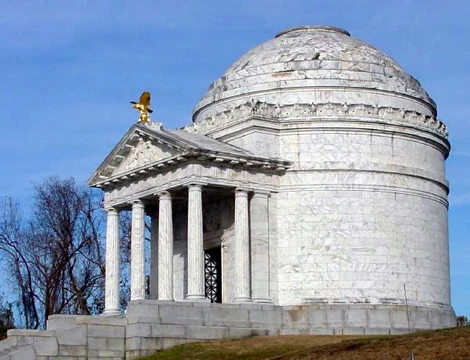
River Raisin National Battlefield Park
Only national battlefield park for the War of 1812.
Last updated
Where it is
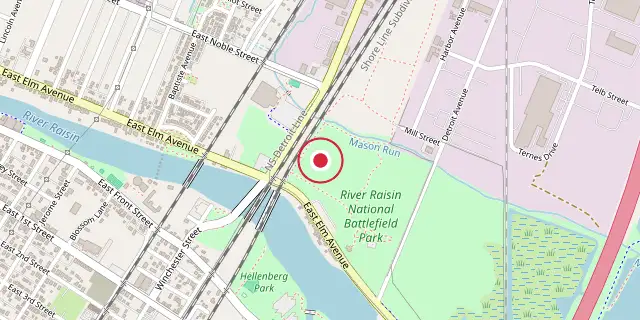
Coordinates: 41°54′50″N 83°22′41″W (41.9140, -83.3780) · Open in OpenStreetMap
Coordinates and connected clubs: the infobox of Wikipedia: River Raisin National Battlefield Park (CC BY-SA 4.0). Map: drawn by Codexery from OpenStreetMap tiles.
River Raisin National Battlefield Park in southeastern Michigan preserves the site of the January 1813 Battle of Frenchtown. It is the only national battlefield park dedicated to a War of 1812 engagement. The park was established as the 393rd unit of the National Park Service in 2009 and began operations in 2010.
Background
The park covers the site of the Battle of Frenchtown, a costly War of 1812 engagement. On January 18, 1813, American forces won the first encounter. Their retreat was blocked; only 33 of 980 men escaped. The following day, wounded American prisoners unable to walk were killed by Potawatomi in an incident called the River Raisin Massacre.
Recent history
The River Raisin Battlefield Site was listed as a Michigan Historic Site on February 18, 1956, though the exact date of initial park organization is not recorded. The site lies within present-day Monroe, bounded by North Dixie Highway, the River Raisin, Detroit Avenue, and Mason Run Creek. The battles extended a few miles north and south of the current park. Frenchtown was gradually abandoned after the fighting; Monroe developed 1.5 miles west.
The park covers about 40 acres on Monroe's east side, roughly 440 yards west of Interstate 75. A paper mill operated on the site from about 1911 until 1995. The site was added to the National Register of Historic Places on December 10, 1982, as River Raisin Battlefield Site (20MR227). In July 1990, the Monroe County Historic Commission and Historical Society opened the River Raisin Battlefield Visitor Center at 1403 East Elm Avenue, which houses relics from the battle.
A memorial service is held each January. Expansion began in 1995 after the paper mill closed; the city, historical society, and property owner negotiated cleanup and acquisition of the mill property and adjacent landfill for donation to the park service. Wetlands were transferred to the State of Michigan for Sterling State Park. Acquisitions were complete by 2006, the mill demolished by 2009, cleanup finished in 2010, and land transfers completed in 2011.
More in National Battlefields and Military Parks of the United States
Sources
Compiled from Wikipedia and the sources listed below. Text from Wikipedia is available under CC BY-SA 4.0; this entry is adapted from it.
- Wikipedia: River Raisin National Battlefield Park (CC BY-SA 4.0).
Spotted an error? Know more?
Reader corrections go straight into our review queue. Suggest an edit · How this site is sourced