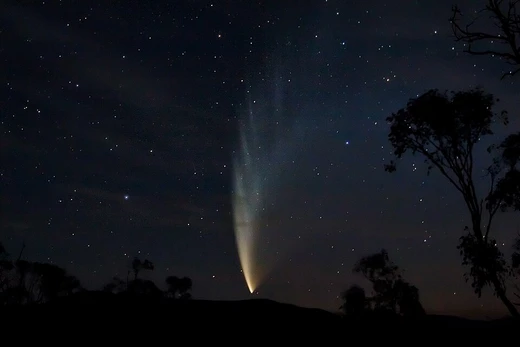
C/2007 N3 (Lulin)
A green, naked-eye comet with a disconnected plasma tail.
Last updated
Comet Lulin (official name C/2007 N3, also known as 鹿林彗星) is a non-periodic comet. It was found by Quanzhi Ye and Lin Chi-Sheng at the Lulin Observatory. At its brightest, it reached a magnitude between +4.5 and +5, making it visible without a telescope. It made its closest approach to Earth on February 24, 2009, coming within 0.411 AU (61.5 million km or 38.2 million miles).
The comet was first captured on film on July 11, 2007, by astronomer Lin Chi-Sheng using a 0.41-meter telescope at the Lulin Observatory in Nantou, Taiwan. The discovery came from the Lulin Sky Survey, a project searching for small Solar System objects, especially near-Earth ones.
It was 19-year-old Ye Quanzhi, a student at Sun Yat-sen University in China, who spotted the new object in three of Lin's photographs. At first, it looked like an asteroid with a magnitude of 18.9, but images taken a week later with a larger 0.61-meter telescope showed a faint coma. The comet was named after the observatory.
Observational history
The comet became visible to the naked eye from dark locations around February 7. It passed near the double star Zubenelgenubi on February 6, near Spica on February 15–16, near Gamma Virginis on February 19, and near the star cluster M44 on March 5–6.
It also appeared near the planetary nebula NGC 2392 on March 14 and near the double star Wasat around March 17. On February 23, it was close to Saturn, and on February 26–27, it headed outward toward its aphelion, appearing against the background stars in the direction of Regulus in Leo. On May 12, 2009, it passed near Comet Cardinal.
NASA explains that Comet Lulin's green color comes from gases in its atmosphere, mainly diatomic carbon, which glows green when sunlight hits it in space. When the SWIFT satellite observed the comet on January 28, 2009, it was releasing about 3,000 liters (800 US gallons) of water every second. The comet was also rich in methanol.
Orbit
Astronomer Brian Marsden of the Smithsonian Astrophysical Observatory calculated that Comet Lulin reached its perihelion on January 10, 2009, at a distance of 182 million km (113 million miles) from the Sun. Its orbit is nearly parabolic, with an eccentricity of 0.999986 in 2009 and 0.999998 in 2010. It moves in a retrograde orbit with a very low inclination of just 1.6° relative to the ecliptic.
Ranked in
More in Named Comets
Sources
Compiled from Wikipedia and the sources listed below. Text from Wikipedia is available under CC BY-SA 4.0; this entry is adapted from it.
- Wikipedia: C/2007 N3 (Lulin) (CC BY-SA 4.0).
- Word definitions: the , each quoted from its Wikipedia article.
Spotted an error? Know more?
Reader corrections go straight into our review queue. Suggest an edit · How this site is sourced