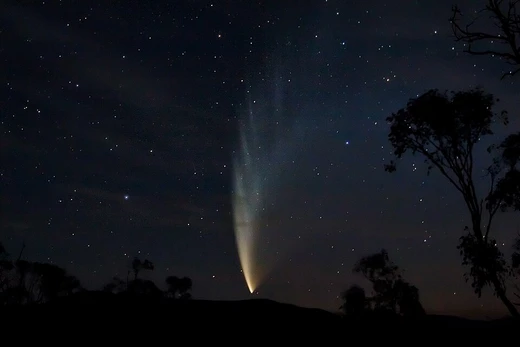
Comet McNaught
The brightest comet in over 40 years, visible in daylight.
Last updated

Don Heffernan · CC BY 4.0
Comet McNaught, also designated C/2006 P1, is a non-periodic comet discovered on 7 August 2006 by Robert H. McNaught.[1][2] Observers in the Southern Hemisphere could see it with the naked eye during January and February 2007, and it was the brightest comet seen in more than four decades.[1] The comet's peak magnitude was estimated at −5.5, making it the second most brilliant comet observed since 1935.[3]
Key facts and history
Using 39 positions from August 7 to 11, a perihelion date of 2007 January 11.74 and a perihelion distance of 0.170 AU were determined.[2] An estimated maximum apparent magnitude of −5.5 was reached by the comet on 13 and 14 January 2007.[4] 15 January 2007 marked the comet's closest approach to Earth, at a distance of 0.82 AU.[4] At its peak, the tail extended 35 degrees across the sky and was estimated to be 74.935 million km long.[3]
Space.com gave the comet the name "Great Comet of 2007".[4] C/2006 P1 originated from the Oort cloud and required millions of years to travel to the inner Solar System.[5]
What the research sources say
Kronk's Cometography reports that McNaught described the comet as magnitude 17.3 with a faint coma 20 arc seconds across in moonlight at discovery.[2] The comet entered the field of the STEREO satellites on January 11, and operators opened the SECCHI/HI-1B instrument door for the first time since launch to see it.[2] Kronk's Cometography also states that the comet entered the field of the LASCO camera aboard SOHO on January 12, and it was the brightest comet SOHO had seen.[2] The Astronomy Online blog reports that Robert McNaught took a photo of the comet with a Canon 5D camera and a 135mm lens.[6]
That blog also states that the comet was reported to have a magnitude as bright as −6.0 to northern hemisphere observers, while Perth Observatory estimated its brightness at −4.0 on January 13, 2007.[6] The perihelion time is given as 2007-Jan-12.7988436329 by Horizons data from the Jet Propulsion Laboratory.[7][8][9]
References
- Wikipedia, "Comet McNaught" (CC BY-SA 4.0), which cites: "Report on the comet discovery and progress from Robert McNaught's homepage" (original not read by us) en.wikipedia.org
- "Kronk's Cometography – C/2006 P1". facts only, no text reused. cometography.com
- Wikipedia, "Comet McNaught" (CC BY-SA 4.0), which cites: "Kronk's Cometography – C/2006 P1" (we also read that source) en.wikipedia.org
- Wikipedia, "Comet McNaught" (CC BY-SA 4.0), which cites: "Untitled Document"; "Southern Comets Homepage" (original not read by us) en.wikipedia.org
- Wikipedia, "Comet McNaught" (CC BY-SA 4.0), which cites: Horizons output, "Barycentric Osculating Orbital Elements for Comet C/2006 P1 (McNaught)"; "McNaught (C/2006 P1): Heliocentric elements 2006–2050", Jet Propulsion Laboratory, 18 July 2007 (we also read that source) en.wikipedia.org
- "McNaught Captures McNaught", Astronomy Online, 2007. facts only, no text reused. astronomyonline.org
- "McNaught (C/2006 P1): Barycentric elements 2050", Jet Propulsion Laboratory, 18 July 2007. facts only, no text reused. ssd.jpl.nasa.gov
- "McNaught (C/2006 P1): Heliocentric elements 2006–2050", Jet Propulsion Laboratory, 18 July 2007. facts only, no text reused. ssd.jpl.nasa.gov
- Horizons output, "Barycentric Osculating Orbital Elements for Comet C/2006 P1 (McNaught)". facts only, no text reused. ssd.jpl.nasa.gov
Each numbered sentence above was checked against the source it cites before publication. Sentences citing Wikipedia adapt text from the English Wikipedia article Comet McNaught (contributors), used under CC BY-SA 4.0; this entry is available under the same licence. Other sources were used for facts only; no text or images are copied from them.
Ranked in
More in Named Comets
Sources
Compiled from Wikipedia and the sources listed below. Text from Wikipedia is available under CC BY-SA 4.0; this entry is adapted from it.
- Wikipedia: Comet McNaught (CC BY-SA 4.0).
- Word definitions: the , each quoted from its Wikipedia article.
Spotted an error? Know more?
Reader corrections go straight into our review queue. Suggest an edit · How this site is sourced