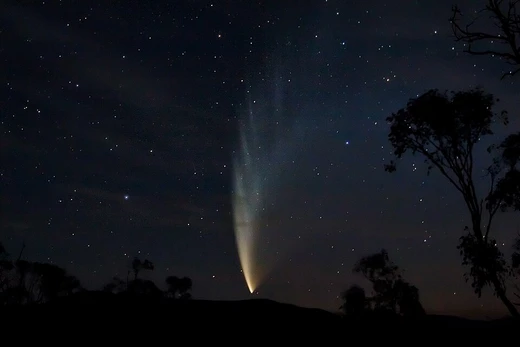
C/2011 L4 (PanSTARRS)
Non-periodic comet discovered in 2011, visible to the naked eye in March 2013.
Last updated

Mallorcasaint / Mallorcasaint at English Wikipedia · CC BY-SA 3.0
C/2011 L4 (PanSTARRS) is a non-periodic comet first spotted in June 2011. It became bright enough to see without a telescope as it approached its closest point to the Sun in March 2013. The discovery was made with the Pan-STARRS telescope on the summit of Haleakalā, on Maui, Hawaii.
Observational history
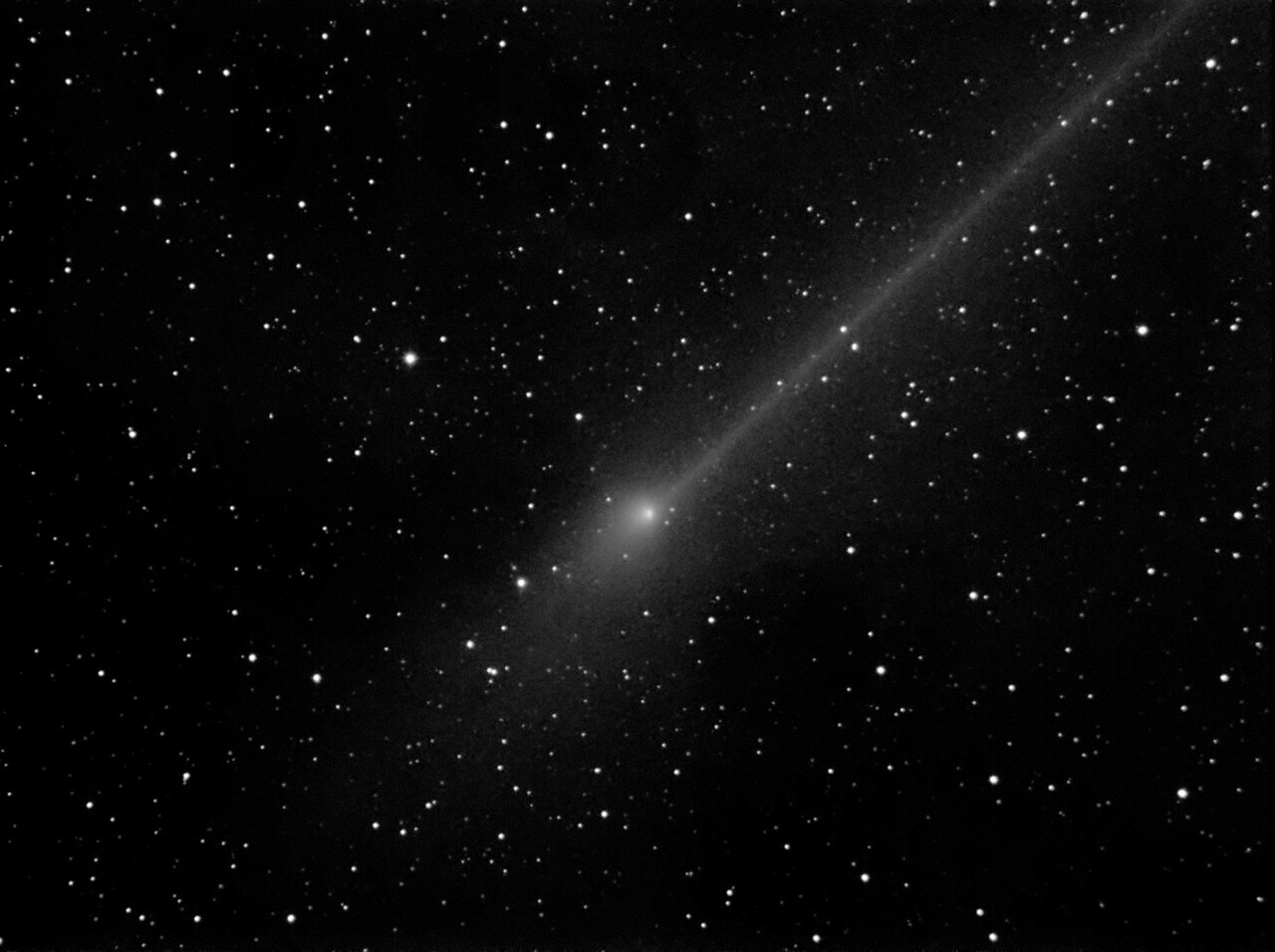
At the time of its discovery, the comet was 7.9 AU from the Sun and had an apparent magnitude of 19. By early May 2012, it had brightened to magnitude 13.5, making it visible through a large amateur telescope from a dark location. In October 2012, its coma—the expanding, tenuous dust atmosphere—was estimated to be roughly 120,000 kilometers across.
On 7 February 2013, it was spotted without optical aid at about magnitude 6. During the first weeks of March, the comet could be seen from both hemispheres. It made its closest approach to Earth on 5 March 2013, at a distance of 1.09 AU, and reached perihelion on 10 March 2013.
Early brightness predictions varied widely. Some initial estimates suggested it might reach magnitude 0, similar to Vega or Alpha Centauri A. An October 2012 forecast put it as bright as magnitude −4, comparable to Venus. By January 2013, a slowdown in brightening indicated it might only reach magnitude +1, and by February the curve suggested a perihelion magnitude around +2.
A later study using the secular light curve identified a "slowdown event" when the comet was 3.6 AU from the Sun at magnitude 5.6; this study predicted a perihelion magnitude of +3.5. For comparison, Comet Halley would be magnitude −1.0 at the same distance. The same study classified C/2011 L4 as a very young comet, a "baby comet" with a photometric age under four comet years.
When perihelion arrived in March 2013, the actual peak magnitude was around +1, as reported by observers worldwide. However, the comet's low altitude above the horizon made these estimates difficult and uncertain, due to a lack of suitable reference stars and the need for corrections for atmospheric extinction. By mid-March, it was best seen in binoculars about 40 minutes after sunset, because of twilight and its low elevation. On 17–18 March, it passed near the 2.8-magnitude star Algenib (Gamma Pegasi).
On 22 April, it was near Beta Cassiopeiae, and on 12–14 May, near Gamma Cephei. The comet continued moving north until 28 May. It may have had a sodium tail, similar to Comet Hale–Bopp.
Frequently Asked Questions
What is C/2011 L4 (PanSTARRS)?
It is a long-period, non-periodic comet first detected in June 2011 by the Pan-STARRS survey telescope on Haleakalā, Maui. The comet made a splash in early 2013 when it brightened to naked-eye visibility as it swung past the Sun.
When and where was C/2011 L4 (PanSTARRS) discovered?
The comet was first spotted in June 2011 using the Pan-STARRS telescope atop Haleakalā on the island of Maui, Hawaii. At the time of detection it sat roughly 7.9 AU from the Sun and shone at a faint 19th magnitude.
How bright did C/2011 L4 (PanSTARRS) get, and when was it easiest to see?
The comet reached an apparent magnitude of about +1 near its perihelion passage on 10 March 2013, making it clearly visible to the naked eye. Its closest approach to Earth came on 5 March 2013 at a distance of approximately 1.09 AU.
How big is the nucleus of C/2011 L4 (PanSTARRS)?
Estimates place the nucleus diameter somewhere between roughly 1 and 2.4 kilometres, depending on the measurement method. Absolute nuclear magnitude and albedo calculations suggest a size above 2.4 km, while coma-decay modelling yields about 2.3 km.
Ranked in
More in Named Comets
Sources
Compiled from Wikipedia and the sources listed below. Text from Wikipedia is available under CC BY-SA 4.0; this entry is adapted from it.
- Wikipedia: C/2011 L4 (PanSTARRS) (CC BY-SA 4.0).
- Word definitions: the , each quoted from its Wikipedia article.
Spotted an error? Know more?
Reader corrections go straight into our review queue. Suggest an edit · How this site is sourced