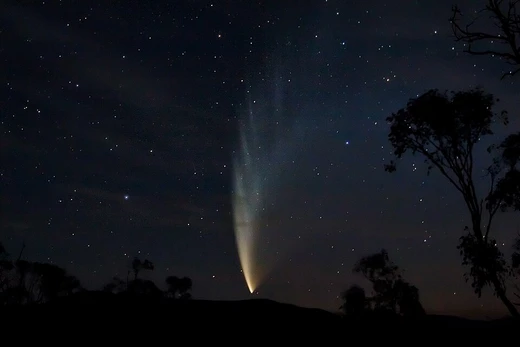
C/1993 Y1 (McNaught–Russell)
Long-period comet possibly linked to a 6th-century apparition.
Last updated
Comet McNaught–Russell (C/1993 Y1) is a long-period comet that peaked at magnitude 6.5 in early 1994, too faint to see with the naked eye. Robert H. McNaught and Kenneth S. Russell discovered it on a photographic plate taken by Russell on the night of 17 December 1993, using the UK Schmidt Telescope in Australia. Both astronomers worked at Siding Spring Observatory and together found five comets between 1991 and 1995. At discovery, the comet appeared as a diffuse trail of about magnitude 17.5 in the constellation Horologium.
Its orbit was initially calculated to have a period exceeding 1,400 years. François Colas of Paris Observatory and Ichiro Hasegawa noted that the comet’s path matched that of C/574 G1, recorded by Chinese observers from 4 April to 23 May in AD 574.
This suggested a period of 1,430±30 years, making it the longest-period comet observed on two separate returns. Because the comet did not approach any planets, its orbit should remain largely unchanged, placing its next return around 3300. However, a 2024 study found that while the paths of the two comets may have run parallel southward, the tail length and brightness of the AD 574 object did not match historical records, ruling out that apparition as an earlier visit of McNaught–Russell.
Ranked in
More in Named Comets
Sources
Compiled from Wikipedia and the sources listed below. Text from Wikipedia is available under CC BY-SA 4.0; this entry is adapted from it.
- Wikipedia: C/1993 Y1 (McNaught–Russell) (CC BY-SA 4.0).
- Word definitions: the Codexery glossary, each quoted from its Wikipedia article.
Spotted an error? Know more?
Reader corrections go straight into our review queue. Suggest an edit · How this site is sourced