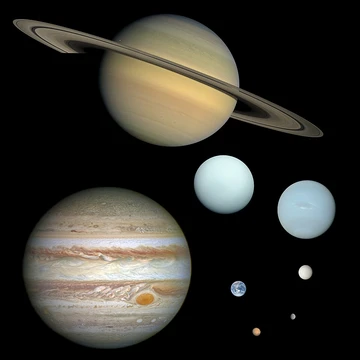
Solar System
The Sun and all objects gravitationally bound to it.
Last updated

via Wikipedia: Solar System · see source
Our Sun and everything gravitationally bound to it make up the Solar System. This includes eight major planets—Earth is one of them—along with countless smaller objects. It is a single-star system, not part of a binary or multiple-star arrangement, located within the Milky Way Galaxy. The whole system began roughly 4.6 billion years ago when a dense patch inside a molecular cloud collapsed, forming the Sun at its center and a surrounding disc of material that later coalesced into the orbiting bodies.
Sun
The Sun holds 99.86% of all mass in the Solar System. Deep inside its core, hydrogen atoms fuse into helium, releasing energy that streams out through the photosphere. This outflow creates the heliosphere and a steady drop in temperature as you move away from the Sun.
The next most massive objects are the eight planets, each of which dominates its own orbital zone. Closest to the Sun, in order, are the four terrestrial planets: Mercury, Venus, Earth, and Mars. These make up the inner Solar System.
Outer planets
Only Earth and Mars lie within the Sun’s habitable zone, where sunlight can keep liquid water stable on a surface under normal atmospheric pressure. Beyond about five astronomical units (AU)—the frost line—lie the outer planets: two gas giants (Jupiter and Saturn) and two ice giants (Uranus and Neptune). Jupiter and Saturn together contain nearly 90% of all non-stellar mass in the system.
Objects that are massive enough to be round but do not clear their orbits are called dwarf planets. The International Astronomical Union’s Minor Planet Center officially lists five: Ceres, Pluto, Eris, Makemake, and Haumea. Four others—Orcus, Quaoar, Gonggong, and Sedna—are also widely recognized as dwarf planets.
Trans-Neptunian region
Smaller still are the countless small Solar System bodies: asteroids, comets, centaurs, meteoroids, and interplanetary dust. Ceres and many of these smaller bodies reside in the asteroid belt between Mars and Jupiter. The other dwarf planets belong to populations of trans-Neptunian objects, found either in the Kuiper belt just beyond Neptune or farther out in the scattered disc.
Many objects do not orbit the Sun directly but instead circle larger bodies as natural satellites, or moons. These range from planetary-mass moons down to tiny moonlets. The two largest moons—Jupiter’s Ganymede and Saturn’s Titan—are bigger than Mercury (though less massive). The seven most massive moons, including Earth’s Moon, are both more massive and larger than any dwarf planet.
Boundary region and uncertainties
Inside the heliosphere, the solar wind—a constant stream of charged plasma—floods the system. Together with interplanetary dust, gas, and cosmic rays, it forms the interplanetary medium that fills the space between bodies. At roughly 70 to 90 AU from the Sun, the solar wind meets the interstellar medium, creating the heliopause—the boundary between the interplanetary medium and interstellar space. Beyond that, the theorized Oort cloud, source of long-period comets, stretches from somewhere past 2,000 AU to the system’s outermost edge.
That edge reaches the limit of the Sun’s Hill sphere, between 178,000 and 227,000 AU (2.81 to 3.59 light-years), where the Sun’s gravitational pull equals that of the Milky Way. The Solar System currently moves through a patch of interstellar medium called the Local Cloud. The nearest star, Proxima Centauri, lies 269,000 AU (4.25 light-years) away. Both the Solar System and Proxima Centauri sit inside the Local Bubble, a relatively small region of the Milky Way about 1,000 light-years across.
Lore & Background
The Solar System formed at least 4.568 billion years ago from the gravitational collapse of a region within a large molecular cloud. This initial cloud was likely several light-years across and probably birthed several stars. As the pre-solar nebula collapsed, conservation of angular momentum caused it to rotate faster, flattening into a protoplanetary disc with a diameter of roughly 200 AU and a hot, dense protostar at the center.
The planets formed by accretion from this disc. In the inner Solar System, heat from the accretion process exceeded the boiling point of hydrocarbon molecules for the first million years, leading to low carbon content for the inner planets. The giant planets formed further out, beyond the frost line at about five astronomical units, where volatile icy compounds could remain solid. Within 50 million years, the pressure and density of hydrogen in the center of the protostar became great enough for it to begin thermonuclear fusion.
Solar wind from the Sun created the heliosphere and swept away the remaining gas and dust from the protoplanetary disc into interstellar space. The Nice model proposes that gravitational encounters between planetesimals and the gas giants caused each to migrate into different orbits, leading to dynamical instability that scattered planetesimals and placed the gas giants in their current positions. The grand tack hypothesis suggests that a final inward migration of Jupiter dispersed much of the asteroid belt, leading to the Late Heavy Bombardment of the inner planets.
Reader's Guide
The Solar System includes the Sun and all objects that are bound to it by gravity and orbit it. The International Astronomical Union describes the Solar System as all objects that are bound by the gravity of the Sun, the Sun itself, its eight planets, and the other celestial bodies which orbit it. The Sun's main-sequence phase will last about 10 billion years; roughly 5 billion years from now, the hydrogen in the core will be entirely converted to helium, marking the end of that phase.
The Sun will then become a red giant, expanding to roughly 260 times its current diameter, with a cooler surface temperature of 2,600 K at its coolest. The expanding Sun is expected to vaporize Mercury and Venus and render Earth and Mars uninhabitable. The Solar System remains in a relatively stable, slowly evolving state, though it is technically chaotic and may eventually be disrupted.
There is a small chance that another star will pass through the Solar System in the next few billion years, which could destabilize the system but would most likely leave it much as it is today. The closest star to the Solar System, Proxima Centauri, is 269,000 AU away. Both are within the Local Bubble, a relatively small 1,000 light-years wide region of the Milky Way.
Frequently Asked Questions
How did the Solar System come into being?
Roughly 4.6 billion years ago, a vast molecular cloud collapsed under its own gravity, and the spinning disk of gas and dust that followed gradually clumped together to produce the Sun and all the bodies that circle it today.
What are the Solar System's most notable stats?
The Sun alone makes up 99.86 % of the system's total mass, with the remaining sliver shared among eight planets, dwarf planets, and countless smaller bodies. Earth and Mars are the two planets that sit within the Sun's habitable zone.
More in Planets & Stellar Astronomy
Related in Planets & Stellar Astronomy
Links follow this subject's own source article.
Sources
Compiled from Wikipedia and the sources listed below. Text from Wikipedia is available under CC BY-SA 4.0; this entry is adapted from it.
- Wikipedia: Solar System (CC BY-SA 4.0).
- Word definitions: the Codexery glossary, each quoted from its Wikipedia article.
Spotted an error? Know more?
Reader corrections go straight into our review queue. Suggest an edit · How this site is sourced