
Adelaide International Raceway
Permanent circuit built and owned by Bob Jane, host of national motorsport.

Will Pittenger · CC BY-SA 3.0
Adelaide International Raceway (also known as Adelaide International or AIR) is a permanent circuit located 26 km north of Adelaide in South Australia on Port Wakefield Road at Virginia, adjacent to Speedway City. Owned and built by the Bob Jane Corporation and run by the Australian Motorsport Club Ltd, the circuit was constructed by Bob Jane in 1972. It served as South Australia's major motor racing circuit from 1972 to 1988 due to a covenant on Mallala, hosting rounds of the Australian Touring Car Championship, the Tasman Series, and other national championships.
Quick Facts
- Nicknames
- AIR
- Location
- Port Wakefield Road, / Virginia, South Australia
- Owner
- Bob Jane Corporation
- Operator
- Australian Motorsport Club Limited
- Broke Ground
- 1970
- Opened
- 9 January 1972
- Layout
- Full Circuit (1972–present)
- Surface
- Asphalt
- Length Km
- 2.410
- Length Mi
- 1.498
- Turns
- 8
- Banking
- Turns 8–9: 5° / Front straight: 0° / Back straight (Bowl): 3°
Facts from the source article.
Lore & Background
Adelaide International Raceway was built by Bob Jane, who also owned Mallala Race Circuit and Surfers Paradise International Raceway. The track remained in an almost raw state until upgrades began in 1994. The circuit can be used in four configurations: the full circuit, short circuit, Speedway Super Bowl, and drag strip. The main straight is approximately 800 m long, also serving as the drag strip and the front straight of the Super Bowl. The track races clockwise, though the Super Bowl runs anti-clockwise for speedway and NASCAR events. The Super Bowl and drag strip have lights for night meetings. Spectator viewing areas extend from the final turn down the main straight, with mounds from turn 3 to turn 6 and along the back straight. Upgrades began in 1994, including removal of old stands, new buildings, and a paved VIP area.
Reader's Guide
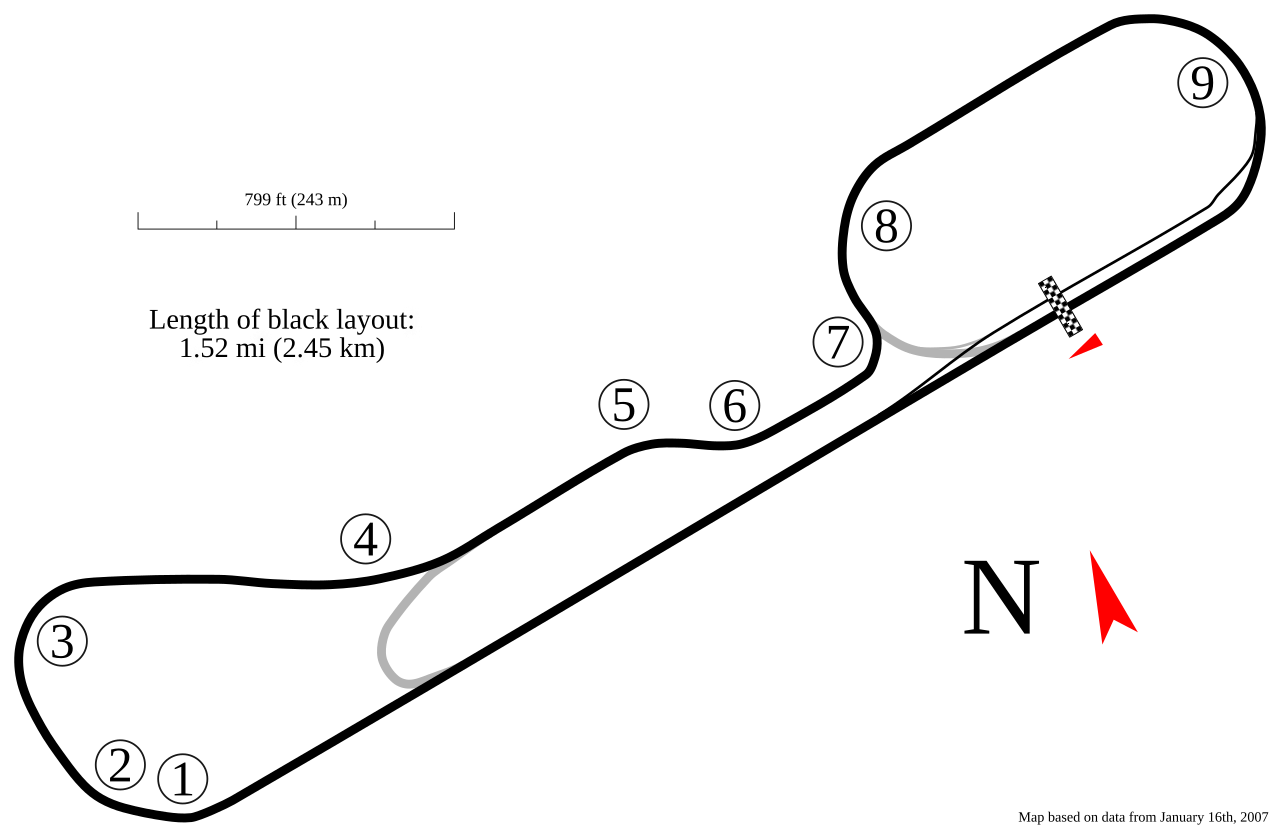
Adelaide International Raceway was South Australia's premier motor racing venue from 1972 to 1988, hosting rounds of the Australian Touring Car Championship, Tasman Series, Rothmans International Series, and other CAMS national championships. The circuit's full layout features nine turns, six of which are right-handers, placing heavy stress on left-hand tyres. The outright lap record for the full circuit is 49.5 seconds, set by Alan Jones in a Lola T332-Chevrolet Formula 5000 during the 1977 Rothmans International Series. The Speedway Super Bowl, a true ½-mile oval with 5° banking, hosted NASCAR-style races in the 1990s. Top-level motorcycle racing was held until the mid-1980s, when safety concerns over the lack of runoff on the Super Bowl's outside wall moved bike racing to Mallala. AIR continues to host drag racing events with Top Bike and Pro Stock Motorcycle classes.
Did You Know?
- The Speedway Super Bowl is a flat oval with no banking.
- Motorcycle racing moved to Mallala after the mid-1980s due to safety concerns about the Super Bowl having no runoff area on the outside of the track.
Origins & Ownership
Adelaide International Raceway traces its roots to 1972, when Surfers Paradise businessman Keith Williams constructed the facility. Williams was no stranger to motorsport infrastructure, holding ownership of both the Mallala Race Circuit and the Surfers Paradise International Raceway at the time. For roughly a decade after its opening, however, the Virginia-based track languished in what could be described as a largely undeveloped condition. That changed in 1982 when the Bob Jane Corporation acquired the property, injecting the investment and corporate backing needed to transform it into a serious national venue. Today the circuit sits 26 kilometres north of Adelaide along Port Wakefield Road, nestled beside Speedway City, the region's premier dirt-track racing venue. The ownership and operational structure reflects a clear division: the Bob Jane Corporation holds the title to the land and facility, while day-to-day management falls to the Australian Motorsport Club Limited, a dedicated motorsport body that oversees racing events and track operations. This arrangement has allowed AIR to maintain its identity as a purpose-built racing circuit rather than a general-purpose speedway, even as it shares its immediate surroundings with the adjacent dirt-oval venue.
Circuit Layout & Configurations
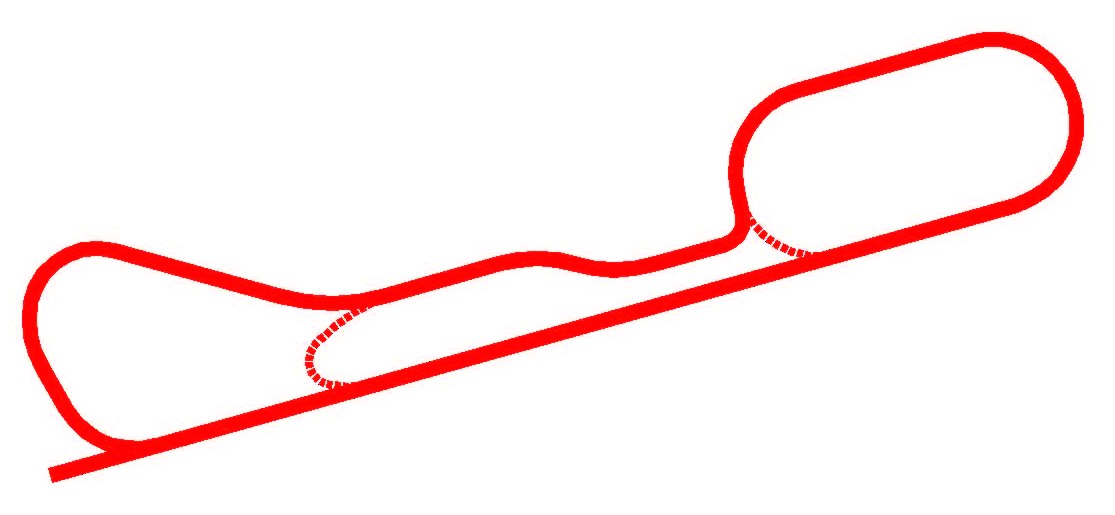
One of AIR's most distinctive features is its versatility. The facility offers four separate racing configurations: a full 2.410-kilometre circuit, a shorter 1.770-kilometre layout, the 0.805-kilometre Speedway Super Bowl, and a 0.40-kilometre drag strip. All four share the same 920-metre main straight, which doubles as the drag strip and the front straight of the Super Bowl. Because it must accommodate drag racing, this front section is noticeably wider than the remainder of the track. In keeping with the tradition of most Australian circuits built in that era, the full and short circuits run clockwise. The Super Bowl is the exception, operating anti-clockwise for speedway meetings and, during the 1990s, NASCAR events. The pit and paddock arrangement is equally unconventional. Although the pit lane sits on the inside of the track at the end of the Super Bowl's back straight, cars actually rejoin the circuit from the outside at the end of turn 9, through a gate that forms part of the retaining wall. This places the main paddock on the outside of the main straight, behind the officials tower and spectator mounds, while a large 21,500-square-metre area inside the Super Bowl behind pit lane remains open and largely unused.
Championship Racing Heritage
Between 1972 and 1988, Adelaide International Raceway served as South Australia's principal motor racing venue, a status largely guaranteed by a restrictive covenant on the Mallala Raceway that prohibited motorsport activities there. During that period, AIR became a regular stop on the national calendar, hosting rounds of the Australian Touring Car Championship, endurance events of the Australian Manufacturers' Championship (later rebranded the Championship of Makes), and rounds of the prestigious Tasman Series. The Rothmans International Series also featured on the schedule, alongside a broad slate of CAMS-sanctioned national titles spanning the Australian Drivers' Championship, Formula 2, Sports Car, Sports Sedan, and GT categories. The circuit also attracted top-level motorcycle competition. The Swann International Series brought riders of the calibre of Graeme Crosby, who claimed the 1980 race, and Gregg Hansford to the straight. An annual three-hour motorcycle race was even broadcast nationally on the ABC until the mid-1980s, before safety concerns over the Super Bowl's lack of outside runoff prompted the series to relocate to Mallala. Today, AIR still hosts motorcycle drag racing, with Top Bike and Pro Stock Motorcycle classes as regular fixtures.
Tyre Demands & Circuit Character
Adelaide International Raceway earned a well-deserved reputation as a tyre-killing circuit. Six of the full circuit's nine turns are right-handers, and the combination of the hardest braking zone at turn 1, the sweeping second and third corners, and the high-speed bowl section created prolonged periods of lateral loading that punished the outside, or left-hand, tyres. The problem was amplified by the sheer speed on the main straight: Formula 5000 cars regularly exceeded 270 km/h before turn 1, and by 1988 Dick Johnson Racing's turbocharged Ford Sierra RS500 was hitting 258 km/h. For drivers and engineers, this meant that tyre selection and suspension setup were not merely important but absolutely critical, particularly over the 40- or 60-lap ATCC races and the grueling 125-lap year-end endurance event. Johnson himself observed during practice for the 1988 ATCC round that even the lighter, considerably slower Gemini cars would be struggling with worn rubber by the end of a 60-lap contest. The circuit's geometry simply demanded that teams manage their tyres with extraordinary care.
Gallery
More in Motorsport in Adelaide 1-20
Spotted an error? Know more?
Reader corrections go straight into our review queue. Suggest an edit · How this site is sourced