
1991 Australian Grand Prix
Shortest F1 race by time; half points awarded.

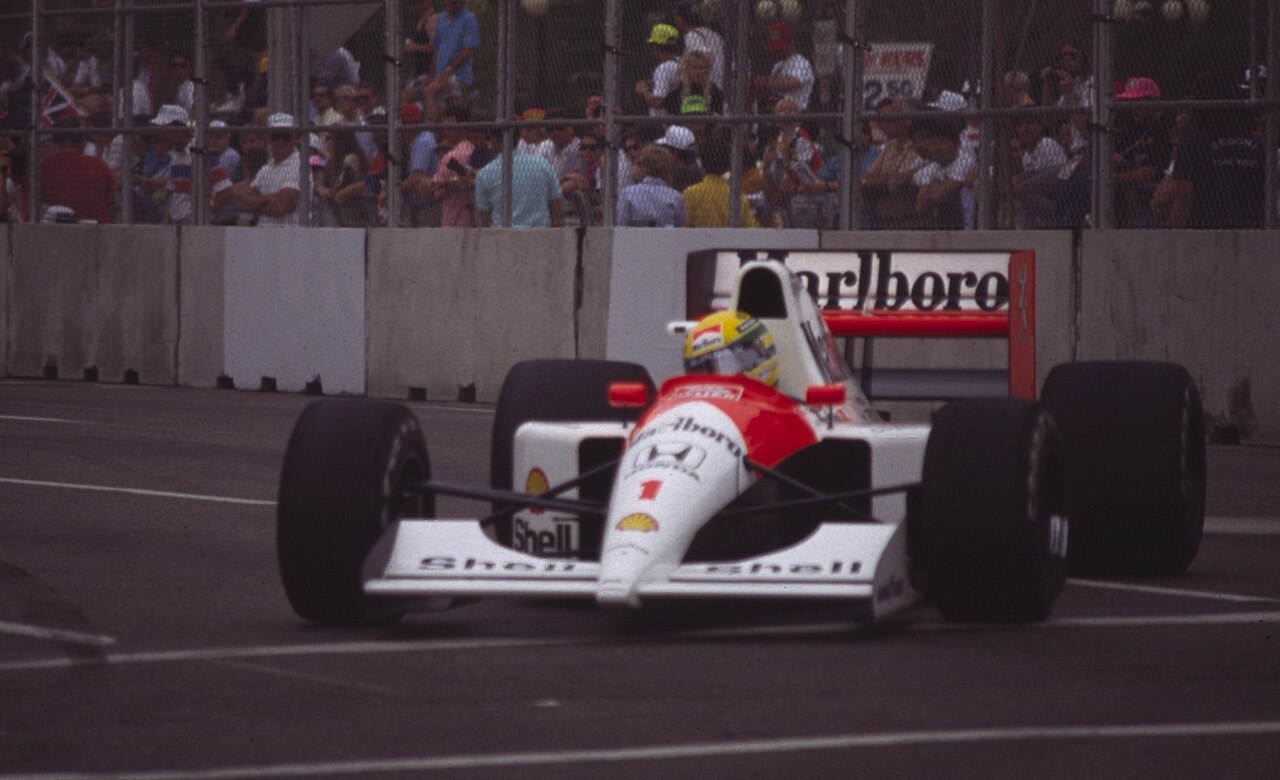
Ayrton_Senna_1991_USA_3.jpg : Stuart Seeger from College Station, Texas, USA der · CC BY 2.0
The 1991 Australian Grand Prix, the final round of the Formula One World Championship, took place on 3 November at the Adelaide Street Circuit. Heavy rain forced officials to halt the race after only 16 of the planned 81 laps. In line with regulations, the results were taken from the end of lap 14, two laps before the stoppage. This race holds the record for the shortest Formula One World Championship race ever conducted under modern rules, lasting just under 30 minutes from the formation lap to the red flag. (The 2021 Belgian Grand Prix, which featured two aborted formation laps and three laps under the safety car before being red-flagged, is officially the shortest F1 race by time in the historical record, though some consider this race the shortest under modern racing regulations.)
Ayrton Senna won the race, with Nigel Mansell finishing second. Gerhard Berger’s third place, combined with Senna’s victory, secured the Constructors’ Championship for McLaren, though McLaren had already secured the title at the previous race (the 1991 Japanese Grand Prix). Mansell could not attend the podium ceremony after crashing at the end of the race, requiring hospital treatment. Because less than 75% of the scheduled distance was completed, only half the usual championship points were awarded. This was the final Formula One race for three-time World Champion Nelson Piquet. It also marked Senna’s 60th career pole position. The event was the last Grand Prix for Satoru Nakajima, Naoki Hattori, Alex Caffi, and Emanuele Pirro, and the final race for Pirelli tyres until the 2011 Australian Grand Prix.
**Pre-race** Ferrari terminated Alain Prost’s contract after his public criticism of the team, replacing him with test driver Gianni Morbidelli. Roberto Moreno, dropped by Jordan two races earlier, returned to Formula One to take Morbidelli’s seat at Minardi. Benetton did not renew Nelson Piquet’s contract, making Australia his last race. Bertrand Gachot returned after completing a jail sentence in Britain, replacing the injured Éric Bernard at Larrousse. The Coloni team entered its final Grand Prix; new owner Andrea Sassetti confirmed the team would be reborn as Andrea Moda Formula for 1992. Williams had a ‘B’-spec FW14 available but chose not to use it.
Quick Facts
- Grand Prix
- Australian
- Country
- Australia
- Date
- 3 November
- Year
- 1991
- Race No
- 16
- Official Name
- Foster's Australian Grand Prix
- Course
- Temporary street circuit
- Location
- Adelaide Street Circuit, Adelaide, Australia
- Course Mi
- 2.362
- Course Km
- 3.780
- Distance Laps
- 14
- Distance Mi
- 32.88
Facts from the source article.
Lore & Background
The race was won by Ayrton Senna, with Nigel Mansell in second position, and Gerhard Berger's third-place finish plus Senna's victory meant that the McLaren team clinched the Constructor's championship, though McLaren had already secured the title at the previous race in Japan. Mansell was unable to take part in the post-race podium ceremony, following a crash at the end of the race that left him requiring hospital treatment. Because less than seventy-five percent of the scheduled race distance had been completed, only half the normal World Championship points were awarded. This was also the final Formula One race for three time World Champion Nelson Piquet. It was the 60th pole position for Ayrton Senna.
Reader's Guide
The 1991 Australian Grand Prix holds the record for being the shortest Formula One World Championship race that was legally conducted under modern rules; the 2021 Belgian Grand Prix, which ran two aborted formation laps that did not count and three laps under the safety car before it was red-flagged (two of which did not count under the countback rule), does not count under the post-2022 rule changes. The race was stopped after 16 laps due to torrential rain, with official results declared from the end of the 14th lap. The race order at the end of lap 16 was Senna from Piquet, Morbidelli, de Cesaris, Zanardi and Modena, but officials counted back to lap 14 despite the 1991 ruling that early race stoppages should have been counted back one lap, a controversy similar to the 2003 Brazilian Grand Prix. Attempts to restart the race were met with serious protests from Senna and Riccardo Patrese.
Did You Know?
- The race lasted barely 30 minutes from formation lap to abandonment, the shortest in F1 history by time.
- Nigel Mansell crashed at the end of the race and required hospital treatment, missing the podium ceremony.
- This was the final F1 race for Nelson Piquet, Satoru Nakajima, Naoki Hattori, Alex Caffi, and Emanuele Pirro.
The Season's Final Chapter in Adelaide
The 1991 Australian Grand Prix carried the weight of closing the Formula One season, a role the event had traditionally fulfilled when staged in Adelaide. For years, the Australian round served as the curtain-closer to the World Championship, giving drivers and teams one last opportunity to reshape the standings before the season book was shut. By 1991, the race had been a fixture on the F1 calendar since 1985, meaning it had already accumulated seven years of championship history. The Adelaide setting placed the event firmly in the southern hemisphere's summer, a deliberate contrast to the European circuits that dominated the rest of the calendar. This seasonal positioning meant the race concluded the competitive year at a time when northern hemisphere tracks were dormant, making the Australian finale a unique bookend to the global racing season. The tradition of Adelaide as the season's final stop would continue until the event's relocation to Melbourne's Albert Park in 1996, which shifted the race to the opening or early rounds of the season.
Twenty-Three Venues, One Enduring Title
By the time the 1991 edition rolled around, the Australian Grand Prix had already called twenty-three different circuits home. The title's journey began in 1928 at Phillip Island, where Arthur Waite's modified Austin 7 claimed the inaugural 100 Miles Road Race victory. From that rectangular dirt track, the event wandered across the continent — through Victor Harbor, Mount Panorama at Bathurst, Lobethal, and a string of temporary airfield and street circuits during the post-war years. The Albert Park Lake streets in Melbourne hosted the race in the mid-1950s, and Jack Brabham's 1955 Port Wakefield win in a rear-engined Cooper marked a technological turning point. By the 1960s, the Tasman Series had drawn the great European F1 teams to race Australian summers, and the Grand Prix became a jewel of that golden era. When the race settled into Adelaide before its 1996 Melbourne move, it carried the accumulated identity of all those previous stops — a title forged across decades of different surfaces, different states, and different eras of motorsport.
Seven Years of Championship Pedigree
The 1991 Australian Grand Prix was the seventh season the event had been woven into the Formula One World Championship, a status it first earned in 1985. That integration transformed what had been a prestigious national competition into a globally televised spectacle, with the full grid of factory and privateer teams committing their best drivers to the Australian round. The championship context meant the 1991 race carried the same stakes as any other round — points, positions, and title implications — yet it retained a distinct character as the season's closing act in Adelaide. The event's long pre-championship history, stretching back to the Bugatti-dominated Phillip Island races of the early 1930s and the post-war era of Australian specials and imported Talbot-Lagos, gave the Adelaide venue a depth of racing heritage that few other F1 circuits could match. The fact that the title had survived three years of lapse in the late 1930s, the disruption of World War II, and decades of venue-hopping before finding its F1 home spoke to the enduring appeal of Australian motorsport.
The Tasman Legacy and the Road to 1991
The 1991 Australian Grand Prix existed because of a chain of events that began in the early 1960s, when European Formula One teams recognized the appeal of Australia's powerful 2.5-litre cars. The BRM team's 1962 tour of Australia planted the seed for the Tasman Series, which from 1963 to 1969 brought the sport's top drivers and works teams to race the southern hemisphere summers. That era, in which the Australian and New Zealand Grands Prix became the jewels of the racing calendar, also had a direct impact on Formula One itself — the popularity of the Tasman formulae is credited as a factor behind the 1966 return to larger engines in the championship. Jack Brabham's development of the Repco-Brabham V8 through Tasman competition gave him the tools to dominate the mid-1960s F1 world. By 1991, the race had long since shed its national-competition identity and operated as a full F1 World Championship round, but the cultural infrastructure built during the Tasman years — the crowds, the media attention, the engineering connections — remained the foundation upon which the modern event was constructed.
Gallery
More in Motorsport in Adelaide 1-20
Spotted an error? Know more?
Reader corrections go straight into our review queue. Suggest an edit · How this site is sourced