
1993 Australian Grand Prix
Senna's final win; Prost's final race; end of an era.

Stu Newby · CC BY-SA 2.0
The 1993 Formula One season concluded on 7 November in Adelaide with the Australian Grand Prix. Ayrton Senna, driving a McLaren-Ford, won the 79-lap race from pole position, leading every lap except during pit stops. It was his final race for McLaren before moving to Williams in 1994. Alain Prost, in his last Grand Prix before retirement, finished second for Williams-Renault, with teammate Damon Hill third.
Senna’s victory was the 41st and last of his career. He would never again finish a race, score points, or stand on a podium; the following season he retired in Brazil and Japan before dying at Imola. This was also the last win for a Brazilian driver until Rubens Barrichello triumphed at the 2000 German Grand Prix. Riccardo Patrese and Derek Warwick also retired from Formula One after this race—Patrese having competed in a then-record 256 Grands Prix.
The event marked several finales in Formula One history. It was the last Grand Prix for a car powered by a Lamborghini V12 engine (the Larrousse LH93). It was also the last race without refuelling until the 1994 Brazilian Grand Prix, as refuelling was banned from 1994 to 2009. While the race was the last for cars with active suspension, which was banned for 1994, some electronic driver aids like traction control were allowed in various forms until later bans, and the 1994 season had some carryover of these systems. The FIA banned active suspension for the next seven seasons, though three electronic aids (fully-automatic gearboxes, launch control, and traction control) were eventually reintroduced at the 2001 Spanish Grand Prix after the FIA struggled to enforce the ban.
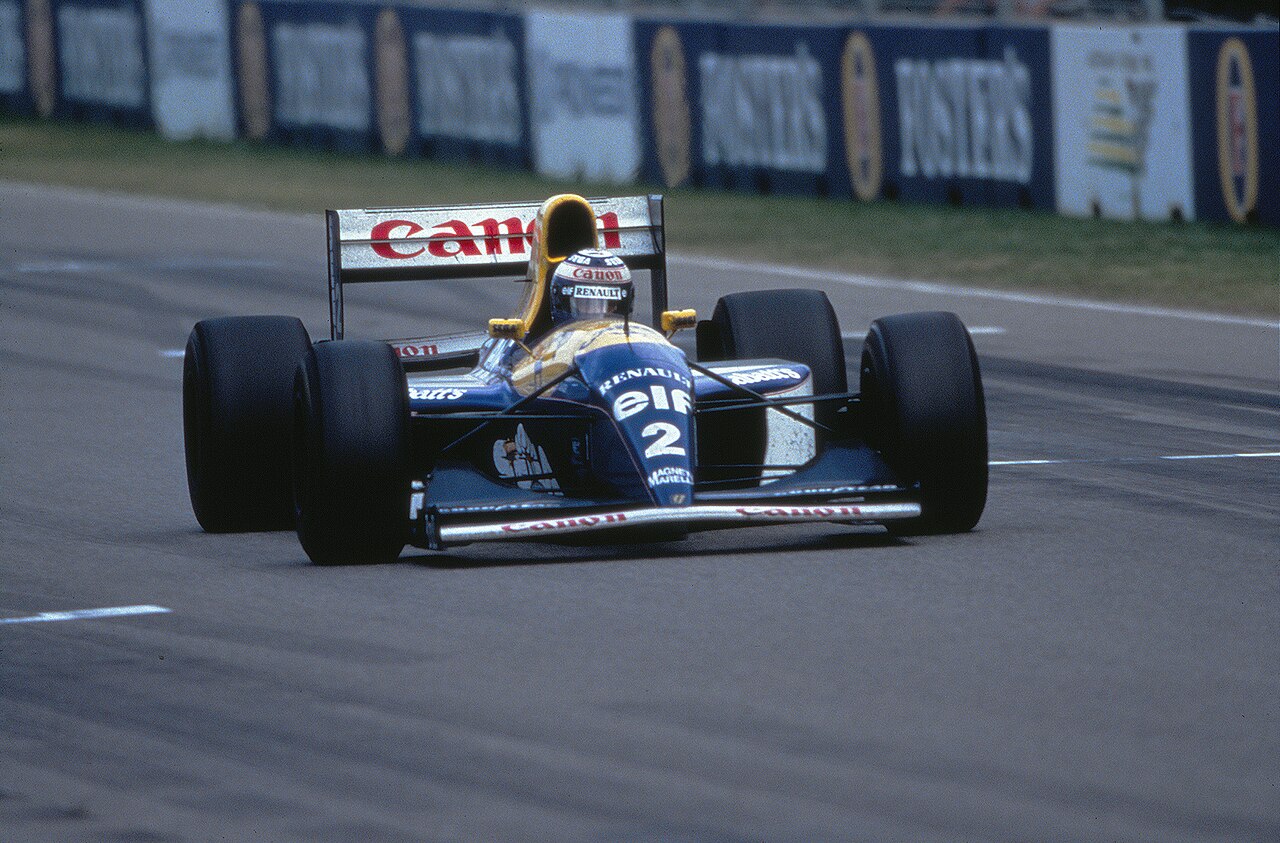
By winning, McLaren surpassed Ferrari as the most successful constructor in race wins, a record they held until the 1995 Canadian Grand Prix. McLaren’s car, running in Marlboro livery as title sponsor, took its final pole and win for the team until the 1997 season. This race was also the last for Williams sponsored by Canon and for Benetton sponsored by Camel; both teams switched to Rothmans and Mild Seven respectively in 1994.
**Qualifying** Senna took his first pole since the 1993 Brazilian Grand Prix, breaking a run of 24 consecutive poles by Williams and denying them a clean sweep for the season. Prost joined him on the front row, with Hill and Michael Schumacher on the second row, and Mika Häkkinen and Gerhard Berger on the third.
Quick Facts
- Grand Prix
- Australian
- Country
- Australia
- Date
- 7 November
- Year
- 1993
- Race No
- 16
- Course
- Temporary street circuit
- Location
- Adelaide Street Circuit / Adelaide, South Australia, Australia
- Course Mi
- 2.362
- Course Km
- 3.780
- Distance Laps
- 79
- Distance Mi
- 186.598
- Distance Km
- 298.620
Facts from the source article.
Lore & Background
The race marked the final Grand Prix for Alain Prost, who finished second in his Williams-Renault, and for Riccardo Patrese and Derek Warwick. Patrese retired after a then-record 256 Grands Prix. Senna's victory was the 41st and last of his Formula One career, and the last time he would finish on the podium, score points, or finish a race, as he died at Imola the following season. It was also the last win for a Brazilian driver until Rubens Barrichello at the 2000 German Grand Prix.
Reader's Guide
This race is historically significant as the final Formula One event for several key figures and technologies. It was the last Grand Prix for Alain Prost, a four-time World Champion, and for veterans Riccardo Patrese and Derek Warwick. Ayrton Senna's win was his last victory before his fatal accident in 1994. The race also marked the last F1 Grand Prix to feature a car powered by a Lamborghini V12 engine, the last race without refuelling during races until 2010, and the last race for cars with active suspension and electronic driver aids, which were banned for the next seven seasons. McLaren surpassed Ferrari as the most successful constructor in number of wins, a record held until the 1995 Canadian Grand Prix. The event also saw the final pole and win for McLaren in Marlboro livery, and the last sponsorship by Canon for Williams and Camel for Benetton.
Did You Know?
- Senna took his first pole position since the 1993 Brazilian Grand Prix, breaking a run of 24 straight poles for Williams.
- The race required three attempts to get underway due to stalls and a missed grid slot.
The Circuit's Architecture and Character
The Adelaide Street Circuit stretches 3.780 kilometres through the East Parklands, beginning on a 500-metre pit straight in Victoria Park that faces northwest. Every grandstand and building along the track was entirely temporary, dismantled and hauled away after each season. Drivers exit the straight into the Senna Chicane — a name bestowed in memory of Ayrton Senna after his fatal crash at the 1994 San Marino Grand Prix — before climbing a fast left-hander up Wakefield Road toward East Terrace. From there the layout threads through three sharp ninety-degree corners, a fourth onto Bartels Road, and the flowing turn-8 sweeper. The full Grand Prix configuration skips the Bartels Road branch and instead carries through a sweeping left-right-right sequence into Stag Turn, then along the 360-metre Rundle Road, renamed for Alan Jones in 1987. The 900-metre Dequetteville Terrace straight, christened after Jack Brabham for Formula One and later Peter Brock for touring cars, was the stage where turbo-era machines exceeding 1,000 horsepower once screamed past 200 mph, making Adelaide the fastest street circuit on the calendar. The lap closes with a hairpin at the Britannia Roundabout, a left turn, and a long sweeping right back into Victoria Park behind the pit lane.
Formula One's Adelaide Chapter
Adelaide was granted a place on the Formula One World Championship calendar in October 1984, and Macmahon Holdings undertook the construction of the temporary street circuit. The inaugural race took place in 1985 as the season's closing round, and the circuit went on to host eleven Australian Grands Prix in total before the final event in 1995. The 1993 race fell squarely within this golden window, when Adelaide was still the designated Australian round before the rights were ultimately lost to Melbourne and the championship moved to the Albert Park Street Circuit. During the turbo era of 1985 through 1988, the 900-metre Dequetteville Terrace straight became a spectacle of raw speed, with cars producing over 1,000 horsepower reaching velocities beyond 200 mph. This made Adelaide the swiftest street circuit on the globe, outpacing the far tighter layouts of Monaco, Detroit, and Phoenix. The circuit's character — a blend of fast sweepers, sharp ninety-degree turns, and a long power straight — gave it a distinctive rhythm that set it apart from other temporary street tracks of the era.
Life Beyond Formula One: Supercars and Multi-Sport Heritage
Even during its Formula One years, the Adelaide Parklands Circuit served a broader motorsport community, staging annual non-championship races for Group A and later Group 3A touring cars. After the F1 era ended, the track found a new identity through the Adelaide 500, which ran from 1999 to 2020 on a shortened 3.219-kilometre variant of the original layout. Typically structured as two 250-kilometre races, the event grew into one of the most celebrated fixtures on the Supercars calendar and stands as the sole entry in the Supercars Hall of Fame. In 2022 the Adelaide 500 returned, though its position shifted to close the season rather than open it. The circuit also hosted the Race of a Thousand Years American Le Mans Series race in 2000 and continues to feature in the Adelaide Motorsport Festival. Looking ahead, a modified version of the original track is slated to host the Australian Motorcycle Grand Prix from 2027, when the event relocates from Phillip Island.
The 2027 MotoGP Controversy and Environmental Stakes
On 19 February 2026, South Australian Premier Peter Malinauskas announced that an annual MotoGP round would take place in Adelaide's eastern Parklands from late 2027, using a heavily modified version of the former Formula One circuit. The Premier stated that roughly forty-five trees would be felled and that the century-old Glover East Playspace would need to be relocated, yet the Adelaide Parklands Association argued this significantly understated the true impact. Subsequent analysis suggested up to two hundred trees could be lost. The proposal drew sharp criticism from residents, councillors including Lord Mayor Jane Lomax-Smith, and others who urged that the event be relocated to The Bend at Tailem Bend. A letter spearheaded by the South East City Residents Association, signed by ecologists, historians, conservationists, academics, and local residents, was sent to FIM president Jorge Viegas calling for an independent environmental impact assessment. The stakes extend beyond trees: the proposed circuit borders the remnant grassland at Pakapakanthi, home to a vulnerable colony of the chequered copper butterfly, a species absent from Adelaide plains for sixty years before its 2011 rediscovery in Victoria Park.
Gallery
More in Motorsport in Adelaide 1-20
Spotted an error? Know more?
Reader corrections go straight into our review queue. Suggest an edit · How this site is sourced