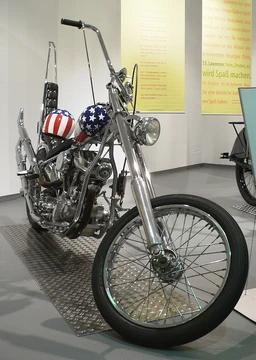
Triumph Bonneville
A British parallel-twin motorcycle named after Utah's Bonneville Salt Flats.

via Wikipedia: Triumph Motorcycles Ltd · see source
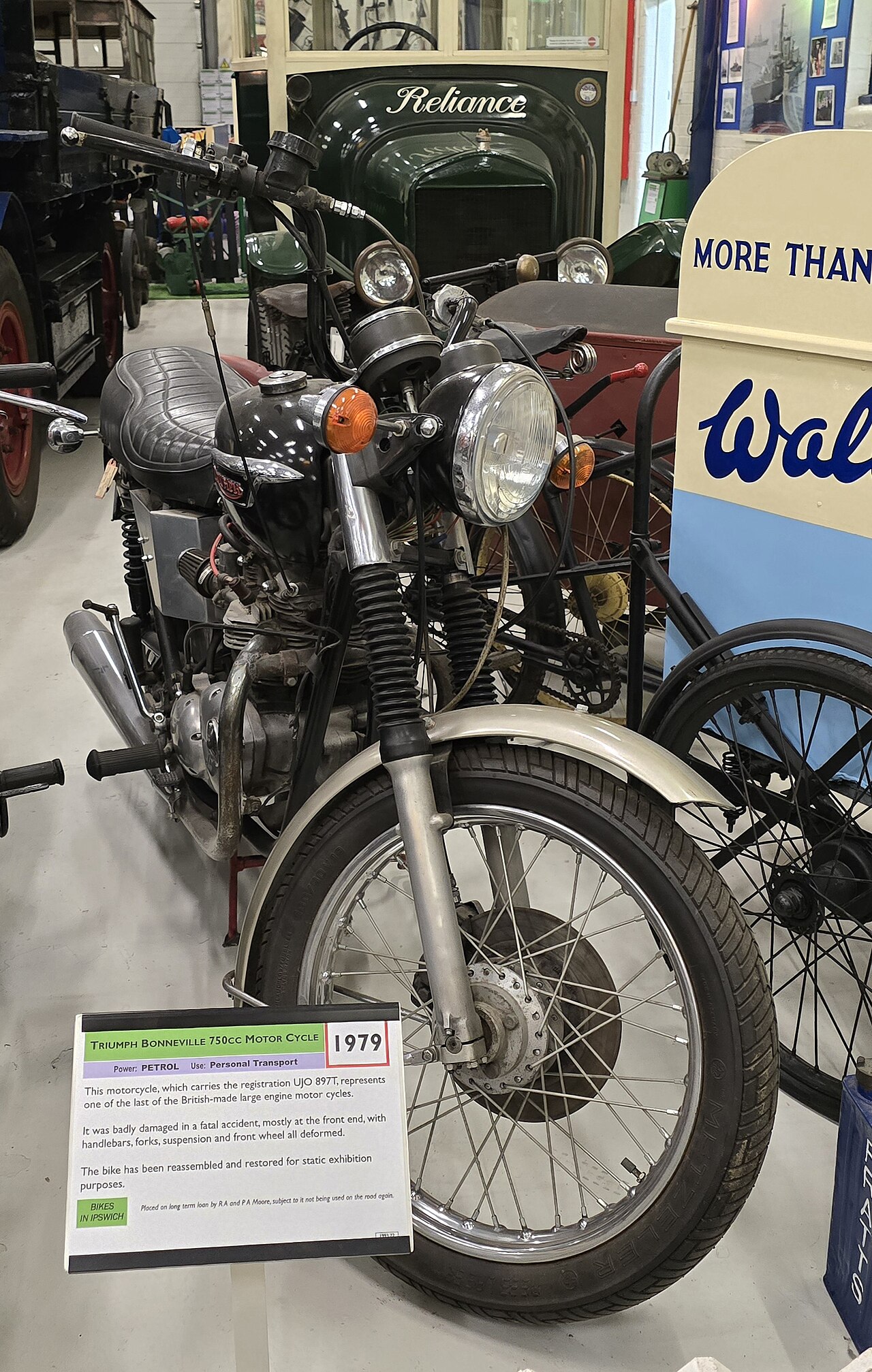
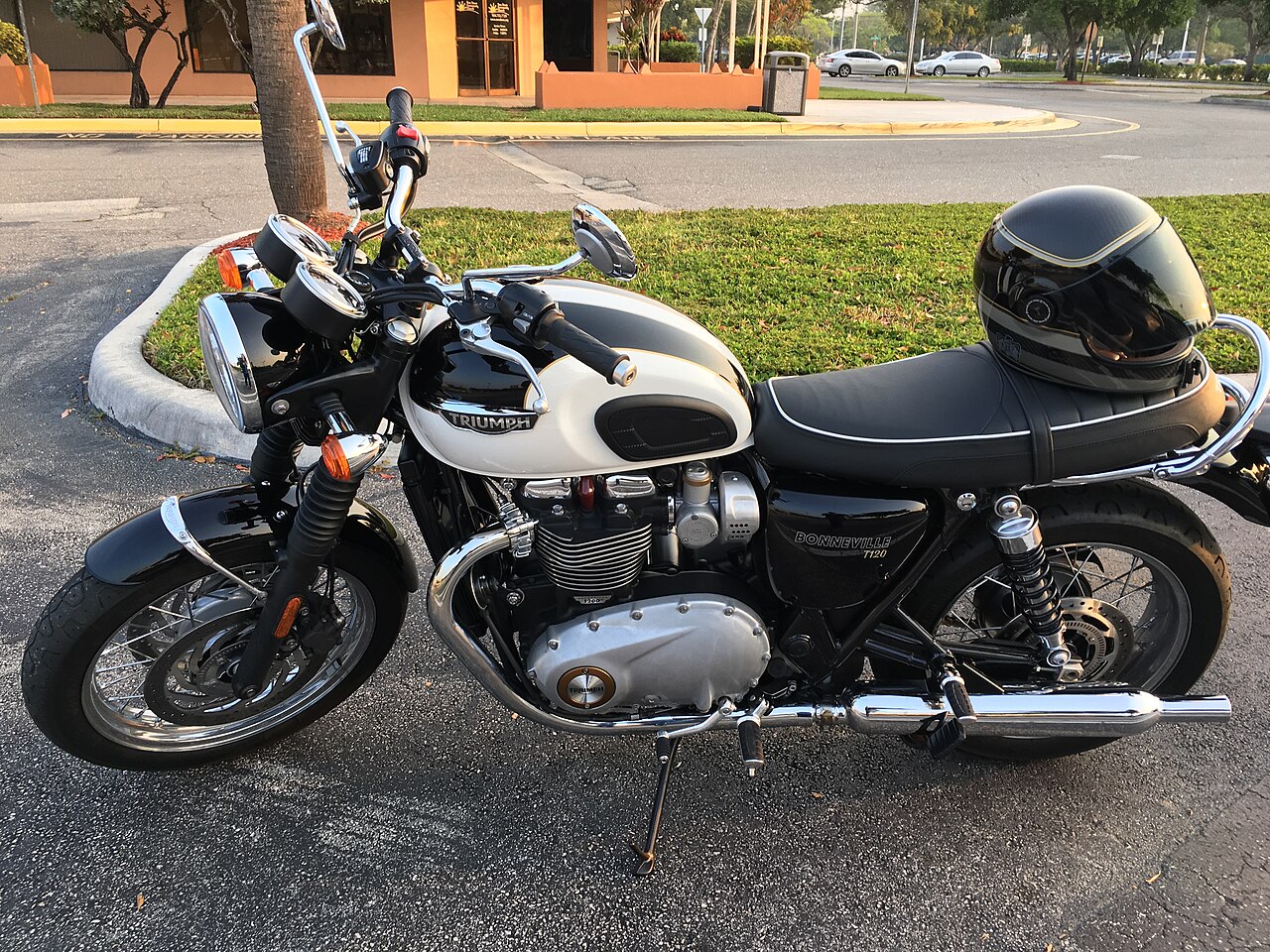
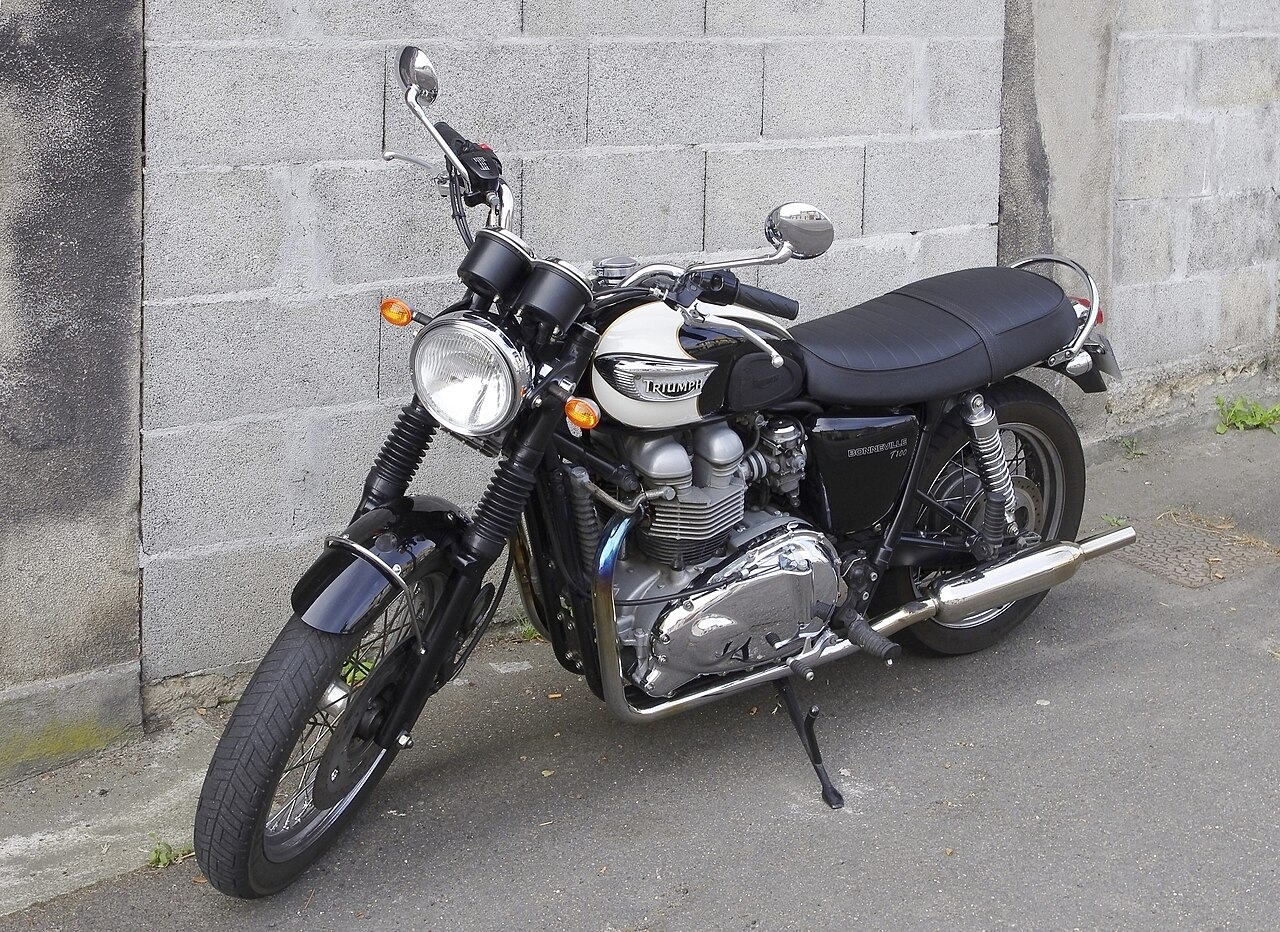
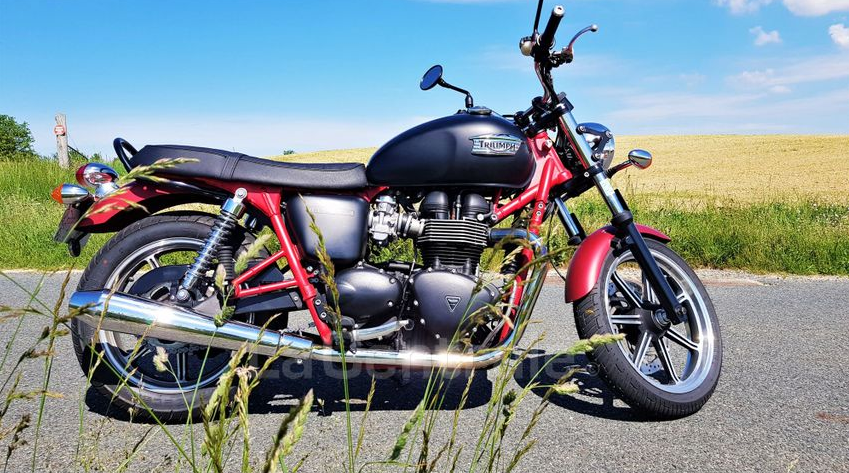
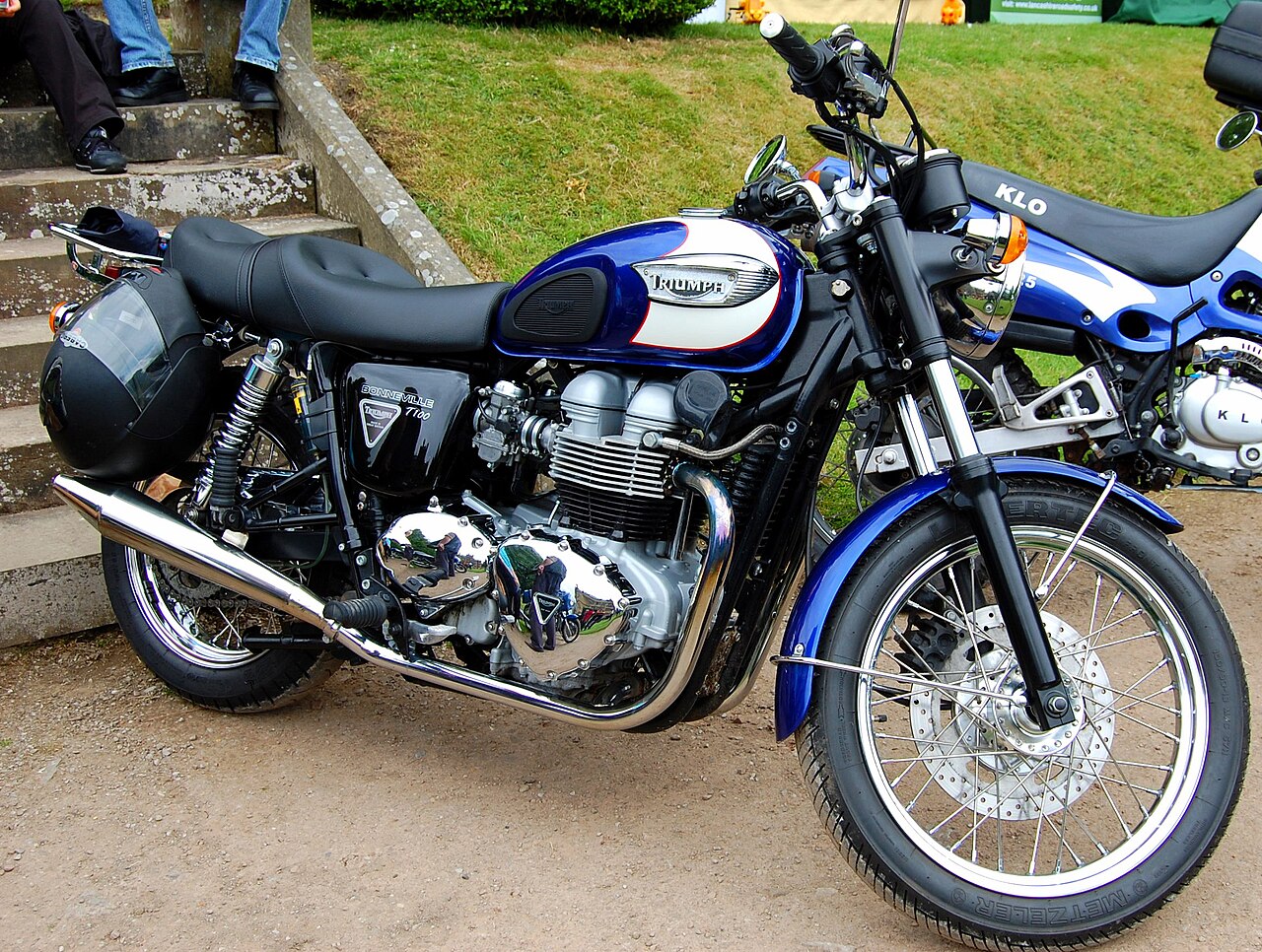
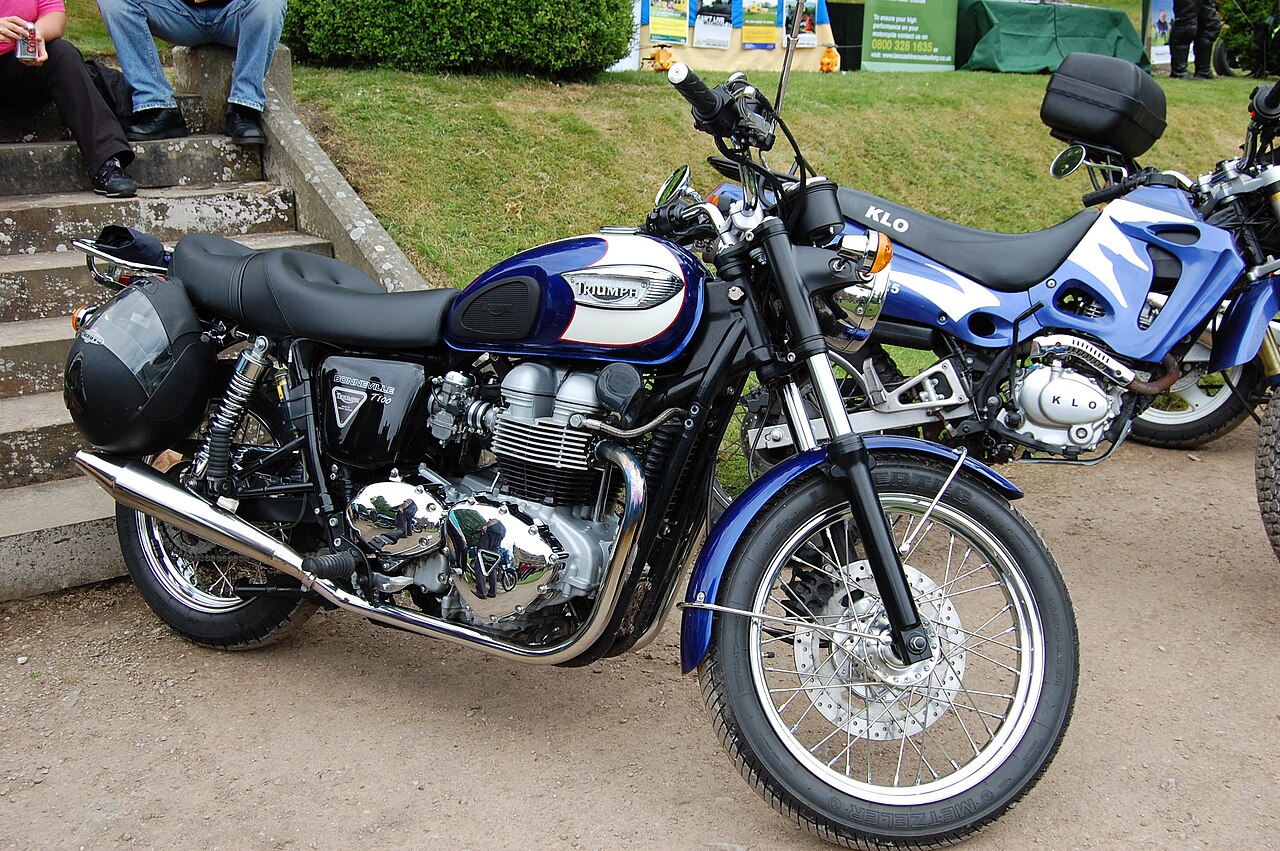
The Triumph Bonneville is a standard motorcycle with a parallel-twin four-stroke engine. It has been produced in three distinct generations across three separate periods. The first two generations came from the now-defunct Triumph Engineering in Meriden, West Midlands, England, running from 1959 to 1983, and then again from 1985 to 1988. The third generation, built by Triumph Motorcycles in Hinckley, Leicestershire, started in 2001 and continues today. This latest version is an entirely new design that closely mimics the look of the original series. The bike’s name comes from the Bonneville Salt Flats in Utah, USA, a location where Triumph and other manufacturers tried to break motorcycle speed records. The original Bonneville, the T120, was a 650 cc parallel-twin made by Triumph Engineering and later Norton Villiers Triumph from 1959 to 1974. It was based on the Triumph Tiger T110 and came standard with that model’s optional twin 1 3/16-inch Amal monobloc carburettors and its high-performance inlet camshaft. Early versions had a pre-unit construction engine, allowing the bike to reach 115 mph without any modifications. In 1963, a unit construction model appeared, which was stiffer and more compact, with added bracing at the steering head and swing arm. A few years later, the steering angle was changed and improved forks were fitted, helping the Bonneville match its rivals in performance. Later T120 models used a frame that held the engine oil instead of a separate tank, known as the oil-in-frame version. The T120 engine, both standard and tuned, was popular in café racers like Tribsas (using a BSA frame) and Tritons (with a Norton featherbed frame). In 1973, the 650 cc T120 was joined by the T140 Bonneville, which had a 750 cc engine. Designated the T140V, it featured a 724 cc engine, a five-speed gearbox, and a single disc front brake. Soon after, the engine was bored out to 744 cc. After a factory lock-in by Meriden workers kept Triumph twin-cylinder models off the market for over a year, only the larger Bonneville returned in 1975. By then, the gearshift lever had moved from the right to the left to meet new U.S. regulations, and a rear disc brake was added. Several T140 models followed with various styling and engineering changes, including electronic ignition from 1979 and electric starting from 1980, until production ended with the closure of the Meriden factory in 1983. This was not the end, however. Businessman John Bloor bought Triumph Motorcycles and licensed Racing Spares in Devon, run by Les Harris, to manufacture the T140 Bonneville. These continuation bikes, called ‘Devon’ or ‘Harris’ Bonnevilles, did not reach the market until 1985 and were not sold in the U.S. Their production ended in 1988. Bloor’s Triumph Motorcycles Ltd launched a completely new model, the Bonneville 800 (790 cc), in September 2001. Originally built only in Hinckley, England, some models have been produced at the company’s Thailand facility since 2014, which also makes components and accessories. The new Bonneville strongly resembles earlier models in style and basic layout but uses modern engineering. At its debut, it had a 790 cc parallel-twin engine, with the up-spec T100 receiving an 865 cc engine from 2005. From 2007 onward, all Bonnevilles got the 865 cc engine. Through 2007, all engines used carburettors; electronic fuel injection (EFI) was introduced for 2008 models in Britain and for 2009 models in the United States, to meet stricter emissions rules. Dummy carburettors—actually redesigned throttle bodies made to look like carburettors—were added to 2009 models to keep the vintage styling. For 2016, Triumph introduced a new T120 with a 1200 cc, 270° liquid-cooled, SOHC engine, and in 2017 a T100 with a 900 cc version. From 2008, all Bonnevilles received a slightly larger, reshaped fuel tank to fit the EFI pump, though tank capacity stayed the same. U.S. 2008 models, which were not fuel-injected, still got the larger tank, leaving the pump space unused. All bikes in Triumph’s “Modern Classics” line are derived from the new Bonneville, including the SE (with a smaller front wheel for shorter riders), T100, Thruxton, Scrambler, America, and Speedmaster. In 2006, Triumph launched the “Sixty-8” line of Bonneville accessories, offering vintage and modern items like seats, seat covers, cam covers, sprocket covers, petrol tank covers, tank badges, panniers, and more, allowing owners to customise their bikes at lower cost than traditional modifications. The switch to EFI in 2008 made many of these accessories obsolete, as tank covers and badges no longer fit the redesigned tank. The original T120 Bonneville was a speed-oriented motorcycle, but the new Bonnevilles are softer and aimed at the roadster market. The 865 cc Bonneville competes directly with the Harley-Davidson 883, with MotorCycle News stating that “Triumph Bonneville is unquestionably the better motorcycle.
- Manufacturer (original)
- Triumph Engineering (Meriden, West Midlands, England)
- Manufacturer (current)
- Triumph Motorcycles (Hinckley, Leicestershire, England)
- Engine type
- Parallel-twin four-stroke
- Notable variants
- T120 (650 cc), T140 (750 cc), New Bonneville (790, 865, 900, 1200 cc)
Verified Timeline
Quick Facts
- Aka
- 'Bonnie'
- Manufacturer
- Triumph Engineering / Triumph Motorcycles Ltd
- Production
- 1959–1983, 1985–1988, 2001–
- Predecessor
- TR6 Trophy
- Engine
- Four-stroke parallel twin
- Transmission
- 4-speed (later 5-speed & 6-speed)
Facts from the source article.
Lore & Background
It was based on the company's Triumph Tiger T110 and was fitted with the Tiger's optional twin 1 3/16 in Amal monobloc carburettors as standard, along with that model's high-performance inlet camshaft. Later T120 Bonnevilles used a new frame which contained the engine oil instead of using a separate tank, known as the oil in frame version. The T120 engine was popular in café racers such as Tribsas and Tritons. Triumph Motorcycles was then acquired by businessman John Bloor, who licensed Racing Spares in Devon, run by Les Harris, to manufacture the T140 Bonneville; these continuation bikes, known as 'Devon' or 'Harris' Bonnevilles, reached the market from 1985 to 1988. Originally built exclusively in Hinckley, England, some models are now produced at the company's Thailand manufacturing facility. The new Bonneville strongly resembles earlier models in style but with modern engineering. From 2007 all Bonnevilles received an 865 cc engine; electronic fuel injection was introduced from 2008 in Britain and 2009 in the United States. All bikes in Triumph's current 'Modern Classics' line are derived from the new Bonneville.
Reader's Guide
Its original 650 cc and 750 cc models defined British parallel-twin performance in the mid-20th century, competing with rivals and becoming a foundation for café racer culture. The Bonneville's name, drawn from the Bonneville Salt Flats, links it to land-speed record attempts. After the closure of the Meriden factory, the brand was revived by John Bloor with a completely new design that retained the classic look while incorporating modern engineering. Its legacy includes continuous production through corporate changes, a devoted following, and adaptation to emissions regulations while preserving vintage styling.
Did You Know?
- The Bonneville name comes from the Bonneville Salt Flats in Utah, USA, where Triumph and others attempted to break motorcycle speed records.
- After Triumph Engineering went into receivership in 1983, John Bloor licensed Les Harris of Racing Spares in Newton Abbot, Devon, to continue building the old Bonneville; about 14 were built per week at peak production.
- The 2002 Hinckley factory fire, which began at 21:00 on 15 March, destroyed half the main factory including the assembly area and stores, yet production resumed by September that same year.
- In 2024, Triumph introduced its first ever off-road motorcycle, the motocross racer TF 250-X, developed with seven-time AMA motocross champion Ricky Carmichael.
- The partnership with Bajaj Auto, announced in 2017, led to the Speed 400 and Scrambler 400 models, which collected 10,000 bookings in India within ten days of their July 2023 launch.
The 1983 Rebirth and Bloor's Vision
When Triumph Engineering collapsed into receivership in 1983, the brand that had been building motorcycles since 1902 faced an existential threat. John Bloor stepped in, purchasing the name and manufacturing rights from the Official Receiver. Rather than immediately relaunching with the outdated Coventry plant, Bloor made a pragmatic choice: he let Les Harris of Racing Spares in Newton Abbot, Devon, continue producing the old Bonneville under licence, building roughly fourteen bikes per week at peak. Meanwhile, Bloor hired former Triumph designers and sent his team on a study tour of Japanese competitors' facilities. The lesson was clear—adopt Japanese manufacturing techniques and computer-controlled machinery. By 1985, equipment was in place for secret prototype work; by 1987, the first new engine was complete. In 1988, Bloor broke ground on a ten-acre factory in Hinckley, Leicestershire, and the first Hinckley-built Triumphs rolled out for the 1991 model year. Between the brand purchase and breaking even in 2000, somewhere between seventy and one hundred million pounds was poured into the enterprise.
The 2002 Fire and a Century of Resilience
On the night of 15 March 2002, just as the company was gearing up to mark a century of the Triumph name, a fire erupted at the rear of the Hinckley facility. By 21:00, the blaze had consumed half the main factory, including the assembly area and stores. At its peak, more than a hundred firefighters and thirty vehicles were battling the flames. The company, which employed over 650 people at the time, faced what could have been a terminal blow. Yet Triumph's response was remarkably swift: the facility was rebuilt and production resumed by September of that same year. The episode became a defining test of the brand's post-rebirth character. In the months that followed, the company also pressed ahead with its international manufacturing strategy, beginning construction of a sub-assembly plant in Chonburi, Thailand, in May 2002. The fire, far from derailing Triumph, seemed to accelerate its commitment to a more distributed, modern production model—one that would eventually see the bulk of large-scale motorcycle manufacturing shift overseas while the UK retained its design, R&D, and specialist custom-building roles.
Going Global: Thailand and the Bajaj Partnership
Triumph's manufacturing footprint has grown well beyond its Hinckley roots. The first Thai sub-assembly facility opened in Chonburi in 2002, followed by a second plant in 2006—officially opened by Andrew Mountbatten-Windsor—with wet painting and assembly lines, and a third in 2007 adding high-pressure die-casting and machining. By then, Triumph was targeting capacity above 130,000 motorcycles, and its Thai operation, a wholly UK-owned entity, employed around a thousand staff. In February 2020, the company announced it would move the remainder of large-scale production, including the Tiger 1200 and Speed Triple lines, to Thailand, retaining only R&D and the specialist Factory Customs workshop in the UK. A separate but equally significant expansion came in 2017, when Triumph partnered with Pune-based Bajaj Auto. Under that agreement, the two firms would develop smaller-capacity motorcycles for high-volume developing markets, all badged Triumph. The first fruits—Speed 400 and Scrambler 400, scaled-down versions of their 1200cc siblings—launched in July 2023 and collected ten thousand Indian bookings within ten days, prompting a price increase and a production ramp-up by Bajaj.
Breaking New Ground: The Motocross Venture
For over a century, Triumph had been a road-and-touring marque, but in 2024 the company broke new ground with the TF 250-X, its first-ever off-road motorcycle. The project was announced in a July 2021 press release, which also named seven-time AMA motocross and five-time supercross champion Ricky Carmichael and five-time enduro champion Iván Cervantes as development partners. A series of "Vision to Reality" videos on Triumph's YouTube channel then peeled back the design process, showcasing the chassis and engine of the 250cc four-stroke machine. Carmichael and amateur rider Evan Ferry—son of 1997 AMA 125cc Supercross East champion Tim Ferry—were filmed testing the bike on a track. The production version made its public debut on 22–23 September 2023 at the SuperMotocross World Championship Finals in the Los Angeles Memorial Coliseum, where three-time AMA motocross and supercross champion Jeff Stanton rode it before the crowd. The TF 250-X marked a genuine departure from Triumph's heritage, signaling that the Hinckley-based brand was willing to compete in a segment it had never previously touched.
Common Misconceptions (Editorial)
Some people think the Bonneville name refers to a person or place unrelated to speed records, but it actually comes from the Bonneville Salt Flats in Utah, where Triumph attempted to break motorcycle speed records. Another common mistake is believing that Triumph’s production ended permanently when the company went into receivership in 1983; in fact, John Bloor licensed Les Harris to continue building the Bonneville from 1985 to 1988. It is also incorrect to assume that all Bonnevilles have always used electronic fuel injection—this was only introduced from 2008 in Britain and 2009 in the United States.
Why It Matters (Editorial)
The Triumph Bonneville endures because it bridges classic British motorcycle heritage with modern engineering, remaining a symbol of style and reliability across generations. Its continuous reinvention—from the oil-in-frame T120 to the new “Modern Classics” line—demonstrates how a vintage design can thrive in a contemporary market, while notable collaborations and off-road expansions show its ongoing influence on the industry.
Gallery
Frequently Asked Questions
What is the Triumph Bonneville?
It is a classic British standard motorcycle built around a parallel-twin four-stroke engine, originally introduced in 1959 by Triumph Engineering in Meriden, West Midlands.
Why is it called 'Bonneville'?
The name is a nod to the Bonneville Salt Flats in Utah, the legendary desert strip where Triumph and rival makers once chased land-speed records.
What engine does the Bonneville use?
Every generation has relied on a parallel-twin four-stroke layout, spanning displacements from the early 650 cc T120 and 750 cc T140 to today's 790, 865, 900, and 1200 cc variants.
How many generations of the Bonneville have been produced?
Three: two runs by the original Meriden-based Triumph Engineering (1959–1983 and 1985–1988) and a third, fully redesigned series from Hinckley-based Triumph Motorcycles that launched in 2001.
Is the Triumph Bonneville still in production?
Yes; the current third-generation model has been built continuously since 2001 and remains a core offering in Triumph Motorcycles' lineup in Leicestershire, England.
More in Iconic Motorcycles 1-20
Spotted an error? Know more?
This is a living reference — every entry is fact-audited, and reader corrections feed straight into our audit queue. Suggest an edit · See this site's audit record