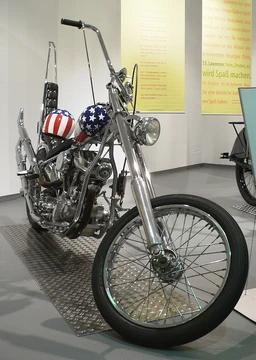
Norton Commando
The Norton Commando: a five-time Bike of the Year winner with an old engine but a revolutionary vibration-damping mount.

via Wikipedia: BSA motorcycles · see source
The Norton Commando is a British motorcycle that was produced by Norton-Villiers-Triumph (NVT) after a government-organised rescue operation in 1973 led to the takeover of BSA-Triumph motorcycle operations. The Commando won the Motor Cycle News "Bike of the Year" award for several years running, but its engine was an old design, being a pre-unit pushrod parallel-twin, despite its effective and revolutionary vibration-damping 'Isolastic' engine mounting system. The only NVT models listed for the 1975 model year were the Norton Commando and the Triumph T160 Trident.
- field
- Motorcycle manufacturing
- nationality
- British
- known_for
- Rubber-mounted engine, five-time Machine of the Year
Lore & Background
The Norton Commando was a product of Norton-Villiers-Triumph (NVT), formed in 1973 when BSA's motorcycle businesses were merged with the Manganese Bronze company, Norton-Villiers, as part of a government-initiated rescue plan. The Commando's engine was an old design, a pre-unit pushrod parallel-twin, but it was fitted with an effective and revolutionary vibration-damping 'Isolastic' engine mounting system. Despite winning the Motor Cycle News "Bike of the Year" award for several years running, the Commando could not hide the fact that its engine was outdated. The T160 Trident, the other NVT model for 1975, was an upgraded triple with electric starting and all-disc braking, whose engine was built at BSA's Small Heath plant and bore a striking similarity to the original BSA Rocket 3.
Reader's Guide
The Norton Commando is significant as the last major British parallel-twin motorcycle from the NVT era. Its 'Isolastic' engine mounting system was a revolutionary solution to the vibration problems of large parallel twins, allowing the Commando to win the Motor Cycle News "Bike of the Year" award for several years running. However, the Commando's engine was an old pre-unit pushrod design, and the bike was produced during a period of financial turmoil. The NVT company was formed in 1973 after a government rescue plan merged BSA's motorcycle businesses with Norton-Villiers, but the plan failed in the face of worker resistance. Norton's and BSA's factories were eventually shut down, while Triumph staggered on to fail four years later.
Did You Know?
- The Norton Commando won the Motor Cycle News "Bike of the Year" award for several years running.
- The Commando's engine was an old pre-unit pushrod parallel-twin design, not a new motor.
- The Commando was produced by Norton-Villiers-Triumph (NVT), formed after a government rescue plan in 1973.
- The T160 Trident, the other NVT model for 1975, had an engine built at BSA's Small Heath plant that bore a striking similarity to the original BSA Rocket 3.
- Norton's and BSA's factories were eventually shut down, while Triumph staggered on to fail four years later.
Common Misconceptions (Editorial)
Some believe the Norton Commando’s engine was a completely new design, but in fact the bike used the existing pre-unit pushrod parallel-twin engine, simply fitted with the revolutionary 'Isolastic' vibration-damping mounting system. Others think the Commando was a commercial success that saved Norton, but it was produced during a period of financial decline that led to the shutdown of Norton's and BSA's factories. It is also commonly assumed the Commando was a standalone Norton model, when it was actually a product of Norton-Villiers-Triumph (NVT), a company formed by merging BSA's motorcycle businesses with Norton-Villiers.
Why It Matters (Editorial)
The Norton Commando endures as a landmark of British engineering because it solved the chronic vibration problems of large parallel twins not with a new motor, but with an elegant chassis innovation — the 'Isolastic' engine mounting system. Its five-time "Bike of the Year" award and iconic status prove that clever problem-solving can outshine raw power, making it a lasting symbol of 1960s/70s motorcycle innovation, even as the industry declined.
More in Iconic Motorcycles 1-20
Spotted an error? Know more?
This is a living reference — every entry is fact-audited, and reader corrections feed straight into our audit queue. Suggest an edit · See this site's audit record