Kawasaki Z1
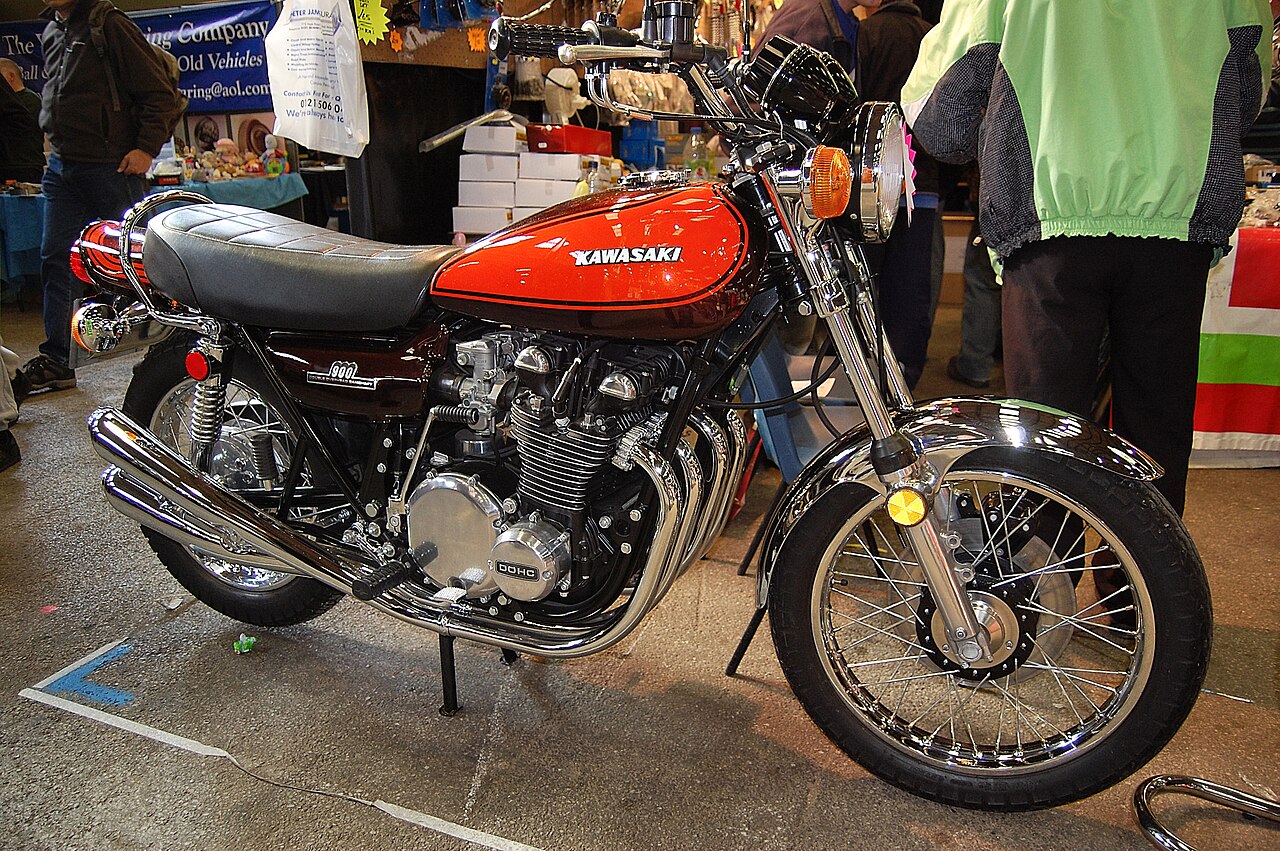
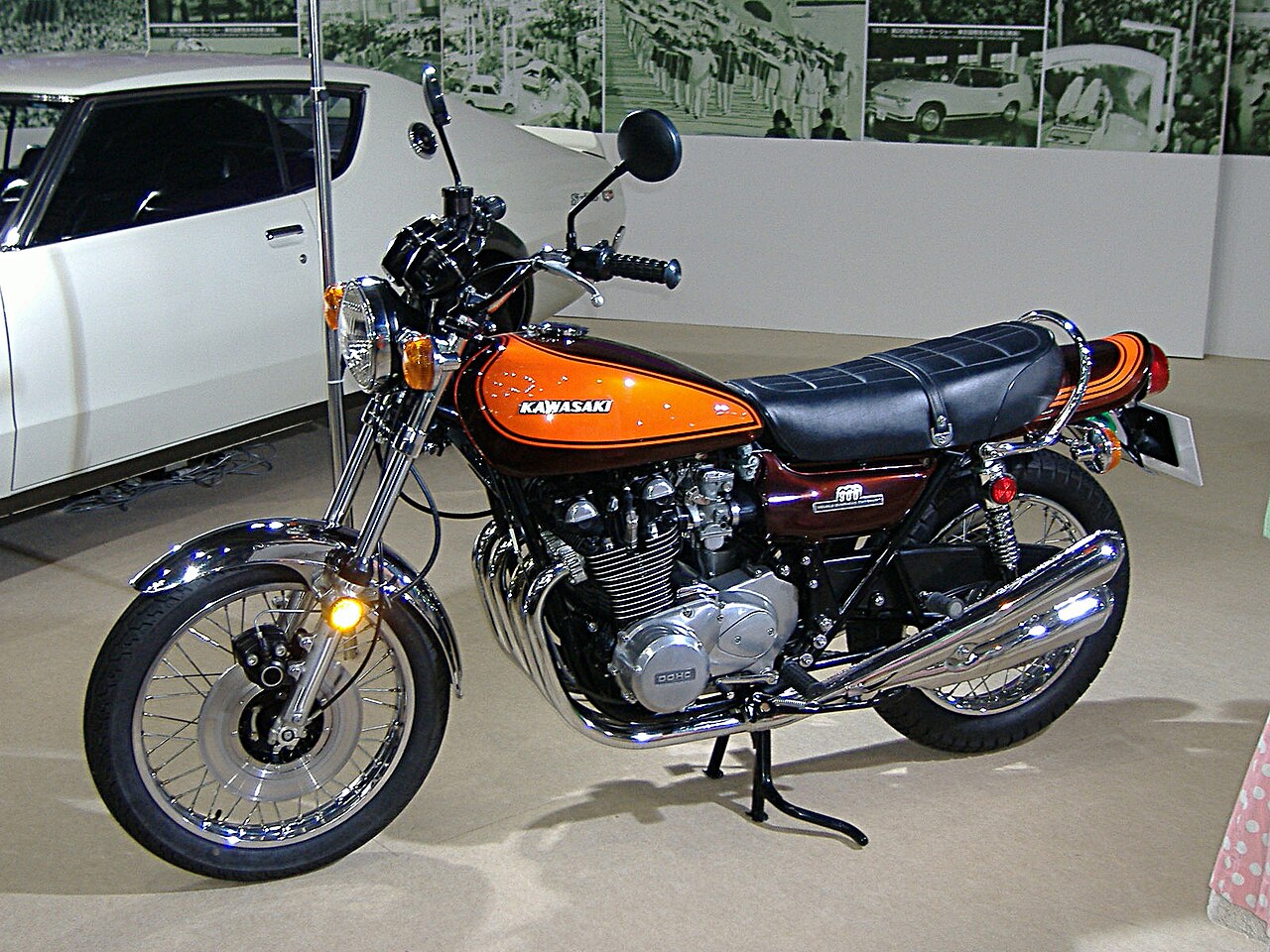
First large-capacity Japanese DOHC four-cylinder production motorcycle.

Chuck Schultz · CC BY-SA 2.0
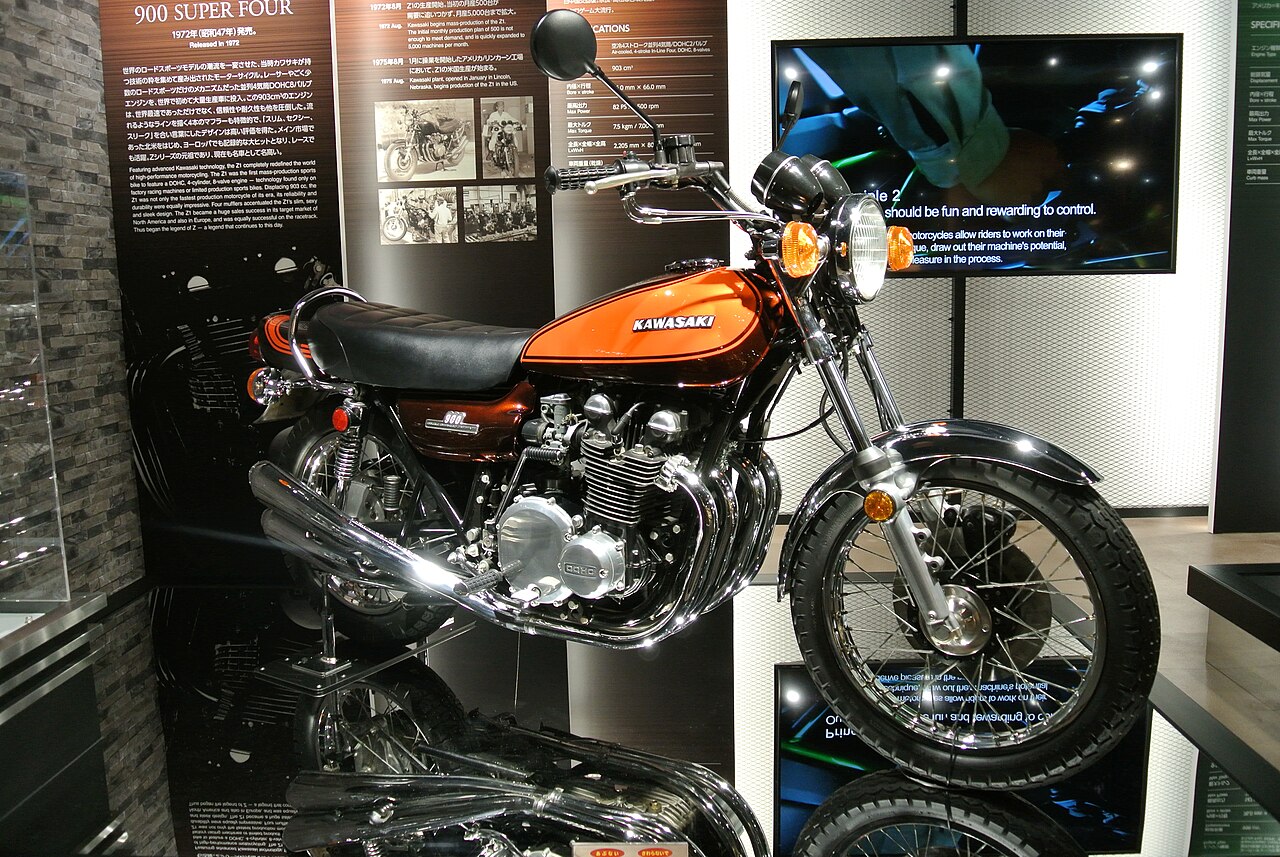
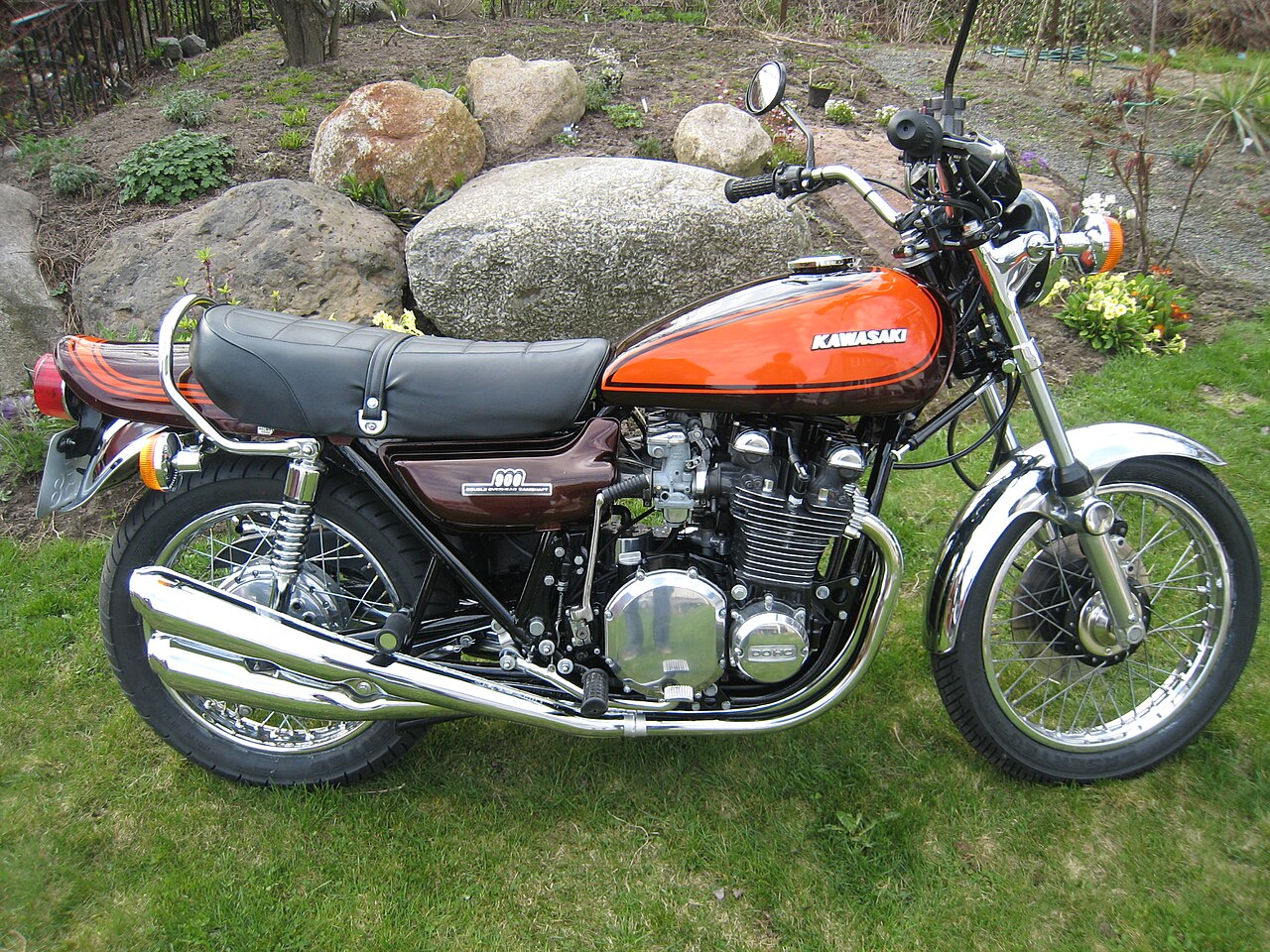
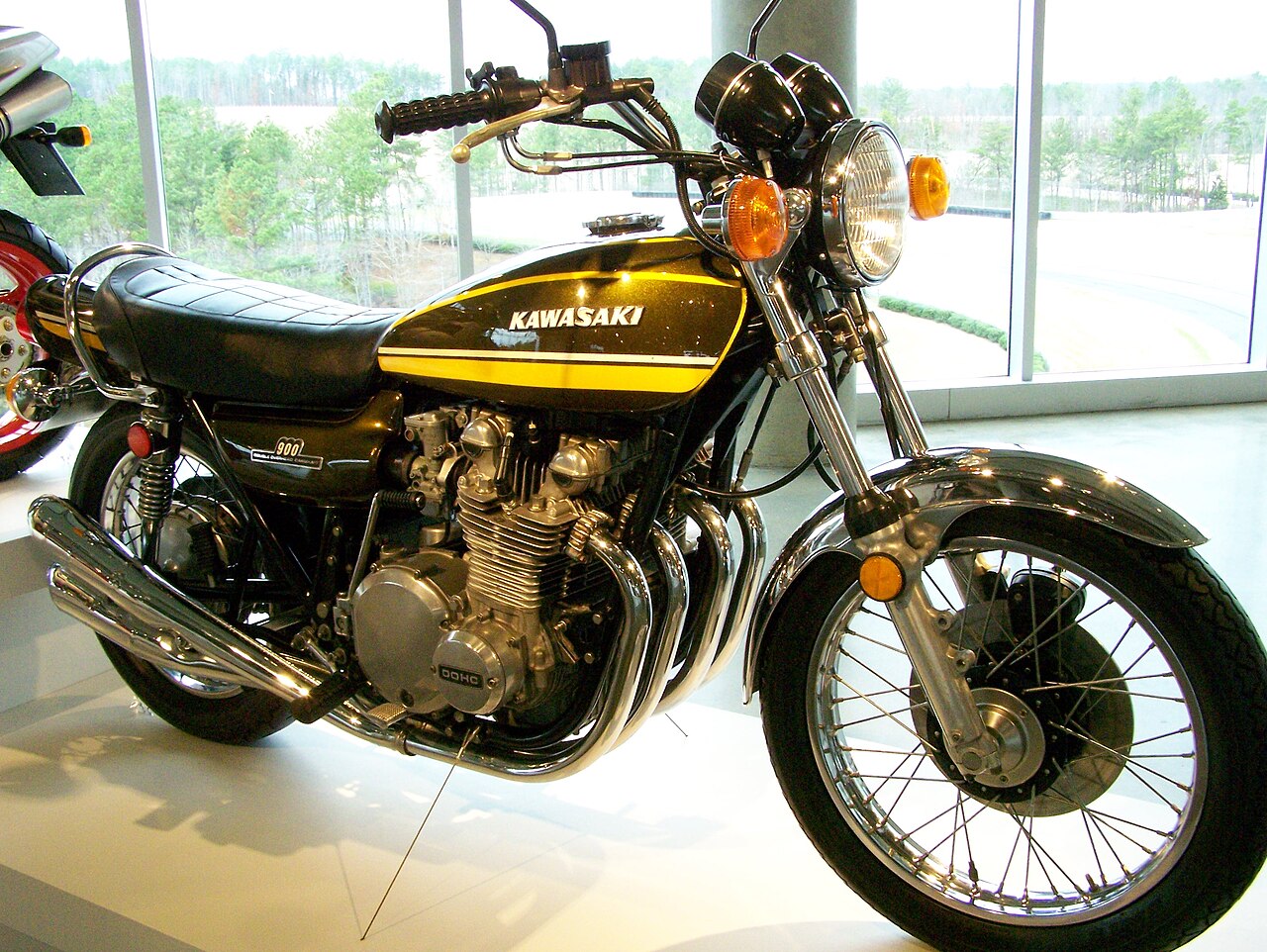
The Kawasaki Z1, a four-cylinder, air-cooled, double-overhead-camshaft motorcycle with carburetors and chain drive, debuted in 1972. Following Honda’s CB750 in 1968, it helped establish the in-line four-cylinder layout across the frame, a design later called the Universal Japanese Motorcycle (UJM). It was the first mass-produced Japanese four-cylinder bike with a double-overhead-camshaft system in a large displacement; before it, only the MV Agusta 750 S used this setup, but that was a costly, limited-run machine, while the Z1 cost less than half as much. Sold under names like Z1-900, 900 Z1, or 900 S4 (“Super Four”), it launched Kawasaki’s Z series.
Developed under the project name “New York Steak,” Kawasaki—already known for two-stroke bikes—began prototyping a 750 cc four-cylinder four-stroke sports model in the late 1960s, working with McFarlane Design in 1969 on its look. When Honda released the CB750 first, Kawasaki delayed the Z1, increasing its engine to 903 cc to compete in the 1000cc class. Production started in 1972, making it the most powerful Japanese four-cylinder four-stroke on the market at the time.
That year, the Z1 set FIM and AMA records for a 24-hour endurance run at Daytona’s banked track, covering 2,631 miles at an average 109.64 mph. Writer LJK Setright noted in 1976 that this was only 0.36% faster than the 1961 record set at Montlhéry by a modified BMW R69S. Also at Daytona, a one-off Z1 tuned by Yoshimura and ridden by Yvon Duhamel achieved a one-lap record of 160.288 mph. Setright said this feat, with a 100-bhp engine, showed how far motorcycles had advanced in twelve years.
The Z1 came with full instrumentation and an electric starter, produced 82 bhp, and reached 130 to 132 mph. The press praised its smoothness, vibration damping, easy starting (both kick and electric), straight-line stability, and linear acceleration. Steering was accurate and handling good, but testers noted rapid wear of the rear tire, chain, and rear shocks. It won Motorcycle News’ “Machine of the Year” from 1973 to 1976, based on reader polls, and the Society of Automotive Engineers of Japan later listed the 1972 Z1 among its 240 Landmarks of Japanese Automotive Technology.
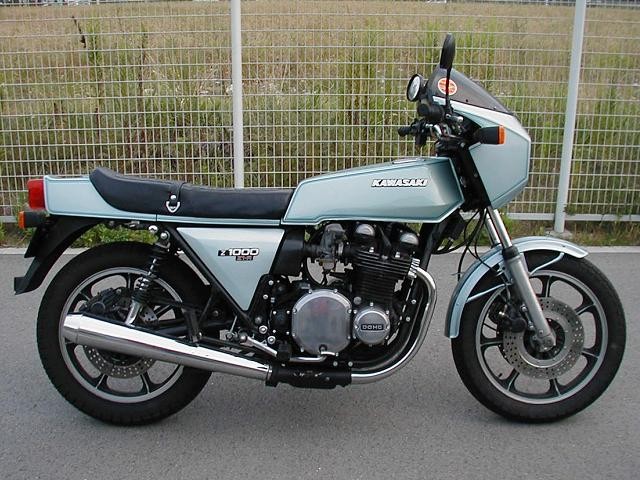
The design stayed largely unchanged until 1975, when the 903 cc Z1-B appeared with more power, better suspension, a stiffer frame, removed automatic chain oiler, revised styling (mainly paint and side-panel badges), and improved brakes. In 1976, the Z1 was replaced by the Kawasaki KZ900 in the U.S. and Z900 elsewhere, followed by the 1977 KZ1000 (Z1000) and Z1000 Z1-R, and the 1984 Z1100R. In 1983, Kawasaki reclaimed the fastest-production-bike title with the GPZ900R, which echoed its predecessor with the ZX900 code, four cylinders, and 900 cc. The 1991 Kawasaki Zephyr series borrowed heavily from the original naked Z1’s design, as did the 2003 Z1000, which saw updates in 2007 and a major redesign in 2010. In 2018, Kawasaki released the Z900RS, a tribute to the original Z1 with modern features like water cooling, fuel injection, a six-speed transmission, upside-down front forks, mono-shock rear suspension, ABS, and traction control.
- power
- 82 bhp
- project_name
- New York Steak
Verified Timeline
Lore & Background
The Kawasaki Z1 was developed under the project name 'New York Steak'.
Reader's Guide
Its introduction helped solidify the in-line four-cylinder format as the Universal Japanese Motorcycle, influencing motorcycle design for decades.
Did You Know?
- The Z1 was developed under the project name 'New York Steak'.
Revolutionary Engineering & Design
Conceived as the successor to the legendary Z1, the GPZ900R emerged from six years of secret development at Kawasaki. The project was ambitious: the company set out to build what would become the world's first 16-valve, liquid-cooled, inline four-cylinder motorcycle engine. The frame philosophy was equally bold. Engineers discovered through testing that the conventional steel downtubes carried virtually no structural load, so they eliminated them entirely, instead using the engine itself as a stressed member. This approach reduced overall weight and sharpened handling without sacrificing rigidity. While the steel frame, 16-inch front and 18-inch rear wheels, air suspension, and anti-dive forks were fairly standard features for the era, the way they were integrated around the new engine architecture pushed Japanese superbike performance to an entirely new level. The result was a machine that redefined what a production motorcycle could achieve.
Performance & Speed Records
The speed numbers did not stop there. These results were not merely marketing claims. They were verified, repeatable performances that cemented the GPZ900R's reputation as a genuine speed record-holder and set a benchmark that competitors would spend years trying to match.
Legacy & Longevity
As the earliest member of the Ninja family and the first Kawasaki model officially marketed under the Ninja brand in North America, it carried enormous symbolic weight for the company. Its racing credentials were established almost immediately.
Cultural Impact & Everyday Rideability
Beyond its raw performance credentials, the GPZ900R achieved a cultural status that few motorcycles can claim. What made the bike remarkable, however, was not just its speed but its usability. A crankshaft counter-balancer nearly eliminated the secondary vibration typical of inline fours, while the new suspension system kept the ride comfortable at all speeds. The fairing's aerodynamic shape, combined with good overall ergonomics, made long-distance riding genuinely pleasant rather than punishing. This duality—outright speedster by day, civilized commuter by another—gave the GPZ900R a broader appeal than many of its contemporaries. It proved that a motorcycle could be the fastest production bike on the road and still feel at home in a city lane or on a multi-day ride, a combination that helped define the modern sport-bike formula that followed.
Common Misconceptions (Editorial)
Some people mistakenly think the Z1's "New York Steak" project name referred to its power or performance, but the facts confirm it was simply the internal development name. Others may assume the Z1 was the first Japanese four-cylinder motorcycle, but it was actually the first large-capacity Japanese four-cylinder to use a double-overhead-camshaft system.
Why It Matters (Editorial)
The Kawasaki Z1 endures as a landmark of engineering ambition, proving that Japanese manufacturers could rival and even surpass established European marques in performance and innovation. Its double-overhead-camshaft design set a new standard for production motorcycles, influencing generations of sportbikes to follow.
Gallery
Frequently Asked Questions
Why is the Kawasaki Z1 considered a landmark motorcycle?
It holds the distinction of being the first large-capacity Japanese four-cylinder production bike to employ a double-overhead-camshaft engine. That engineering choice set a new benchmark for Japanese motorcycle performance in the early 1970s.
More in Iconic Motorcycles 1-20
Spotted an error? Know more?
This is a living reference — every entry is fact-audited, and reader corrections feed straight into our audit queue. Suggest an edit · See this site's audit record