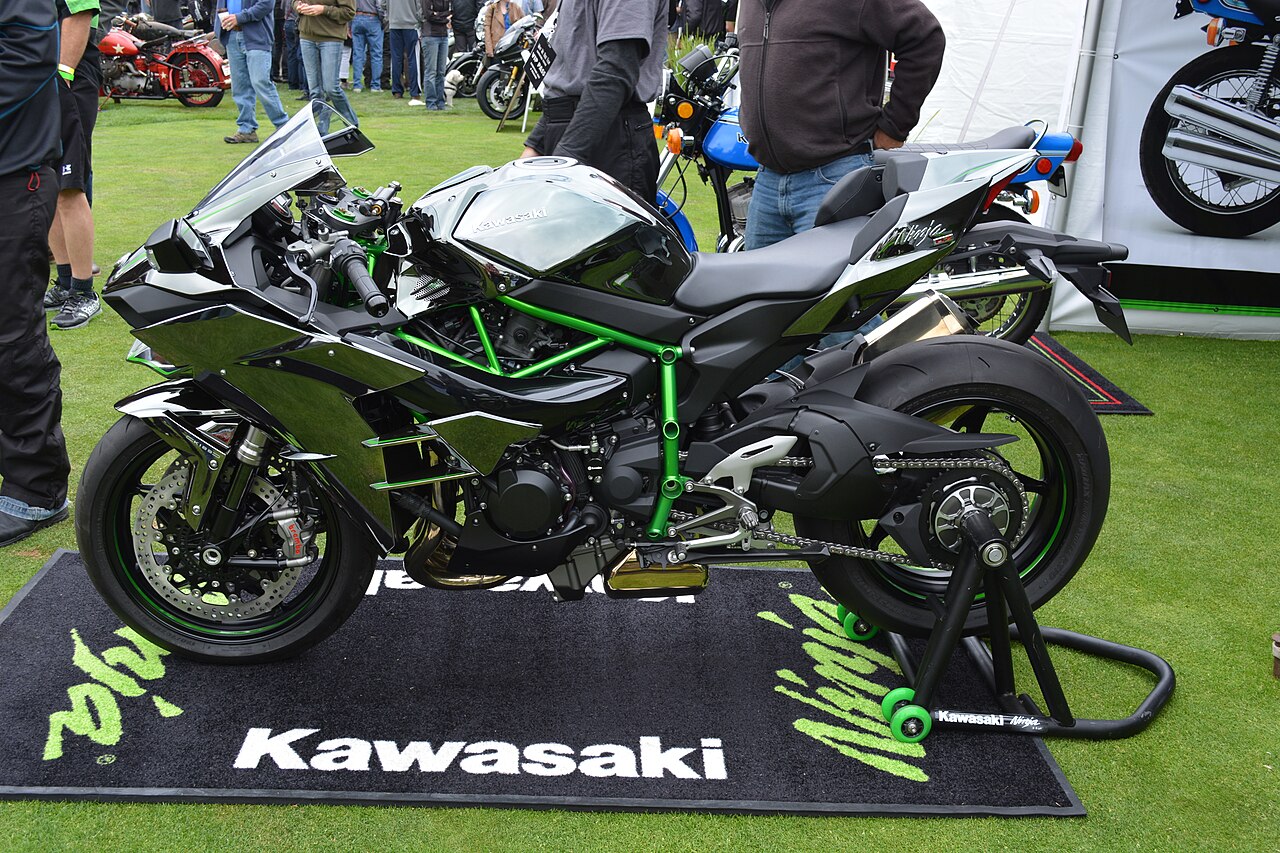
Kawasaki Ninja H2
A modern supercharged marvel, but not the first production motorcycle with a supercharger.

Rainmaker47 · CC BY-SA 4.0
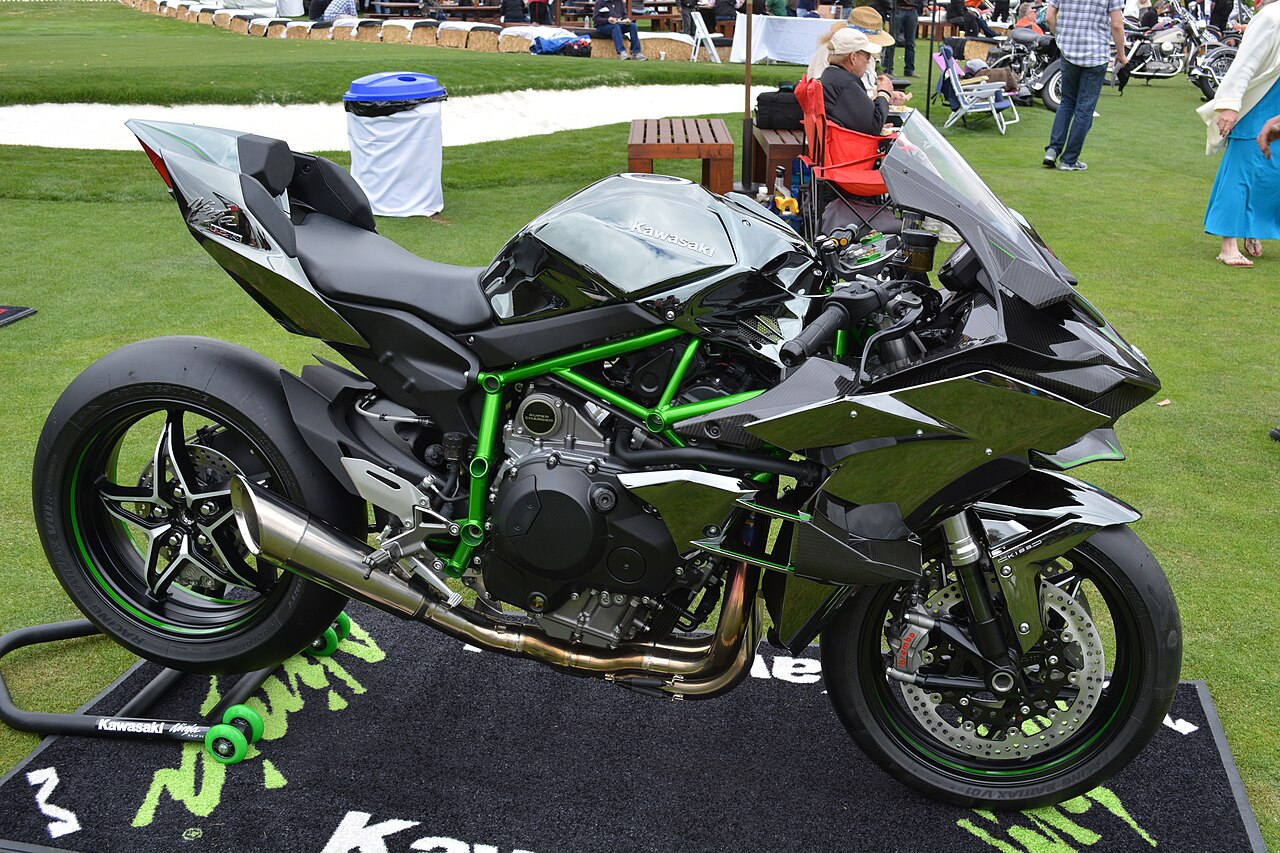
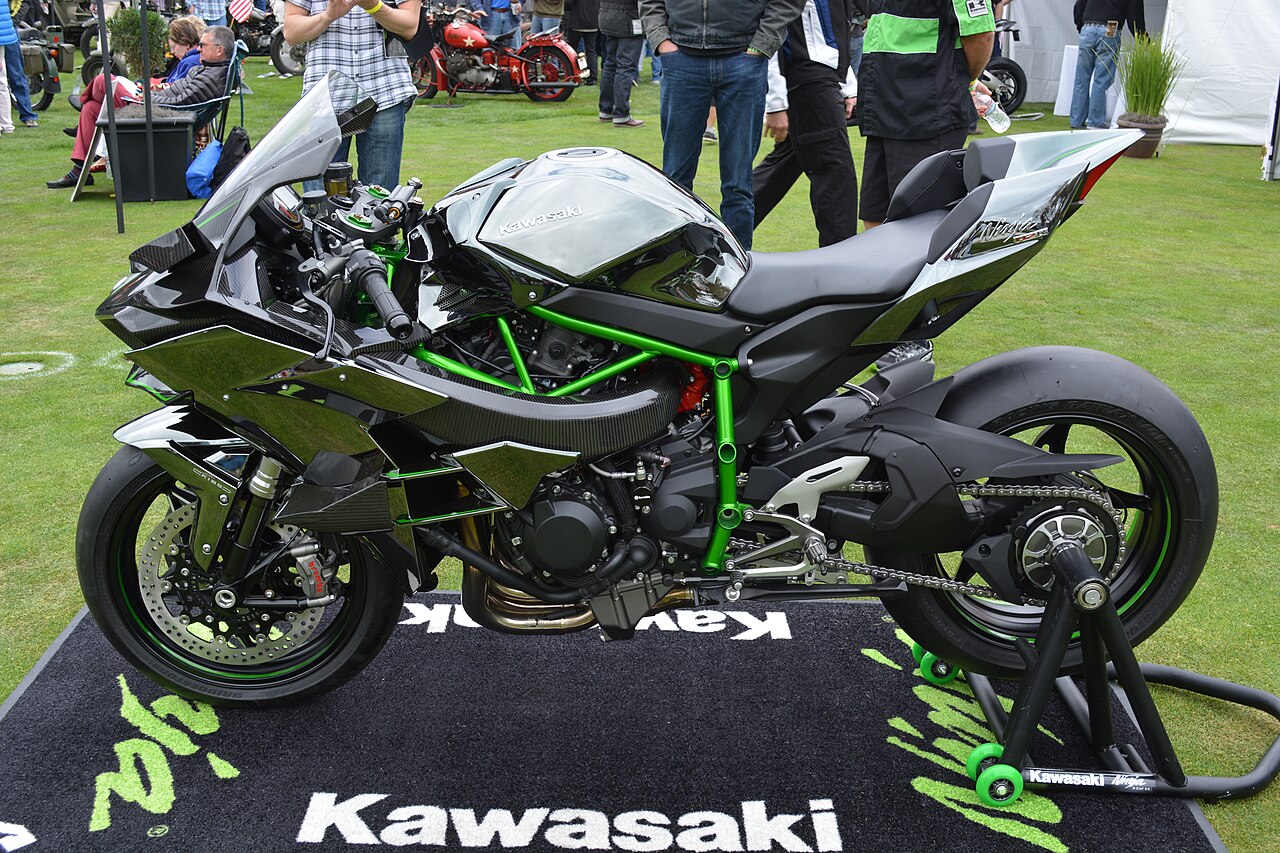
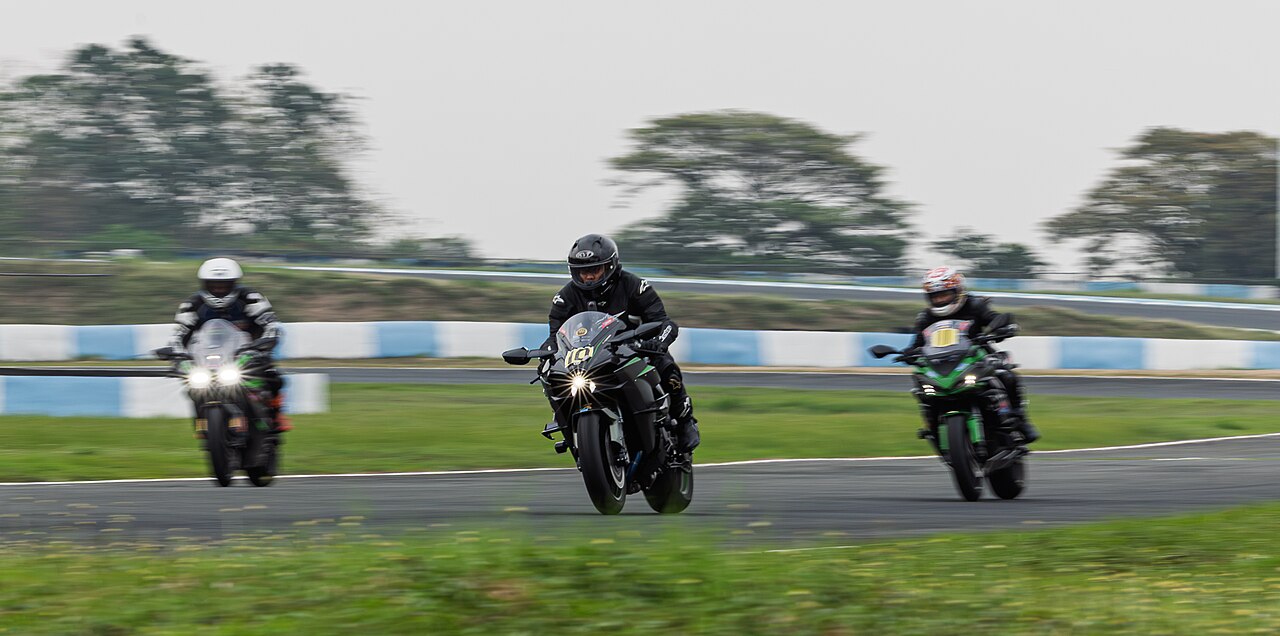
The Kawasaki Ninja H2 belongs to the company’s Ninja sports bike lineup and is a four-stroke hypersport-class motorcycle that uses a variable-speed centrifugal supercharger. Its name pays homage to the 1972 Kawasaki H2 Mach IV, a 750 cc inline triple that the company launched to shake up what it saw as a stagnant motorcycle market. The track-only H2R variant holds the title of the fastest and most powerful production motorcycle available, delivering up to 310 horsepower (230 kW) normally and 326 horsepower (243 kW) with ram-air assistance. This gives the H2R about 50% more power than the quickest street-legal bikes, while the road-going Ninja H2 produces a lower 200 hp (150 kW) to 210 hp (160 kW) with ram-air.
For its top-tier model, Kawasaki chose the literbike platform instead of continuing with the larger-displacement Ninja ZX-14 hyperbike. According to Cycle World’s Kevin Cameron, the literbike class sits at the center of the high-performance market, drawing the best racing development and the finest chassis and suspension designs, making it a logical foundation for a machine that could capitalize on that expertise. The H2 is the first production motorcycle to feature a supercharger, though turbochargers appeared on some models in the early 1980s. Specifications in the infobox come from Kawasaki unless otherwise noted.
The street-legal Ninja H2 uses mirrors where the H2R has winglets, and plastic body panels instead of the H2R’s carbon-fiber ones, though a carbon version of the H2 exists with carbon-fiber panels. Its power output is listed at 200 horsepower (150 kW), likely due to reduced supercharger boost compared to the H2R. Both models share the supercharger—with lower boost on the H2—and many other components, but differ in the head gasket, cam profile and timing, ECU mapping, exhaust system, and clutch (the H2R’s clutch has two extra plates). In 2017, Kawasaki produced a limited run of 120 individually numbered Ninja H2 Carbon units, featuring special paint and a carbon-fiber upper cowl, and also updated the standard Ninja H2 that year.
For 2018, a sport-touring version called the Kawasaki H2 SX arrived, with a claimed wet weight of 256.1 kg (564.5 lb). The H2 SX SE adds features that are optional on the base model and has a claimed wet weight of 260.0 kg (573.3 lb). This variant includes revised throttle bodies, camshafts, crankshaft, pistons, cylinder and cylinder head, plus a new exhaust system designed to boost mid-range torque. The intake system and supercharger impeller were also redesigned, while a larger fuel tank, rear trellis subframe, and panniers add 19 pounds (8.6 kg) to the bike’s weight. In 2019, the H2 received a 15% power increase through updates to the intake, spark plugs, ECU, and air filter, among other parts. New features included an LED lighting scheme, a special top coat of paint that can self-heal small scratches in warmer conditions, lighter and smaller Brembo Stylema calipers, a new TFT dash, and smartphone connectivity offering GPS route, speed, RPM, current gear, fuel mileage, fuel level, and odometer data. The 2019 Ninja H2 SX SE+ also gained electronically controlled suspension. Cycle World named the H2 SX one of the best sport-touring motorcycles in 2025.
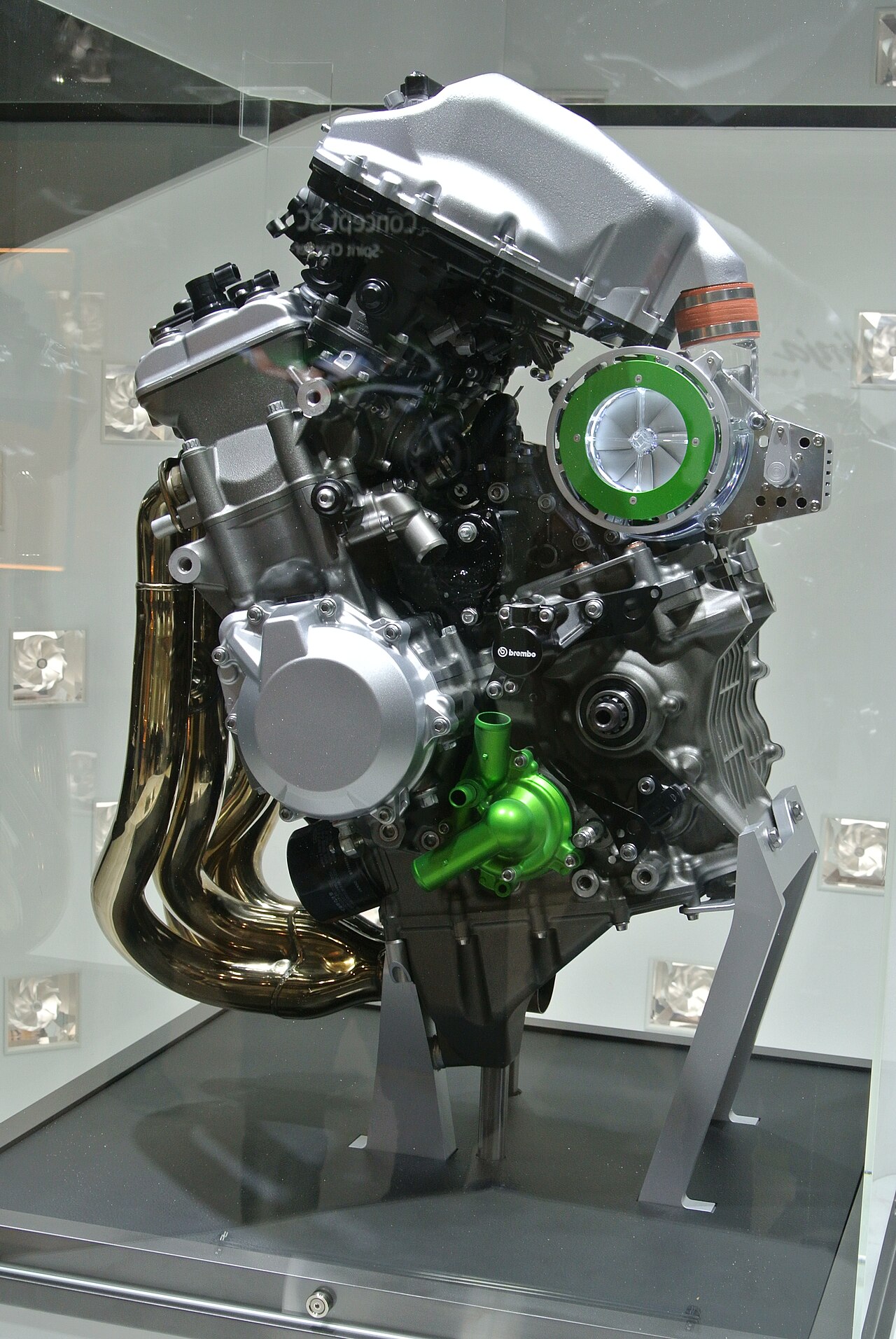
The engine is a 998 cc (60.9 cu in) inline-4 with four valves per cylinder, dual overhead cams, and a two-speed centrifugal supercharger. Power from the flywheel travels through a series of gears and shafts to a planetary drive, which then spins a dog-shifted two-speed shaft connected to the impeller. Throttle control is electronic. A centrifugal supercharger generates less heat than scroll-type or screw-type designs, which is important because the H2 lacks an intercooler; excess heat in the intake charge can cause pre-ignition that may damage or destroy the engine.
Electronic rider aids include an anti-lock braking system (ABS), Kawasaki Traction Control (KTRC), Kawasaki Engine Brake Control (KEBC), a Kawasaki Quick Shifter (KQS), an electronic steering damper (ESD), and Kawasaki Launch Control Mode (KLCM).
The front fairing of the Ninja H2R incorporates carbon-fiber winglets, matching the rest of its exclusive bodywork. These may serve as aerodynamic devices to create a low-pressure zone that helps move cooling air through the engine bay, generate downforce at high speed, or provide straight-line stability in a short-wheelbase sportsbike chassis.
Both the H2 and H2R use a tubular, thin-wall steel trellis frame and a single-sided swingarm, with a traditional sportsbike wheelbase of 1,450 mm (57 in). Explaining why Kawasaki focused on aerodynamics instead of lengthening the wheelbase, Independent Online’s Dave Abrahams noted that building stability into a hard-accelerating drag machine is easy with a long wheelbase, but Kawasaki wanted a track-day machine that could also handle corners. High-speed motorcycles often have long wheelbases; drag bikes typically use extended swingarms, and land speed record streamliners can have wheelbases of several meters (the current record holder, Ack Attack, has a 3.7-meter wheelbase).
Kawasaki announced the H2 in a late-2014 teaser campaign, and many expected a full reveal at the Intermot motorcycle trade show that year. Before details were released, several industry observers believed the supercharged inline-4 engine was identical or closely related to a nearly 1,000 cc inline-4 with a centrifugal supercharger that Kawasaki had displayed at the 2013 Tokyo Motor Show.
- Manufacturer
- Kawasaki
- Class
- Hypersport
- Notable variant
- Ninja H2R track-only
Lore & Background
Kawasaki selected the literbike platform for the Ninja H2 rather than continuing with the higher-displacement Ninja ZX-14 hyperbike, as the literbike class is the center of the high-performance market. The H2 and H2R share the supercharger, with lower boost on the H2, and many other components except the head gasket, cam profile and timing, ECU mapping, exhaust system, and clutch. The H2R has approximately 50% more power than the street-legal H2.
Reader's Guide
The Kawasaki Ninja H2 represents a significant milestone in motorcycle engineering as the first production bike to use a supercharger, reintroducing forced induction to the marketplace after turbocharged models in the early 1980s. The H2's development leveraged the literbike platform's advanced chassis and suspension design, and its supercharger—driven by gears and shafts from the flywheel—generates less heat than scroll-type or screw-type superchargers, avoiding the need for an intercooler. The H2's legacy includes extensive global press coverage and a reputation for redefining performance standards in motorcycling.
Did You Know?
- The H2 is a landmark modern supercharged motorcycle, but earlier supercharged production bikes existed, like the Moto Guzzi from the 1920s/1930s.
Racing Heritage and Competitive Necessity
The solution was the ZX-7, born from a prototype endurance race machine designated ZXR7. That racing lineage proved no mere marketing flourish: over the following decade, ZX-7-based race machines claimed four AMA Superbike Championships and a single Superbike World Championship title, cementing the platform as a genuine competitor at the highest level of production motorcycle racing.
A Decade of Engine Refinement
Four 36-millimeter Keihin constant-velocity carburetors fed the intake, and a 4-2-1 exhaust header collected the exhaust.
Chassis Philosophy and Running Gear
Structurally, the ZX-7R relied on an aluminum twin-spar frame built from pressed and cast sections welded into a rigid unit, with bolt-on down tubes cradling the engine. The rear subframe used welded square-tube aluminum, strong enough to carry a pillion rider. At the rear, a double-sided aluminum swingarm paired with Kawasaki's Uni-Trak rocker-arm linkage delivered progressively stiffer damping and spring rate as the suspension compressed. Power reached the rear wheel through a multi-plate wet slipper clutch and a six-speed transmission.
Naming, Markets, and a Fourteen-Year Run
The ZX-7's identity shifted considerably across markets and model years, reflecting Kawasaki's evolving global branding strategy. This renaming consolidated the lineup under a single, more recognizable badge and eliminated the confusion of parallel naming conventions.
Common Misconceptions (Editorial)
Some people assume the Kawasaki Ninja H2 was the first production motorcycle to feature a supercharger, but earlier examples include Moto Guzzi models from the 1920s/1930s. Others may think the H2 and H2R are mechanically identical, but they differ in head gasket, cam profile and timing, ECU mapping, exhaust system, and clutch, with the H2R producing about 50% more power.
Why It Matters (Editorial)
The Kawasaki Ninja H2 endures as a landmark in modern motorcycling because it revived forced induction for production bikes, pushing the boundaries of performance in the literbike class. Its engineering not only showcases the potential of supercharging on two wheels but also underscores a continued fascination with extreme speed and innovation that keeps the hypersport segment thrilling for enthusiasts.
Gallery
Frequently Asked Questions
Was the Ninja H2 the first supercharged motorcycle ever built?
No—Moto Guzzi produced supercharged models as early as the 1920s and 1930s, decades before Kawasaki's machine. The H2 is nonetheless a landmark modern example of forced induction on a production sport bike.
More in Iconic Motorcycles 1-20
Spotted an error? Know more?
This is a living reference — every entry is fact-audited, and reader corrections feed straight into our audit queue. Suggest an edit · See this site's audit record