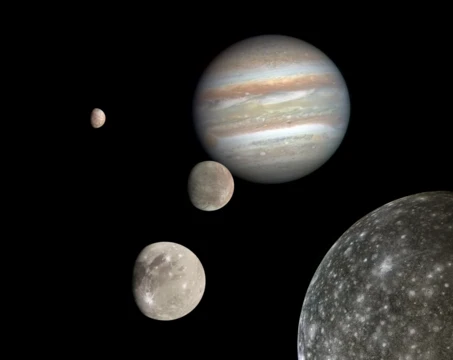
Themisto (moon)
Innermost irregular moon of Jupiter, orbiting alone.

Themisto, designated Jupiter XVIII, is Jupiter's innermost irregular satellite and is considered medium-sized. Its orbit is unique among Jupiter's moons: it travels alone, positioned between the Galilean moons and the Himalia group, and has the shortest orbital period of any irregular moon except Triton.
The moon was first spotted on 30 September 1975 by Charles T. Kowal and Elizabeth Roemer, who reported it on 3 October 1975 under the designation S/1975 J 1. However, too few observations were made to calculate its orbit, and it was lost. On 21 November 2000, Scott S. Sheppard, David C. Jewitt, Yanga R. Fernández, and Eugene A. Magnier discovered what seemed to be a new satellite, designated S/2000 J 1. By computing its past trajectory, they confirmed it was the same object seen in 1975. This finding was linked to an earlier observation on 6 August 2000 by Brett J. Gladman, John J. Kavelaars, Jean-Marc Petit, Hans Scholl, Matthew J. Holman, Brian G. Marsden, Philip D. Nicholson, and Joseph A. Burns, which had been reported to the Minor Planet Center but not published as an IAU Circular. In October 2002, it was officially named after Themisto, a daughter of the river god Inachus and a lover of Zeus (Jupiter) in Greek mythology.
Themisto orbits Jupiter at an average distance of 7.4 million km, completing one revolution in 130 days. Its orbit is prograde, inclined about 45° to the ecliptic, with an eccentricity of 0.252. Solar and planetary perturbations cause its orbit to change continuously.
The satellite is about 9 km in diameter, assuming an albedo of 0.04. Its true albedo could not be measured by NEOWISE due to poor timing. In visible light, Themisto appears red, with color indices (B−V=0.83, V−R=0.46, V−I=0.94) similar to D-type asteroids.
Themisto likely did not form near Jupiter but was captured later. It is probably the remnant of a broken, captured heliocentric asteroid.
Quick Facts
- Pronounced
- θ · ə · ˈ · m · ɪ · s · t · oʊ
- Adjectives
- Themistoan θ · ɛ · m · ə · ˈ · s · t · oʊ · . · ə · n Themistoian θ · ɛ · m · ə · ˈ · s · t · oʊ · . · i · ə · n
- Named After
- Θεμιστώ Themistō
- Mpc Name
- Jupiter XVIII
- Discoverer
- Charles T. Kowal (1975) / Elizabeth P. Roemer (1975) / Scott S. Sheppard (2000) / David C. Jewitt (2000) / Yanga R. Fernández (2000) / Eugene A. Magnier (2000)
- Discovery Site
- Palomar Observatory / Mauna Kea Observatory (rediscovery)
- Discovered
- 30 September 1975 / 21 November 2000 (rediscovery)
- Satellite Of
- Jupiter
- Group
- (own group)
- Epoch
- 23 March 2018 (JD 2458200.5)
- Observation Arc
- 42.54 yr (15,536 days)
- Semimajor
- 0.0494401 AU
Facts from the source article.
Lore & Background
Themisto was first discovered by Charles T. Kowal and Elizabeth Roemer on 30 September 1975, reported on 3 October 1975, and designated S/1975 J 1. However, not enough observations were made to establish an orbit and it was subsequently lost. Then, on 21 November 2000, a seemingly new satellite was discovered by Scott S. Sheppard, David C. Jewitt, Yanga R. Fernández and Eugene A. Magnier and was designated S/2000 J 1. It was soon confirmed from computing the past trajectory that this was the same as the one observed in 1975. This observation was immediately correlated with an earlier observation on 6 August 2000 by the team of Brett J. Gladman, John J. Kavelaars, Jean-Marc Petit, Hans Scholl, Matthew J. Holman, Brian G. Marsden, Philip D. Nicholson and Joseph A. Burns, which was reported to the Minor Planet Center but not published as an IAU Circular. In October 2002, it was officially named after Themisto, daughter of the river god Inachus and lover of Zeus in Greek mythology.
Themisto orbits Jupiter at an average distance of 7.4 million km in 130 days, at an inclination of about 45° to the ecliptic, in a prograde direction and with an eccentricity of 0.252. Its orbit is continuously changing due to solar and planetary perturbations. Themisto is about 9 km in diameter (assuming an albedo of 0.04). While its true albedo could not be measured by NEOWISE due to poor timing of observations, it is known that Themisto is colored red in the visible spectrum, similar to D-type asteroids. Themisto probably did not form near Jupiter but was captured later, and is probably the remnant of a broken, captured heliocentric asteroid.
Reader's Guide
Themisto holds a unique place among Jupiter's irregular moons due to its isolated orbit, lying midway between the Galilean moons and the Himalia group. Its discovery history is notable: first observed in 1975 but lost, then rediscovered in 2000 and identified as the same object through orbital calculations. This re-identification was correlated with an earlier observation from August 2000. Themisto's orbit is continuously changing due to solar and planetary perturbations, and it has the shortest orbital period of all irregular moons apart from Triton. Its physical characteristics—a diameter of about 9 km and red coloration similar to D-type asteroids—suggest it is likely a captured heliocentric asteroid fragment. The moon's naming in October 2002 after a figure from Greek mythology follows the convention for Jupiter's moons. Its significance lies in demonstrating the complex capture and fragmentation history of the Jovian system, as well as the challenges of tracking small, distant satellites.
More in Moons of Jupiter 1-24
Spotted an error? Know more?
Reader corrections go straight into our review queue. Suggest an edit · How this site is sourced