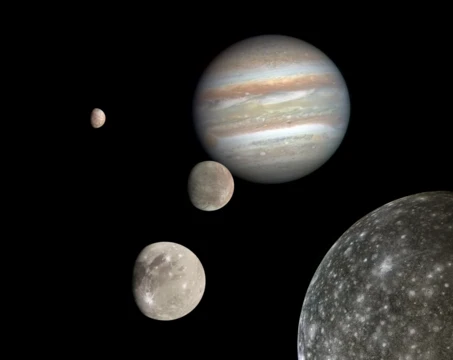
Ersa (moon)
A small prograde moon of Jupiter in the Himalia group.

Ersa (Jupiter LXXI) is a small outer moon of Jupiter, discovered by Scott S. Sheppard on 11 May 2018 using the 4.0-meter Víctor M. Blanco Telescope at Cerro Tololo Observatory in Chile. Its discovery was announced alongside nine other Jovian moons on 17 July 2018, and the Minor Planet Center gave it the provisional designation S/2018 J 1 after enough observations confirmed its orbit. Precovery images of Ersa have been found dating back to 6 August 2000.
The moon belongs to the Himalia group, a close cluster of prograde irregular moons that share similar orbits to Himalia, with semi-major axes between 11 and 12 million kilometers and inclinations between 26° and 31°. With an estimated diameter of about 3 kilometers (based on an absolute magnitude of 15.9), Ersa is one of the smallest known members of this group.
Ersa was named in 2019 after the Greek goddess of dew, daughter of Zeus and Selene. (The moon Herse, or Jupiter L, is also named for this goddess.) The name came from a Twitter naming contest held by the Carnegie Institute, with more than twenty tweets suggesting it. The first submission was by Aaron Quah (@8603103), and other contributors included the 12th-grade students of Saint Sauveur High School in Redon, France (@StSauMoons), the fifth grade at Hillside Traditional Academy in British Columbia, Canada (submitted by @mrgrouchypants), and a 4-year-old child who sang a song about Ersa (submitted by @Thoreson). As a member of the prograde Himalia group, its name ends in the letter "a."
On average, Ersa orbits Jupiter at a semi-major axis of about 11,401,000 kilometers, with an inclination of roughly 29.1° relative to the ecliptic. Like all of Jupiter's irregular moons, it orbits far enough from the planet that it is highly susceptible to gravitational perturbations from the Sun and other planets, making its orbit significantly variable over time.
Quick Facts
- Pronounced
- ˈ · ɜr · s · ə
- Named After
- Ἔρσα Ersa
- Discoverer
- Scott S. Sheppard
- Discovery Site
- Cerro Tololo Obs.
- Discovered
- 11 May 2018
- Mpc Name
- Jupiter LXXI
- Epoch
- 1 January 2000 (JD 2451545.0)
- Observation Arc
- 2000 · 2024 / 2024-12-03 (last obs)
- Earliest Precovery Date
- 6 August 2000
- P Semimajor
- 11401000 km
- P Eccentricity
- 0.116 / <!--
- P Period
- +249.228928 d-->
Facts from the source article.
Lore & Background
Ersa was discovered by Scott S. Sheppard on 11 May 2018 using the 4.0-meter Víctor M. Blanco Telescope at Cerro Tololo Observatory in Chile. It was announced alongside nine other Jovian moons on 17 July 2018 and provisionally designated S/2018 J 1 by the Minor Planet Center after observations confirmed its orbit. Precovery observations have been found as early as 6 August 2000.
The moon was named in 2019 after Ersa, the Greek goddess of dew, daughter of Zeus and Selene. The name was suggested in a naming contest held by the Carnegie Institute on Twitter, with more than twenty tweets proposing it, including from Aaron Quah, the 12th grade students of Saint Sauveur High School in Redon, France, the fifth grade at Hillside Traditional Academy in British Columbia, Canada, and a 4-year-old child who sang a song about Ersa.
Ersa belongs to the prograde Himalia group, whose members are given names ending in 'a'. On average, it orbits Jupiter at a semi-major axis of about 11,401,000 km at an inclination of about 29.1° with respect to the ecliptic. Like all of Jupiter's irregular moons, its orbit is highly variable over time due to gravitational perturbations by the Sun and other planets.
Reader's Guide
Ersa is notable as one of the smallest known members of the Himalia group, a tight cluster of prograde irregular moons of Jupiter that follow similar orbits to Himalia. With an estimated diameter of 3 km and an absolute magnitude of 15.9, it represents the smaller end of the size range for this group. Its discovery by Scott S. Sheppard in 2018 using the Víctor M. Blanco Telescope added to the growing catalog of Jovian moons, and its precovery observations dating back to 2000 helped confirm its orbit. The moon's naming in 2019 through a public contest on Twitter highlights a modern, participatory approach to astronomical nomenclature, involving diverse contributors from around the world, including students and a young child. As part of the Himalia group, Ersa contributes to understanding the dynamics of irregular moons, which are highly subject to solar and planetary perturbations, making their orbits variable over time.
Did You Know?
- The moon was named after Ersa, the Greek goddess of dew, in a naming contest on Twitter in 2019.
- Precovery observations of Ersa exist as early as 6 August 2000.
Discovery and Orbital Confirmation
Scott S. Sheppard first detected Ersa on 11 May 2018 while operating the 4.0-meter Víctor M. Blanco Telescope at Cerro Tololo Observatory in Chile. The find was not immediately publicized; instead, Sheppard waited until observations had accumulated over a sufficiently long window to verify that the object truly followed a stable orbit around Jupiter. On 17 July 2018, the Minor Planet Center formally announced the satellite alongside nine other newly identified Jovian moons, assigning it the provisional designation S/2018 J 1. What makes the discovery timeline particularly intriguing is the precovery data: archival images dating back to 6 August 2000 already contained Ersa, meaning the tiny moon had been silently drifting through the telescope's field of view for nearly eighteen years before anyone recognized it. This gap between first light and formal confirmation is characteristic of faint, distant irregular satellites, whose slow apparent motion and extremely low brightness make them nearly indistinguishable from background stars in a single exposure.
Physical Profile and Group Affiliation
Ersa is a remarkably small body, with an estimated diameter of only about 3 kilometers and an absolute magnitude of 15.9, placing it among the tiniest confirmed members of its orbital family. It belongs to the Himalia group, a tight-knit cluster of prograde irregular moons that share closely similar orbital elements with the larger moon Himalia. Members of this group orbit at semi-major axes ranging from roughly 11 to 12 million kilometers from Jupiter, with orbital inclinations falling between 26 and 31 degrees. Ersa's position within this narrow band of distances and tilts reflects the tight clustering that defines the group's membership. Its prograde motion—traveling in the same direction as Jupiter's rotation—distinguishes it from the retrograde irregular satellites that populate other regions of Jupiter's distant satellite system. At just 3 kilometers across, Ersa is far too small for detailed surface characterization, yet its membership in the Himalia group makes it a valuable data point for understanding the population statistics and formation history of Jupiter's outer satellite families.
Naming and Cultural Resonance
In 2019, the moon received its permanent name through a public naming contest organized by the Carnegie Institute on Twitter. The chosen name, Ersa, honors the Greek goddess of dew, daughter of Zeus and Selene. The connection to Jupiter's satellite family is intentional: Herse, another moon in the same lineage (Jupiter L), also derives from this goddess, and all prograde Himalia-group members follow the convention of ending their names with the letter "a." The contest drew an unexpectedly diverse set of participants. More than twenty tweets proposed the name, including Aaron Quah, who submitted it first; a group of twelfth-grade students from Saint Sauveur High School in Redon, France; fifth-graders at Hillside Traditional Academy in British Columbia, Canada, whose entry was posted on their behalf; and a four-year-old child who sang a song about Ersa, with the submission made on his behalf. This range of voices—from a school-aged child to high-school students across three countries—gave the naming a genuinely global and intergenerational character.
Orbital Dynamics and Perturbations
Ersa traces its path around Jupiter at a mean distance of approximately 11,401,000 kilometers (about 7,084,000 miles), with an orbital inclination of roughly 29.1 degrees relative to the ecliptic plane. These parameters place it squarely within the Himalia group's orbital band. Because it orbits so far from Jupiter, Ersa is highly susceptible to gravitational perturbations from the Sun and the other planets in the solar system. Like every irregular Jovian satellite, it experiences these external tugs continuously, and the cumulative effect causes its orbital elements to shift appreciably over time, making its precise trajectory highly variable on long timescales. The prograde nature of its orbit—moving in the same rotational direction as Jupiter—combined with its moderate inclination, sets it apart from the retrograde populations that dominate other regions of Jupiter's satellite system. For astronomers tracking such distant, small bodies, the ongoing influence of solar and planetary gravity means that orbital predictions must be regularly updated, and the satellite's apparent position can drift noticeably from one observation epoch to the next.
More in Moons of Jupiter 1-24
Spotted an error? Know more?
Reader corrections go straight into our review queue. Suggest an edit · How this site is sourced