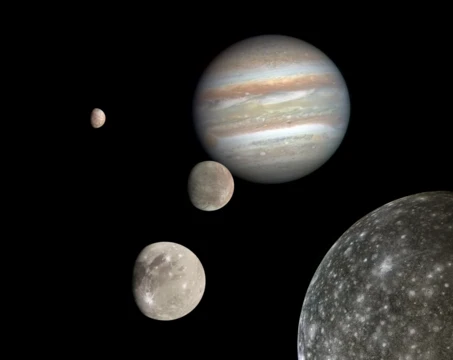
Amalthea (moon)
Jupiter's fifth moon, last discovered by direct visual observation.

Amalthea is a moon of Jupiter, known as Jupiter V, and was the fifth moon of Jupiter to be discovered. It has the third-closest orbit around Jupiter among known moons and is the fifth-largest moon of Jupiter, after the four Galilean moons. It was the last natural satellite to be discovered by direct visual observation; all later moons were discovered by photographic or digital imaging.
Quick Facts
- Pronounced
- ˌ · æ · m · əl · ˈ · θ · iː · ə
- Adjectives
- Amalthean ˌ · æ · m · əl · ˈ · θ · iː · ə · n
- Named After
- Ἀμάλθεια Amaltheia
- Discoverer
- E. E. Barnard
- Discovered
- 9 September 1892
- Eccentricity
- 0.00319 · 0.00004Cooper Murray et al. · 2006
- Satellite Of
- Jupiter
- Dimensions
- 252 × 146 × 126 kmDenk et al. · 2026
Facts from the source article.
Lore & Background
Amalthea was discovered on 9 September 1892 by Edward Emerson Barnard using the 36 inch (91 cm) refractor telescope at Lick Observatory. It was the last planetary satellite to be discovered by direct visual observation (as opposed to photographically) and was the first new satellite of Jupiter since Galileo Galilei's discovery of the Galilean satellites in 1610. The name 'Amalthea' was initially suggested by Camille Flammarion and was not formally adopted by the IAU until 1976, although it had been used informally for many decades. Before 1976, Amalthea was most commonly known simply as Jupiter V.
Amalthea orbits Jupiter at a distance of 181,000 km (2.54 Jupiter radii) with an eccentricity of 0.003 and an inclination of 0.37° relative to Jupiter's equator. Its orbit lies near the outer edge of the Amalthea Gossamer Ring, which is composed of dust ejected from the satellite. The surface of Amalthea is the reddest in the Solar System, possibly due to sulfur originating from Io or some other non-ice material. It is irregularly shaped, with the best ellipsoidal approximation being 250 × 146 × 128 km, and is tidally locked with Jupiter. Its surface is heavily scarred by craters, including Pan (100 km across) and Gaea (80 km across).
Amalthea's density was found to be as low as 0.86 g/cm3, indicating it is either a relatively icy body or very porous 'rubble pile' or something in between. Recent measurements of infrared spectra suggest the moon contains hydrous minerals, indicating it cannot have formed in its current position and likely formed farther from the planet or is a captured Solar System body. Amalthea radiates slightly more heat than it receives from the Sun, probably due to Jovian heat flux, sunlight reflected from the planet, and charged particle bombardment.
Reader's Guide
Amalthea holds significance as the last moon discovered by direct visual observation, marking the end of an era in astronomical discovery before photographic and digital imaging became standard. Its discovery by Edward Emerson Barnard in 1892 using the Lick Observatory's 36-inch refractor telescope was the first new satellite of Jupiter found since Galileo's discoveries in 1610. The moon's low density (0.86 g/cm3) and porous composition challenge earlier assumptions about its structure, suggesting it may be a rubble pile or icy body that formed elsewhere in the Solar System. Its reddish surface, the reddest in the Solar System, and its role as a source of dust for the Amalthea Gossamer Ring highlight its dynamic interaction with Jupiter's environment. The Galileo orbiter's flyby in 2002 provided crucial mass data, while Voyager 1 and 2 in 1979 gave the first resolved images. Amalthea's legacy includes its unique orbit, its potential as a base for observing Jupiter (as suggested by science journalist Willy Ley), and its contribution to understanding the formation and evolution of inner Jovian moons.
Did You Know?
- Amalthea's density is as low as 0.86 g/cm3, suggesting it is a porous rubble pile or icy body.
- From Amalthea's surface, Jupiter would appear 46.5 degrees in diameter, roughly 85 times wider than the full moon from Earth.
Discovery and Mythological Naming
Amalthea entered the astronomical record on 9 September 1892, when Edward Emerson Barnard spotted it through the 36-inch refractor at Lick Observatory. This observation marked a remarkable milestone: it was the first new Jovian satellite identified since Galileo Galilei revealed the four Galilean moons in 1610, and it would ultimately be the last planetary satellite ever found through direct visual observation. Every satellite catalogued after Amalthea was detected via photographic or digital imaging. Barnard's find became the fifth known moon of Jupiter and, by size, the fifth-largest, trailing only the four Galilean giants. The name itself carries mythological weight. Camille Flammarion first proposed calling the moon after Amalthea, the nymph who, in Greek legend, nursed the infant Zeus with goat's milk. Despite being used informally for decades, the International Astronomical Union did not formally adopt the name until 1976. Before that, the body was most commonly referred to simply as Jupiter V.
A Porous World: Composition and Origin
Amalthea defies the neat spherical shape one might expect of a large moon. Its best ellipsoidal fit measures roughly 250 by 146 by 128 kilometers, giving it a surface area estimated somewhere between 88,000 and 170,000 square kilometers. For years, its lopsided form and considerable size led researchers to assume it must be a dense, rigid object, since a weaker icy body should have been pulled round by its own gravity. That assumption collapsed on 5 November 2002, when the Galileo orbiter executed a targeted flyby to within 160 kilometers of the surface. By measuring the deflection in Galileo's trajectory, scientists calculated a density of just 0.86 grams per cubic centimeter, revealing Amalthea as either a porous rubble pile, an icy body, or something in between. Infrared spectra gathered by the Subaru telescope further indicate the presence of hydrous minerals, which complicates the origin story: the hot primordial Jupiter would have melted such material, suggesting Amalthea either formed farther from the planet or was captured from elsewhere in the Solar System.
A Scarred and Asymmetric Surface
Amalthea boasts the reddest surface of any body in the Solar System, a hue scientists attribute either to sulfur deposited from Io or to some unidentified non-ice compound. Brighter, less-red patches dot the major slopes, though their origin remains a mystery. A striking asymmetry separates the two hemispheres: the leading side, which faces the direction of orbital motion, shines 1.3 times brighter than the trailing side. The prevailing explanation is that faster, more frequent micrometeorite strikes on the leading face excavate bright interior material, likely ice, from beneath the darker crust. The surface is heavily pocked with craters, some of them enormous relative to the moon's small size. Pan, the largest, stretches 100 kilometers across and plunges at least 8 kilometers deep. Gaea spans 80 kilometers and is probably twice as deep. Two bright spots, Lyctos Facula and Ida Facula, each up to 25 kilometers wide, sit along a ridge on the anti-Jupiter side. In total, four geological features carry official names: two craters drawn from Zeus-and-Amalthea mythology and two faculae named for locations linked to Zeus.
Orbit, Tides, and the Gossamer Ring
Amalthea circles Jupiter at a distance of about 181,000 kilometers, making it the third-closest known satellite to the planet. Its orbit is nearly circular, with an eccentricity of just 0.003 and an inclination of 0.37 degrees to Jupiter's equator. Those small but nonzero values are unusual among inner satellites and are traced to repeated gravitational encounters with Io, the innermost Galilean moon. Over millions of years, Amalthea has passed through several mean-motion resonances with Io, each episode nudging its orbital tilt and shape slightly. The moon's orbit sits near the outer boundary of the Amalthea Gossamer Ring, a faint band of fine dust that has been shed from the satellite's surface. Because Jupiter's tidal pull, combined with Amalthea's low density and irregular shape, reduces the escape velocity at its surface to no more than about one meter per second, even modest micrometeorite impacts can loft dust particles beyond the moon's grasp, feeding the ring continuously. From Amalthea's surface, Jupiter would loom 46.5 degrees across the sky.
More in Moons of Jupiter 1-24
Spotted an error? Know more?
Reader corrections go straight into our review queue. Suggest an edit · How this site is sourced