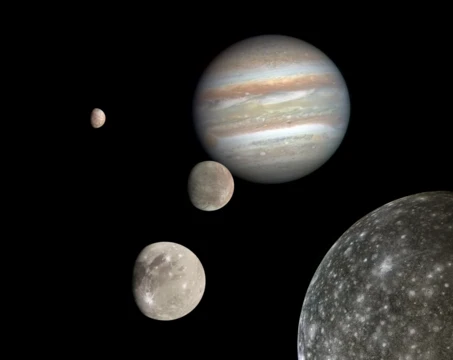
Adrastea (moon)
Smallest inner moon of Jupiter, discovered by Voyager 2 in 1979.

Adrastea (Jupiter XV) is the second-closest of Jupiter’s four inner moons and the smallest among them. Unlike any moon discovered before it, Adrastea was first spotted not through a telescope but in images captured by the Voyager 2 spacecraft in 1979. Its name comes from Adrasteia, the foster mother of Zeus in Greek myth—Zeus being the counterpart to the Roman god Jupiter. This moon completes an orbit around Jupiter in less time than it takes the planet to rotate on its axis, a trait shared by only a few moons in the Solar System. Its orbit runs along the outer edge of Jupiter’s main ring, and scientists believe Adrastea is the primary source of material for that ring system. The Galileo spacecraft studied it in the 1990s, but aside from its size and the fact that it is tidally locked to Jupiter, little else is known about its physical makeup.
David C. Jewitt and G. Edward Danielson discovered Adrastea in Voyager 2 photos taken on July 8, 1979. It was initially labeled S/1979 J 1 and appeared only as a faint dot, yet it earned the distinction of being the first moon found by an interplanetary probe. Shortly afterward, two other inner Jovian moons—Thebe and Metis—were identified in earlier Voyager 1 images. In 1998, the Galileo spacecraft managed to determine the moon’s shape, though the images remained poor. The moon received its official name in 1983, after the Greek nymph Adrastea, the daughter of Zeus and his lover Ananke. The Juno orbiter, which reached Jupiter in 2016, carries a camera called JunoCam, but it is mostly aimed at Jupiter itself. Still, if conditions allow, it may capture limited views of Thebe, Metis, and Adrastea. A close flyby of Adrastea was planned for June 3, 2026, during Juno’s 84th perijove. One source says the spacecraft passed within 11,747 km of the moon, while another predicts the flyby was closer to 40,000 km. A second source also suggests an Adrastea flyby within 10,200 km on Juno’s 86th perijove, on August 7, 2026.
Adrastea has an irregular shape, measuring 20 km by 16 km by 14 km, making it the smallest of Jupiter’s four inner moons. Its bulk composition and mass are unknown, but if its density matches that of Amalthea—about 0.86 g/cm³—its mass can be estimated at 2×10¹⁵ kg.
Quick Facts
- Pronounced
- æ · d · r · ə · ˈ · s · t · iː · ə
- Adjectives
- Adrastean æ · d · r · ə · ˈ · s · t · iː · ə · n
- Discoverer
- David C. Jewitt / G. Edward Danielson
- Discovered
- 8 July 1979
- Eccentricity
- 0.0015Evans Porco et al. · 2002Burns Simonelli et al. · 2004
- Inclination
- 0.03° (to Jupiter's equator)Evans Porco et al. · 2002Burns Simonelli et al. · 2004
- Satellite Of
- Jupiter
- Dimensions
- 20 × 16 × 14 kmThomas Burns et al. · 1998
Facts from the source article.
Lore & Background
Adrastea was discovered by David C. Jewitt and G. Edward Danielson in Voyager 2 probe photographs taken on July 8, 1979, and received the designation S/1979 J 1. Although it appeared only as a dot, it was the first moon to be discovered by an interplanetary spacecraft. Soon after its discovery, two other inner moons of Jupiter (Thebe and Metis) were observed in images taken a few months earlier by Voyager 1. The Galileo spacecraft was able to determine the moon's shape in 1998, but the images remain poor. In 1983, Adrastea was officially named after the Greek nymph Adrastea, the daughter of Zeus and his lover Ananke.
Reader's Guide
Adrastea holds significance as the first natural satellite discovered from images taken by an interplanetary spacecraft, marking a milestone in planetary exploration. It is the smallest of Jupiter's four inner moons and the second closest to the planet. Its orbit at the edge of Jupiter's main ring makes it the most copious source of ring material, as evidenced by the densest ring being located at and within Adrastea's orbit. The moon's physical characteristics remain poorly known, with only its size and tidal locking confirmed. The Juno orbiter, which arrived at Jupiter in 2016, may capture limited images of Adrastea, and a close flyby was planned for June 3, 2026, on Juno's 84th perijove, though sources disagree on the distance (one states 11,747 km, another predicts closer to 40,000 km). A second source also suggested an Adrastea flyby within 10,200 km on Juno's 86th perijove on August 7, 2026. The moon's eventual fate is to impact Jupiter due to orbital decay from tidal forces.
Did You Know?
- Adrastea was the first moon discovered from images taken by an interplanetary spacecraft, not through a telescope.
- It orbits Jupiter at 113,000 km/h (70,200 mph) at the edge of the planet's main ring.
- Adrastea is the smallest of Jupiter's four inner moons, measuring 20 km × 16 km × 14 km.
- Its orbit lies inside Jupiter's synchronous orbit radius, causing tidal forces to slowly decay its orbit toward Jupiter.
A Pioneering Discovery from Deep Space
In the summer of 1979, as Voyager 2 swept past Jupiter, researchers David C. Jewitt and G. Edward Danielson spotted a faint dot in the spacecraft's July 8 photographs. That tiny speck, initially catalogued as S/1979 J 1, turned out to be a previously unknown moon, and its identification marked a landmark in planetary science: it was the first natural satellite ever detected from imagery gathered by an interplanetary spacecraft rather than through ground-based telescopic observation. Within weeks, two additional inner moons, Thebe and Metis, were also identified in earlier Voyager 1 frames. The new body received its formal name in 1983, honoring the Greek nymph Adrastea, daughter of Zeus and Ananke. Despite the Galileo probe's 1998 pass, which managed to discern the moon's rough shape, the available pictures remain disappointingly low in resolution. Decades later, NASA's Juno orbiter, which arrived at Jupiter in 2016, has been slated for a close flyby during its extended mission, with one planned encounter in June 2026 at a distance estimated between roughly 11,700 and 40,000 kilometres, and a possible second pass in August 2026 at around 10,200 kilometres.
A Tiny, Irregular World
Adrastea is the smallest of Jupiter's four inner moons, measuring roughly 20 by 16 by 14 kilometres across in an irregular, lumpy shape. Beyond its dimensions and the fact that it is tidally locked—always presenting the same face toward the gas giant—surprisingly little is known about its physical nature. Its bulk composition, internal structure, and precise mass all remain uncertain. Scientists have attempted to estimate its mass by assuming a mean density comparable to that of its larger sibling Amalthea, approximately 0.86 grams per cubic centimetre, which yields a figure on the order of two times ten to the fifteenth kilograms. That density, if it holds, would suggest a body composed largely of water ice with a porosity in the range of ten to fifteen percent, much like Amalthea itself. Yet no surface features, craters, or geological structures have ever been resolved, because every image ever captured of Adrastea—whether from Voyager, Galileo, or any other mission—suffers from extremely low resolution. The moon remains, in essence, a faint smudge whose interior and surface are still largely mysteries.
An Orbit Doomed to Decay
Adrastea circles Jupiter at a radius of approximately 129,000 kilometres—just 1.806 times the planet's equatorial radius—travelling at a speed of about 113,000 kilometres per hour. Its path is remarkably circular, with an eccentricity of only around 0.0015, and it tilts a mere 0.03 degrees relative to Jupiter's equatorial plane. The moon is one of the very few satellites in the entire Solar System whose orbital period is shorter than the rotation period of the planet it encircles. Because of tidal locking, Adrastea spins in perfect synchrony with its orbit, and its longest axis is thought to point steadily toward Jupiter, the lowest-energy orientation. However, this closeness carries a long-term consequence: the orbit lies inside Jupiter's synchronous radius, meaning tidal friction is steadily draining energy from the system and slowly shrinking the moon's path. Over geological timescales, Adrastea is on a one-way trajectory toward a collision with Jupiter. If its density truly matches Amalthea's, its orbit would fall within the fluid Roche limit, yet the fact that it has not disintegrated indicates it still sits outside the rigid-body Roche limit.
The Ring's Quiet Architect
Although Adrastea is the smallest of Jupiter's inner moons, it plays a disproportionately large role in shaping the planet's ring system. It is believed to be the single greatest source of material that populates Jupiter's faint rings. The mechanism is straightforward: meteorite strikes on the surfaces of the four small inner satellites kick up debris, and because these bodies are so low in density and their surfaces sit close to the edge of their respective Hill spheres, the ejected fragments easily escape into orbit around Jupiter rather than falling back. Adrastea appears to be the most prolific contributor of all, a conclusion supported by the observation that the densest portion of the ring system—the main ring—concentrates at and just inside the moon's orbital path. In fact, Adrastea's orbit traces the outer boundary of that main ring. The precise extent of visible ring material shifts depending on viewing geometry: in forward-scattered light the moon sits firmly outside the ring, while back-scattered illumination, which highlights larger particles, reveals an additional narrow ringlet extending beyond Adrastea's orbit.
More in Moons of Jupiter 1-24
Spotted an error? Know more?
Reader corrections go straight into our review queue. Suggest an edit · How this site is sourced