Dia (moon)
A prograde irregular satellite of Jupiter in the Himalia group.

Dia, also known as Jupiter LIII, is a prograde irregular satellite of Jupiter. It is one of several known small bodies in the Himalia group and is thought to be about 4 kilometres in diameter. The moon is notable for its apparent disappearance after its discovery in 2000, leading some astronomers to consider it lost, before it was finally recovered in observations made in 2010 and 2011.
Quick Facts
- Pronounced
- ˈ · d · aɪ · . · ə
- Named After
- Δῖα Dīa
- Adjective
- Dian ˈ · d · aɪ · . · ə · n
- Discoverer
- Scott S. Sheppard, David C. Jewitt, Yanga R. Fernández, and Eugene A. Magnier
- Discovered
- 5 December 2000 / 11 September 2012 (rediscovery)
- Discovery Site
- Mauna Kea Obs.
- Mpc Name
- Jupiter LIII
- Observation Arc
- 2000 · 2024 / 2024-12-03 (last obs)
- Inclination
- 28.23°
- Eccentricity
- 0.211
- Arg Peri
- 178.0°
- Asc Node
- 290.9°
Facts from the source article.
Lore & Background
Dia was discovered in 2000 by a team of astronomers from the University of Hawaiʻi led by Scott S. Sheppard, with an observation arc of 26 days. Initial observations were not followed up, and Dia was not observed for more than a decade after 2000. This apparent disappearance led some astronomers to consider the moon lost; one theory was that it had crashed into Himalia, creating a faint ring around Jupiter. However, it was finally recovered in observations made in 2010 and 2011.
Provisionally known as S/2000 J 11, it received its name on March 7, 2015. It is named after Dia, daughter of Deioneus (or Eioneus), wife of Ixion. According to Homer, she was seduced by Zeus in stallion form; Pirithous was the issue.
The satellite is one of several known small bodies in the Himalia group. It orbits Jupiter at an average distance of 12 million km in 274 days, at an inclination of 28° (to Jupiter's equator), and with an eccentricity of 0.21.
Reader's Guide
Dia's significance lies in its status as a member of the Himalia group, a collection of small prograde irregular satellites of Jupiter. Its discovery in 2000 by Scott S. Sheppard and his team added to the known population of such bodies. The moon's apparent disappearance after initial observations, leading to speculation that it had collided with Himalia and created a faint ring, highlights the challenges of tracking small, distant objects. Its recovery in 2010 and 2011 resolved this uncertainty, confirming its continued existence. The naming on March 7, 2015, after a figure from Greek mythology—Dia, daughter of Deioneus (or Eioneus) and wife of Ixion, who was seduced by Zeus in stallion form—connects the moon to classical lore. With an estimated diameter of about 4 kilometres, Dia represents the small, faint bodies that populate Jupiter's outer satellite system, and its orbital parameters—average distance of 12 million km, period of 274 days, inclination of 28°, and eccentricity of 0.21—characterize its motion within the Himalia group.
A Small Voice in the Jovian Chorus
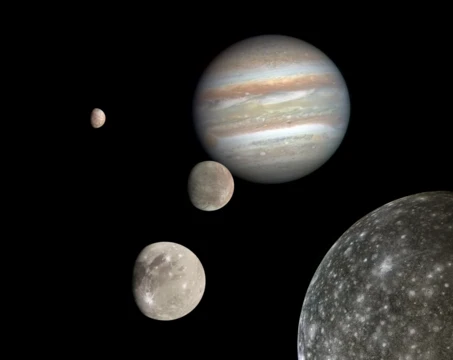
As of April 2026, the planet Jupiter hosts 115 confirmed moons, a sprawling satellite family colloquially called the Jovian system. Yet this tally is only a partial census: it excludes meter-sized moonlets shed from the inner satellites and hundreds of possible kilometer-scale outer bodies glimpsed only briefly through telescopes. Within this vast retinue, the four Galilean moons—Io, Europa, Ganymede, and Callisto—command absolute dominance in mass. The remaining 111 moons, together with Jupiter's ring system, account for a mere 0.003 percent of the total orbiting mass. Dia belongs to this long tail of smaller companions. Beginning in 1892, astronomers have identified dozens of these far smaller Jovian moons, and tradition dictates they receive names drawn from the lovers, sexual partners, or daughters of the Roman god Jupiter or his Greek counterpart Zeus. Dia thus occupies a modest but recognized place in a system where the giants eclipse everything else by orders of magnitude, and where the true population of orbiting bodies likely remains far larger than current counts suggest.
Orbital Architecture and Classification
Jupiter's satellite system divides into two broad architectural categories. Eight regular satellites trace prograde, nearly circular paths that stay close to Jupiter's equatorial plane. The Galilean members of this group are nearly spherical, massive enough that they would qualify as planets if they orbited the Sun directly. The four inner regular moons are considerably smaller and hug Jupiter more tightly, serving as the dust sources that feed the planet's rings. Dia, by contrast, belongs to the outer irregular satellite population. These bodies travel on orbits far more distant from Jupiter, often highly inclined and eccentric, and many move in retrograde fashion—revolving opposite to the planet's spin. In terms of size, every non-Galilean Jovian moon measures under 250 kilometres in diameter, and most barely exceed 5 kilometres. Of the 107 known irregular moons, 58 still await official naming. Jupiter is expected to harbour roughly 100 irregular moons larger than 1 kilometre in diameter, plus around 500 smaller retrograde bodies down to 0.8 kilometres, meaning Dia's true siblings in the outer system are numerous and still being discovered.
Origins in Captured Debris
The outer irregular moons of Jupiter, the class to which Dia belongs, are believed to have originated as asteroids on independent solar orbits. Jupiter's gravitational reach, aided by a still-massive proto-lunar disk, absorbed enough orbital momentum to pull these wanderers into satellite status. Many were shattered during the violent capture process or by subsequent collisions with other small bodies, producing the kilometer-sized fragments we observe today as collisional families sharing similar orbital parameters. The Ananke and Carme groups, for instance, likely arose from impacts by passing planetesimals roughly 0.53 and 0.59 kilometres across—sizes that were extremely common in the early Solar System. These strikes created large craters but left the parent bodies largely intact, with the largest fragments retaining 96 and 99 percent of the original mass. The Himalia group presents a different story: its parent body split into proportionally more massive pieces, the largest holding only 78 percent of the original mass, requiring a far more energetic impact from a body around 13 kilometres in diameter. Such large planetesimals were probably too rare, pointing instead to a moon-moon collision as the likely origin.
A System in Motion
Jupiter's satellite system is not a static arrangement but one shaped by billions of years of gravitational interplay. The regular satellites are thought to have formed from a circumplanetary disk of gas and solid debris. Simulations suggest that while the disk held a relatively high mass at any given moment, over time a substantial fraction of the material Jupiter captured from the solar nebula passed through it. Yet only 2 percent of the proto-disk mass is needed to account for the existing satellites, implying that several generations of Galilean-mass moons may have formed and been lost to drag-induced inward spiraling before the present generation took shape. By the time what may be the fifth generation formed, the disk had thinned enough to stop disrupting the moons' orbits. The current Galileans settled into a 1:2:4 orbital resonance among Io, Europa, and Ganymede, still active today. Tidal dissipation continues throughout the system, and Callisto is expected to join this resonance in about 1.5 billion years, extending the chain to 1:2:4:8. For a small moon like Dia, orbiting far from this resonant core, the gravitational landscape is quieter, yet the Jovian system's broader architecture continues to evolve around it.
More in Moons of Jupiter 1-24
Spotted an error? Know more?
Reader corrections go straight into our review queue. Suggest an edit · How this site is sourced