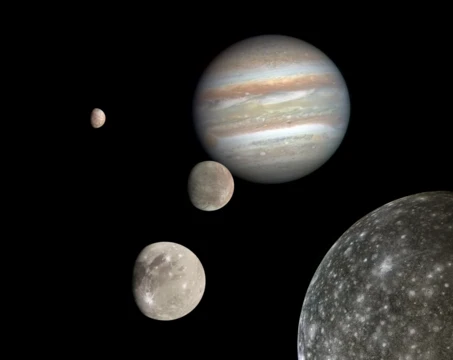
Pandia (moon)
Small prograde irregular moon of Jupiter in the Himalia group.

Pandia, also known as Jupiter LXV, is a small outer moon of Jupiter. It was discovered by Scott S. Sheppard using the 4.0-meter Víctor M. Blanco Telescope at Cerro Tololo Observatory in Chile, with the discovery announced on 17 July 2018. The moon was initially given the provisional designation S/2017 J 4 by the Minor Planet Center after enough observations had been gathered to confirm its orbit. Precovery images of Pandia have been found dating back to 2003. This moon belongs to the Himalia group, a cluster of prograde irregular satellites that travel in similar orbits to Himalia, with semi-major axes between 11 and 12 million kilometers and inclinations ranging from 26 to 31 degrees. With an estimated diameter of about 3 kilometers and an absolute magnitude of 16.2, Pandia is one of the smallest known members of this group. The moon was named in 2019 after Pandia, the Greek goddess of the full moon and daughter of Zeus and Selene. The name was one of the most popular suggestions in a Twitter naming contest held by the Carnegie Institute, with the winning submission coming from the astronomy club of Lanivet School in Cornwall, United Kingdom, submitted on their behalf by user "@emmabray182". The school chose the name because its mascot is a panda, and the local village once supplied bamboo for a panda at London Zoo. As a member of the prograde Himalia group, its name ends in the letter "a". Pandia orbits Jupiter at an average semi-major axis of about 11,481,000 kilometers, with an inclination of roughly 29.0 degrees relative to the ecliptic. Like all of Jupiter's irregular moons, it orbits far enough from the planet that its path is strongly affected by gravitational pulls from the Sun and other planets, making its orbit highly variable over time.
Quick Facts
- Pronounced
- p · æ · n · ˈ · d · aɪ · ə
- Named After
- Πανδία Pandīa
- Discoverer
- Scott S. Sheppard
- Discovery Site
- Cerro Tololo Obs.
- Discovered
- 23 March 2017
- Mpc Name
- Jupiter LXV
- Epoch
- 1 January 2000 (JD 2451545.0)
- Observation Arc
- 2017 · 2024 / 2024-12-03 (last obs)
- P Semimajor
- 11481000 km
- P Eccentricity
- 0.179 / <!--
- P Period
- +251.911064 d-->
- P Mean Motion
- 521.969928
Facts from the source article.
Lore & Background
Pandia was discovered by Scott S. Sheppard and his team on 23 March 2017, but not announced until 17 July 2018 via a Minor Planet Electronic Circular from the Minor Planet Center. It was announced alongside nine other Jovian moons on 17 July 2018 and provisionally designated S/2017 J 4 by the Minor Planet Center, after observations were collected over a long enough time span to confirm the satellite's orbit. The satellite has been found in precovery observations as early as 2003. Pandia is part of the Himalia group, a tight cluster of prograde irregular moons of Jupiter that follow similar orbits to Himalia at semi-major axes between 11–12 million km and inclinations between 26–31°. With an estimated diameter of 3 km for an absolute magnitude of 16.2, it is one of the smallest known members of the Himalia group. On average, Pandia orbits Jupiter at a semi-major axis of about 11,481,000 km at an inclination of about 29.0° with respect to the ecliptic. Like all of Jupiter's irregular moons, Pandia orbits far enough away that it is highly subject to gravitational perturbations by the Sun and other planets, which makes its orbit highly variable over time.
Reader's Guide
Pandia's significance lies in its membership in the Himalia group, a tight cluster of prograde irregular moons of Jupiter that follow similar orbits to Himalia. As one of the smallest known members of this group, with an estimated diameter of 3 km, it contributes to understanding the population and dynamics of irregular satellites. Its discovery by Scott S. Sheppard using the 4.0-meter Víctor M. Blanco Telescope at Cerro Tololo Observatory, Chile, and its announcement alongside nine other Jovian moons on 17 July 2018, highlight ongoing efforts to catalog Jupiter's outer moons. The moon's naming in 2019 after Pandia, the Greek goddess of the full moon, was the result of a public naming contest on Twitter, with the winning submission from the astronomy club of Lanivet School in Cornwall, United Kingdom, who chose the name because their school's mascot is a panda and their local village supplied bamboo for a panda at London Zoo. This reflects a unique blend of astronomical tradition and community engagement. Pandia's orbit, with a semi-major axis of about 11,481,000 km and inclination of about 29.0°, is highly variable due to gravitational perturbations by the Sun and other planets, a characteristic shared by all of Jupiter's irregular moons. Precovery observations as early as 2003 demonstrate the value of archival data in confirming such distant satellites.
More in Moons of Jupiter 1-24
Spotted an error? Know more?
Reader corrections go straight into our review queue. Suggest an edit · How this site is sourced