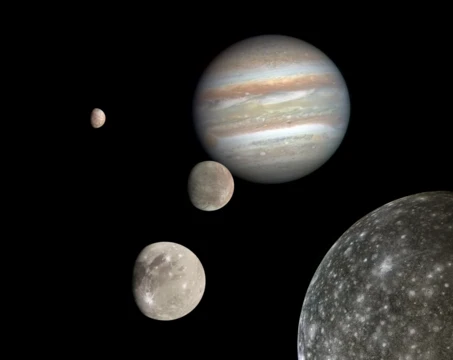
Lysithea (moon)
One of the larger irregular satellites of Jupiter.

Lysithea (designated Jupiter X) is a relatively large irregular moon of Jupiter. American astronomer Seth Barnes Nicholson discovered it in 1938 using the Mount Wilson Observatory. The moon takes its name from Lysithea, a daughter of Oceanus and a lover of Zeus in Greek mythology. Before receiving this name in 1975, it was known simply as Jupiter X, and from 1955 to 1975 it was sometimes called Demeter.
The moon travels around Jupiter at an average distance of about 11,700,710 km, completing one orbit in roughly 258.57 days. Its orbit is prograde, tilted about 27° to the ecliptic, and has an eccentricity of 0.148. Solar and planetary gravitational pulls constantly alter this path. Lysithea is a member of the Himalia group, a collection of prograde moons whose orbits lie between 11 and 13 million km from Jupiter, with inclinations of 27–30° and eccentricities of 0.11–0.24.
Physically, Lysithea has an estimated diameter of around 42 km and a low albedo of about 3.6%, making it the fifth largest irregular Jovian moon. Like other Himalia group members, its surface appears gray, with color indices (B−V=0.72, V−R=0.36, V−I=0.74) that place it between C-type and P-type asteroids. Its rotation period was measured at roughly 12 hours and 45.6 minutes, though a later study considered this uncertain due to limited observation time.
Lysithea likely did not form near Jupiter but was later captured by the planet’s gravity. Along with the other Himalia group moons, which share similar orbits, it is probably a fragment of a larger captured asteroid that broke apart.
Quick Facts
- Pronounced
- l · aɪ · ˈ · s · ɪ · θ · i · əCf. also 'Lysithous' in Noah Webster (1884) A Practical Dictionary of the English Language
- Adjective
- Lysithean l · aɪ · ˈ · s · ɪ · θ · i · ə · n
- Named After
- Λυσιθέα Lysithea
- Mpc Name
- Jupiter X
- Discoverer
- Seth B. Nicholson
- Discovery Site
- Mt. Wilson Observatory
- Discovered
- 6 July 1938
- Satellite Of
- Jupiter
- Group
- Himalia group
- Epoch
- 27 April 2019 (JD 2458600.5)
- Observation Arc
- 79.87 yr (29,171 days)
- Semimajor
- 0.0782144 AU
Facts from the source article.
Lore & Background
Lysithea was discovered by Seth Barnes Nicholson in 1938 at Mount Wilson Observatory. It did not receive its present name until 1975; before then, it was simply known as Jupiter X. It was sometimes called 'Demeter' from 1955 to 1975. The moon is named after the mythological Lysithea, daughter of Oceanus and one of Zeus' lovers.
Lysithea orbits Jupiter at an average distance of 11,700,710 km in 258.57 days, at an inclination of about 27° to the ecliptic, in a prograde direction and with an eccentricity of 0.148. Its orbit is continuously changing due to solar and planetary perturbations. It belongs to the Himalia group, a prograde group of moons orbiting between 11 and 13 Gm from Jupiter at inclinations between 27 and 30°, and eccentricities between 0.11 and 0.24.
Physically, Lysithea has a diameter of about 42 kilometers, with a measured albedo of about 3.6%, making it the fifth largest irregular moon of Jupiter. Like the other members of the Himalia group, the satellite appears gray (B−V=0.72, V−R=0.36, V−I=0.74) and intermediate between C-type and P-type asteroids. Its rotation period was found to be approximately 12 hours and 45.6 min, but this was regarded by a later paper as uncertain due to the short observation periods.
Reader's Guide
Lysithea is notable as one of the larger irregular satellites of Jupiter, discovered by Seth Barnes Nicholson in 1938. Its naming history reflects a period of informal designation: it was known simply as Jupiter X until 1975, and was sometimes called 'Demeter' from 1955 to 1975. The moon's orbit places it in the Himalia group, a prograde cluster of moons with similar orbital parameters, suggesting a common origin. The article indicates that Lysithea probably did not form near Jupiter but was captured later, and like other members of the Himalia group, it is likely the remnant of a broken, captured heliocentric asteroid. Its physical characteristics, such as a diameter of about 42 km and a low albedo of about 3.6%, classify it as intermediate between C-type and P-type asteroids. The rotation period of approximately 12 hours and 45.6 min is noted as uncertain due to short observation periods, highlighting the challenges in studying such distant objects. Lysithea's significance lies in its role as a member of a captured group, providing clues about the early solar system and the processes of satellite capture and fragmentation.
More in Moons of Jupiter 1-24
Spotted an error? Know more?
Reader corrections go straight into our review queue. Suggest an edit · How this site is sourced