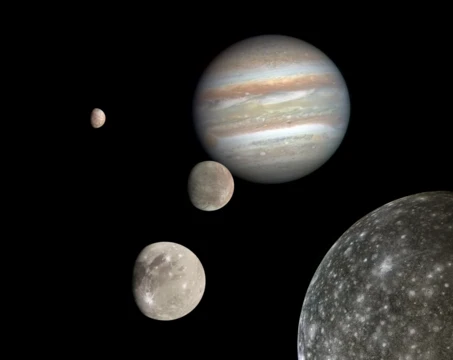
Kore (moon)
A distant retrograde irregular moon of Jupiter.

Kore, designated Jupiter XLIX and originally known as S/2003 J 14, is a tiny moon of Jupiter. It ranks among the planet’s most far-flung irregular satellites, circling Jupiter at an average distance of 24.2 million kilometers (15.0 million miles). The moon was spotted on 8 February 2003 by Scott S. Sheppard, David C. Jewitt, and Jan T. Kleyna, as part of a survey that turned up more than twenty other Jovian moons. Their search, conducted with the 3.6-meter Canada–France–Hawaii Telescope at Mauna Kea Observatory, used sensitive digital cameras to routinely image the sky near Jupiter. A separate team led by Brett J. Gladman independently detected Kore on 27 February 2003. The Minor Planet Center announced the discovery on 3 April 2003 after Brian G. Marsden determined its orbit. Kore was one of 21 Jovian moons announced that year, bringing Jupiter’s known moon count to 61.
Upon discovery, it received the provisional designation S/2003 J 14. The International Astronomical Union’s Working Group for Planetary System Nomenclature officially named it Kore on 5 April 2007, with the Roman numeral Jupiter XLIX. The name is an alternative for the Greek goddess Persephone, daughter of Zeus and Demeter. Following IAU convention for Jovian moons, which are named after mythological lovers and descendants of Zeus, and because Kore has a retrograde orbit, its name ends with the letter “e.”
Kore’s orbit is retrograde—it moves opposite to Jupiter’s rotation—and is highly inclined and elliptical. It orbits at an average distance of 24.2 million km (0.162 AU), far beyond the Galilean moons. Like all irregular Jovian moons, it orbits far enough out that the Sun and other giant planets gravitationally perturb it, causing frequent orbital changes. For this reason, proper orbital elements are often used to describe its average path. On average, Kore takes about 769 days (2.11 years) to complete one orbit, with an eccentricity of 0.338 and an inclination of 141.7° relative to the ecliptic. Simulations over 1,000 years show its semi-major axis varies from 22.9 to 26.0 million km, its eccentricity from 0.061 to 0.693, and its inclination from 132.5° to 151.4°. Its orbit also undergoes nodal precession every 85.6 years and apsidal precession every 71.7 years. On 23 November 2038, Kore will reach 0.2576 AU (38.54 million km) from Jupiter.
Quick Facts
- Discovered
- 8 February 2003
- Discoverer
- Scott S. Sheppard · David C. Jewitt · Jan T. Kleyna
- Discovery Site
- Mauna Kea Obs.
- Mpc Name
- Jupiter XLIX (49)
- Pronounced
- ˈ · k · ɔər · iː
- Named After
- Κόρη Korē
- Observation Arc
- 2003 · 2025 / 2025-01-07 (last obs)
- P Semimajor Unitless
- 24203300 km
- P Eccentricity
- 0.338
- P Inclination
- 141.7° (to ecliptic)
- P Period Unitless
- 769.42 d
- Perihelion Rate
- 18075.3138
Facts from the source article.
Lore & Background
Kore was discovered on 8 February 2003 by Scott S. Sheppard, David C. Jewitt, and Jan T. Kleyna during a search for distant moons of Jupiter at Mauna Kea Observatory in Hawaii, using the 3.6-meter Canada–France–Hawaii Telescope. The discovery was announced by the Minor Planet Center on 3 April 2003 after its orbit was determined by Brian G. Marsden. It was one of 21 Jovian moons announced in 2003. The moon was officially named 'Kore' with the Roman numeral designation Jupiter XLIX by the IAU on 5 April 2007, following the convention of naming retrograde moons with names ending in 'e'.
Kore orbits Jupiter at an average distance of 24.2 million km in a retrograde direction, with an orbital period of about 769 days. Its orbit is highly elliptical (eccentricity 0.338) and inclined 141.7° to the ecliptic. Due to its immense distance, the orbit is strongly perturbed by the Sun and other giant planets, causing frequent changes; over a 1,000-year timescale, its semi-major axis varies from 22.9 to 26.0 million km, eccentricity from 0.061 to 0.693, and inclination from 132.5° to 151.4°. Kore shares similar orbital properties with the larger irregular moon Pasiphae, making it a member of the Pasiphae group, whose moons are believed to be fragments of an asteroid captured and destroyed by collision billions of years ago.
Little is known about Kore's physical characteristics. It is very faint with an average apparent magnitude of 23.6, and NASA estimates a diameter of 2 km assuming a low albedo of 0.04. It is likely irregularly shaped, as it is too small for its gravity to pull itself into a sphere.
Reader's Guide
Kore is significant as one of the most distant irregular moons of Jupiter, discovered during a prolific 2003 survey that raised Jupiter's known moon count to 61. Its membership in the Pasiphae group provides evidence for the theory that these moons are remnants of a captured asteroid shattered by a collision billions of years ago. The moon's orbit is strongly perturbed by the Sun and other giant planets, causing frequent changes in its orbital elements over timescales of centuries, illustrating the dynamical complexity of the outer Jovian system. Kore's naming follows the IAU convention for retrograde Jovian moons, taking the name of a mythological descendant of Zeus (Persephone, also called Kore). Its small size (2 km diameter) and faint magnitude (23.6) mean it can only be observed with large, sensitive telescopes, and its physical properties remain largely unknown. The moon's orbit will reach a maximum distance of 0.2576 AU from Jupiter on 23 November 2038.
More in Moons of Jupiter 1-24
Spotted an error? Know more?
Reader corrections go straight into our review queue. Suggest an edit · How this site is sourced