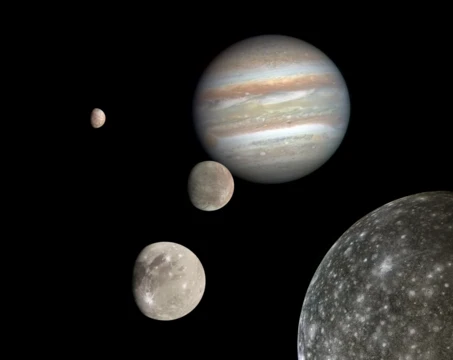
Himalia (moon)
Largest irregular satellite of Jupiter, discovered in 1904.

Himalia, designated Jupiter VI, holds the title of Jupiter’s largest irregular satellite. Measuring roughly 140 kilometers across, it ranks as the sixth-largest moon orbiting the planet, trailing only the four Galilean moons and Amalthea. This moon anchors the Himalia group, a collection of prograde satellites that likely formed from a single captured asteroid that later shattered.
Charles Dillon Perrine spotted Himalia on December 3, 1904, using the 36-inch Crossley reflecting telescope at Lick Observatory, which he had recently refurbished. The moon’s name comes from the nymph Himalia, who, in Greek mythology, bore three sons to Zeus (the Roman Jupiter). For decades after its discovery, it was simply called Jupiter VI or Jupiter Satellite VI. The name “Himalia” wasn’t officially adopted until 1975. Between 1955 and 1975, it was sometimes referred to as Hestia, after the Greek goddess. Astronomer A.C.D. Crommelin had argued as early as 1905 that numerals for Jupiter’s moons were becoming as confusing as those once used for Saturn’s, and that names were a more poetic and practical alternative.
Himalia orbits Jupiter at an average distance of 11,388,690 kilometers, completing one lap every 248.29 days. Its path is prograde, tilted about 30° to the ecliptic, with an eccentricity of 0.154. Solar and planetary gravity constantly tweak this orbit. The moon gives its name to the Himalia group, whose members orbit between 11 and 13 million kilometers from Jupiter, with inclinations of 27° to 30° and eccentricities from 0.11 to 0.24. These moons are thought to be fragments of a single parent body broken apart by a collision, making them a collisional family.
Because Himalia is relatively large, it has a decent chance of smashing into other moons over the Solar System’s history. Any impactor would likely be much smaller and would be obliterated. This process may explain why no retrograde Jovian moons exist with semi-major axes between 0.05 and 0.11 AU (7.5 to 16.5 million kilometers). Surviving retrograde moons only appear farther out, beyond 0.13 AU (19 million kilometers). The wide gap between prograde and retrograde groups could be the result of collisions wiping out any moons that once occupied that zone. Dust kicked up by such impacts spreads across the Jovian system, with much of it settling on the Galilean moons.
Quick Facts
- Pronounced
- h · ɪ · ˈ · m · eɪ · l · i · ə or h · ɪ · ˈ · m · ɑː · l · i · ə
- Adjectives
- Himalian
- Named After
- Ἱμαλία Himalia
- Mpc Name
- Jupiter VI
- Discoverer
- Charles D. Perrine
- Discovery Site
- Lick Observatory
- Discovered
- 3 December 1904
- Satellite Of
- Jupiter
- Group
- Himalia group
- Epoch
- 27 April 2019 (JD 2458600.5)
- Observation Arc
- 114.25 yr (41,728 days)
- Semimajor
- 0.0761287 AU
Facts from the source article.
Lore & Background
Himalia was discovered by Charles Dillon Perrine at the Lick Observatory on 3 December 1904 in photographs taken with the 36-inch Crossley reflecting telescope. The moon is named after the nymph Himalia, who bore three sons of Zeus. It did not receive its present name until 1975; before then it was known as Jupiter VI or Jupiter Satellite VI. From 1955 to 1975 it was sometimes called Hestia.
Himalia orbits Jupiter at an average distance of 11,388,690 km in 248.29 days, with an inclination of about 30° to the ecliptic, in a prograde direction and with an eccentricity of 0.154. Its orbit is continuously changing due to solar and planetary perturbations. It gives its name to the Himalia group, a prograde group of moons likely fragments of a previous body shattered in a collision. Due to its large size, Himalia has a significant probability of impacting other moons, and such collisions may explain the lack of retrograde moons at certain distances.
Resolved images by Cassini gave a size estimate of 150 km × 120 km, while a 2018 occultation gave 205.6 km × 141.3 km. Himalia appears neutral in color, similar to a C-type asteroid, with a featureless spectrum and a slight absorption at 3 μm possibly indicating water. Its mass is estimated between (1.9–4.2)×10^18 kg. It likely did not form near Jupiter but was captured later, possibly from the Nysa–Polana complex or Hilda group. In 2025, James Webb Space Telescope observations detected phyllosilicates, suggesting past aqueous alteration and similarity to Ceres.
Reader's Guide
Himalia is notable as the largest irregular satellite of Jupiter and the sixth largest Jovian moon overall. Its discovery in 1904 by Charles Dillon Perrine at Lick Observatory added to the growing catalog of Jupiter's moons beyond the Galilean four. The moon's naming history reflects the shift from numerical designations to mythological names, a change advocated by astronomers like A.C.D. Crommelin. As the largest member of the Himalia group, it is central to understanding the collisional history of Jupiter's irregular satellites. The group is likely a collisional family from a captured asteroid, and Himalia's large size makes it a key player in potential impacts that may have shaped the orbital distribution of Jovian moons. Observations by Cassini and New Horizons provided the first resolved images, and the 2018 occultation gave precise size measurements. The detection of phyllosilicates by the James Webb Space Telescope in 2025 suggests aqueous alteration, linking Himalia to asteroid belt sources rather than the Kuiper belt, challenging typical models for irregular satellite origins. The Himalia ring, photographed by New Horizons in 2006, was initially thought to be debris from an impact but was later disproven when the moon Dia was recovered.
Did You Know?
- It is the largest member of the Himalia group, a prograde group of moons likely originating from a captured asteroid.
- In 2025, James Webb Space Telescope observations detected phyllosilicates on Himalia, suggesting past aqueous alteration.
- Himalia's rotational period is 7 hours 46 minutes 55 seconds.
More in Moons of Jupiter 1-24
Spotted an error? Know more?
Reader corrections go straight into our review queue. Suggest an edit · How this site is sourced