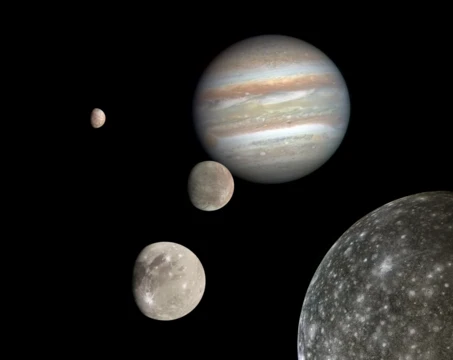
Ganymede (moon)
Largest moon in the Solar System, with its own magnetic field.

Ganymede is a natural satellite of Jupiter and is the largest and most massive moon in the Solar System. It is larger than the planet Mercury, though it has somewhat less surface gravity due to its lower density. Ganymede is the only natural satellite known to possess an internally generated magnetic field, and its internal ocean potentially contains more water than all of Earth's oceans combined.
Quick Facts
- Pronounced
- ˈ · ɡ · æ · n · ᵻ · m · iː · d / GAN · im · eed
- Adjectives
- Ganymedian, / Ganymedean (ˌ · ɡ · æ · n · ə · ˈ · m · iː · d · i · . · ən)
- Named After
- grc · Γανυμήδης, grc · Ganymēdēs
- Discoverer
- Galileo Galilei / Simon Marius
- Discovered
- January 7, 1610
- Eccentricity
- 0.0013
- Inclination
- 2.214° (to the ecliptic) / 0.20° (to Jupiter's equator)
- Satellite Of
- Jupiter
Facts from the source article.
Lore & Background
Ganymede was discovered in 1610 by Simon Marius and Galileo Galilei, who both observed it as the third of the Galilean moons. Marius named it after Ganymede, a Trojan prince desired by Zeus, who carried him off to serve as cupbearer to the gods. Chinese astronomical records from 365 BC report that Gan De observed a small reddish star beside Jupiter, which might have been Ganymede, though the color is puzzling as Ganymede is too faint for its color to be perceived with the naked eye.
Ganymede orbits Jupiter in roughly seven days and is in a 1:2:4 orbital resonance with Europa and Io. It is a fully differentiated body with an iron-rich, liquid metallic core, giving it the lowest moment of inertia factor of any solid body in the Solar System. Its surface has two main terrain types: lighter regions crosscut by grooves and ridges dating from slightly less than 4 billion years ago, and darker regions saturated with impact craters dated to 4 billion years ago. The cause of the light terrain's disrupted geology may be tectonic activity due to tidal heating.
Ganymede has a thin oxygen atmosphere that includes O, O2, and possibly O3, with atomic hydrogen as a minor constituent. Whether it has an ionosphere is unresolved. The Voyager probes refined measurements of its size, while the Galileo spacecraft discovered its underground ocean and magnetic field. The next planned mission is the European Space Agency's Jupiter Icy Moons Explorer (Juice), launched in 2023, which is planned to enter orbit around Ganymede after flybys of all three icy Galilean moons.
Reader's Guide
Ganymede's significance lies in being the largest moon in the Solar System and the only natural satellite with an internally generated magnetic field, likely created by convection within its liquid metallic core and influenced by Jupiter's magnetic field. Its internal ocean may contain more water than all of Earth's oceans combined, making it a key target for astrobiological study. The moon's orbital resonance with Europa and Io—a 1:2:4 pattern known as the Laplace resonance—is a complex dynamical system that has shaped its tidal heating history and surface geology. The grooved terrain covering two-thirds of its surface may result from past tidal heating episodes when its orbital eccentricity was higher. Discovered in 1610 by Galileo and Marius, Ganymede was the first group of objects found orbiting another planet, revolutionizing understanding of the Solar System. Its naming after a mythological figure loved by Zeus reflects a tradition that ultimately became standard for Jupiter's moons. The upcoming Juice mission, after flybys of the icy Galilean moons, will enter orbit around Ganymede, promising further insights into its interior, ocean, and magnetic field.
Did You Know?
- Ganymede is larger than the planet Mercury but has less surface gravity due to its lower density.
- It is the only natural satellite in the Solar System with an internally generated magnetic field.
More in Moons of Jupiter 1-24
Spotted an error? Know more?
Reader corrections go straight into our review queue. Suggest an edit · How this site is sourced