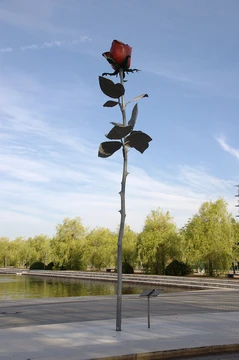
Yves Klein
French artist and leading member of Nouveau réalisme, pioneer of performance art.

Yves Klein, born in Nice in 1928, was a French artist central to postwar European art. He belonged to Nouveau réalisme, a movement launched in 1960 by critic Pierre Restany. Klein helped pioneer performance art and influenced minimal art and pop art. He created International Klein Blue, a signature color.
His parents, both painters, exposed him to various styles but gave him no formal art training. From 1942 to 1946, he studied at maritime and language schools, befriending Arman and Claude Pascal. At nineteen, on a beach, the three divided the world: Arman took the earth, Pascal words, and Klein the space around the planet, which he signed. This gesture foreshadowed his artistic quest. In 1948, he encountered Rosicrucian ideas through Max Heindel’s text.
Klein began judo while studying languages. Between 1948 and 1952, he traveled to Italy, Britain, Spain, and Japan. In 1953, at twenty-five, he earned a fourth-degree black belt from the Kodokan in Japan, the first European to do so. He later led the Spanish judo team and wrote a book on judo in 1954. That year, he settled in Paris to pursue art.
Between 1947 and 1948, he conceived the Monotone Symphony: a single D major chord held for twenty minutes, followed by twenty minutes of silence. This piece foreshadowed his monochrome paintings and influenced minimal musicians. First performed in 1960 in a Paris gallery with ten musicians, Klein described its sound as screams. During the performance, three naked women, whom he called “living brushes,” covered themselves in blue paint and pressed their bodies onto paper during the sound, freezing during the silence.
Klein painted monochromes from 1949 and privately exhibited them in 1950. His first public showing was the 1954 book *Yves Peintures*, parodying a catalogue raisonné with intense monochromes tied to cities he had lived in. Two exhibitions of oil paintings followed in 1955 and 1956, featuring orange, yellow, red, pink, and blue monochromes. Audiences treated them as decorative mosaics, disappointing Klein. He realized viewers saw his work as abstract interior decoration, so he decided to focus on a single primary color: blue.
In January 1957, at Milan’s Gallery Apollinaire, he exhibited eleven identical blue canvases. The color used ultramarine pigment suspended in a synthetic resin called “The Medium,” developed with paint dealer Edouard Adam. This resin kept the pigment brilliant, unlike linseed oil. Klein filed a Soleau envelope for the recipe to protect the “authenticity of the pure idea.” The blue, reminiscent of lapis lazuli in medieval Madonna paintings, became International Klein Blue. The canvases were mounted 20 centimeters from the walls to create spatial ambiguity. Each was priced differently; buyers chose the canvas they found best, believing each held a unique quality others might miss.
- born
- 28 April 1928
- died
- 6 June 1962
- nationality
- French
- known_for
- International Klein Blue, performance art, monochrome painting
Verified Timeline
Lore & Background
Klein was born in Nice on 28 April 1928. His parents, Fred Klein and Marie Raymond, were both painters—his father painted in a loose post-impressionist style, while his mother was a leading figure in Art informel. Klein received no formal training in art. From 1942 to 1946, he studied at the École Nationale de la Marine Marchande and the École Nationale des Langues Orientales. At nineteen, he and his friends Arman and Claude Pascal lay on a beach in the south of France and divided the world: Arman chose the earth, Pascal words, and Klein the ethereal space surrounding the planet, which he signed. In early 1948, Klein read Max Heindel's 1909 text The Rosicrucian Cosmo-Conception and pursued membership with an American Rosicrucian society. While at language school, Klein began practicing judo. He traveled to Japan in 1953 and at age 25 became a master at judo, receiving the rank of yondan (4th dan black belt) from the Kodokan—the first European to do so. Later that year he became technical director of the Spanish judo team. In 1954 he wrote a book on judo called Les Fondements du judo and settled permanently in Paris. Between 1947 and 1948, Klein conceived his Monotone Symphony (1949, formally Monotone Silence Symphony): a single 20-minute sustained D major chord followed by 20 minutes of silence. The first performance was in a Paris art gallery in 1960 with only ten musicians; Klein invited three naked women as 'living brushes' who covered themselves in blue paint and pressed their bodies on paper during the sound half, freezing during the silence. Klein's first public monochrome showing was the book Yves Peintures in November 1954. After disappointing public responses to his early monochrome shows, he concentrated on one single primary color: blue. In January 1957 at the Gallery Apollinaire, Milan, he exhibited 11 identical blue canvases using ultramarine pigment suspended in a synthetic resin 'Rhodopas', later known as International Klein Blue (IKB). For his April 1958 exhibition at Iris Clert Gallery, he showed nothing—called La spécialisation de la sensibilité à l'état matière première en sensibilité picturale stabilisée, Le Vide—removing everything, painting surfaces white, and staging an elaborate entrance. 3,000 people queued up. Later he decorated the Gelsenkirchen Opera House with vast blue murals, the largest 20 metres by 7 metres.
Reader's Guide
Klein's significance comes from his radical approach to art as pure sensibility. After early monochrome shows were misunderstood as decoration, he focused exclusively on blue, creating International Klein Blue (IKB) using ultramarine pigment in synthetic resin 'Rhodopas' to retain brilliance. His 1957 Milan exhibition featured 11 identical blue canvases priced differently, each buyer seeing something unique. His 1958 'The Void' exhibition at Iris Clert Gallery—an empty white room with elaborate entrance procedures including republican guards and blue cocktails—drew 3,000 visitors. He created Anthropometry works using naked female models as 'living brushes' covered in blue paint. His Monotone Symphony (1949) of a 20-minute D major chord followed by 20 minutes of silence was first performed in 1960 with ten musicians and three models. Klein's judo training in Japan (earning 4th dan black belt in 1953, first European to do so) and interest in Rosicrucianism and Zen Buddhism informed his use of ritual to reach abstraction. His work influenced minimal art, pop art, and performance art. He died on 6 June 1962.
Did You Know?
- Klein became the first European to earn a 4th dan black belt in judo from the Kodokan, at age 25 in 1953.
- His Monotone Symphony (1949) consists of a single 20-minute sustained D major chord followed by 20 minutes of silence.
- For his 1958 exhibition 'The Void', Klein emptied the gallery, painted everything white, and 3,000 people queued to enter.
- Klein used naked female models as 'living brushes'—covering them in blue paint and pressing them onto canvases—calling these works Anthropometry.
- He deposited a Soleau envelope for the recipe of International Klein Blue to maintain 'the authenticity of the pure idea.'
More in Modern & Contemporary Artists 1-24
Spotted an error? Know more?
This is a living reference — every entry is fact-audited, and reader corrections feed straight into our audit queue. Suggest an edit · See this site's audit record