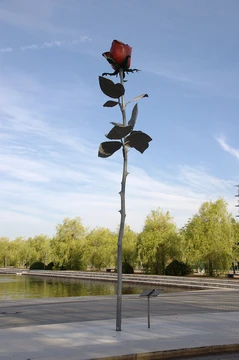
Eva Hesse
German-born American sculptor who pioneered postminimal art.

Ansgar Walk · CC BY-SA 2.0 de
Eva Hesse was a German-born American sculptor who helped launch the postminimal art movement in the 1960s. She is remembered for her groundbreaking use of materials like latex, fiberglass, and plastics.
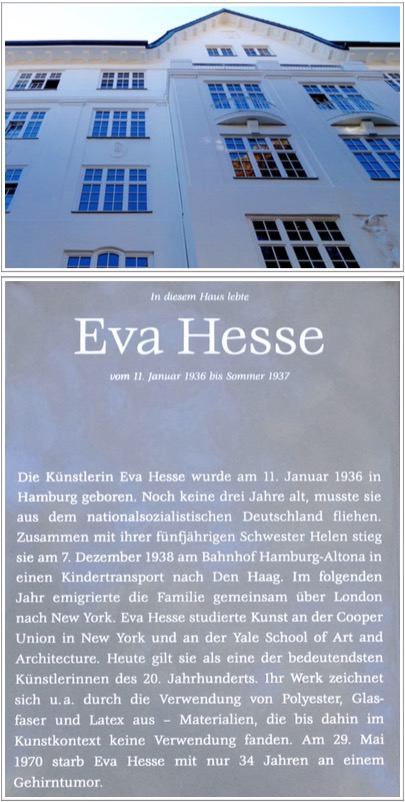
Hesse was born on January 11, 1936, in Hamburg, Germany, to a Jewish family. Her father was a lawyer named Wilhelm Hesse, and her mother was Ruth Marcus Hesse. She had an older sister, Helen. In December 1938, when Hesse was two, her parents sent both daughters to the Netherlands on one of the last Kindertransport trains to escape Nazi Germany. After nearly six months apart, the family reunited and moved to England, then emigrated to New York City in 1939, settling in Manhattan’s Washington Heights. Her parents separated in 1944; her father remarried in 1945, and her mother died by suicide in 1946. In 1961, Hesse married sculptor Tom Doyle; they divorced in 1966. In October 1969, she was diagnosed with a brain tumor. After three failed operations over the following year, she died on May 29, 1970, at age 34. Though her career lasted only a decade, it became highly influential.
Hesse graduated from New York’s School of Industrial Art at 16. In 1952, she enrolled at the Pratt Institute of Design but dropped out after a year. At 18, she interned at Seventeen magazine and took classes at the Art Students League. From 1954 to 1957, she studied at Cooper Union, and in 1959 she earned a BA from Yale University, where she studied under Josef Albers and was deeply influenced by Abstract Expressionism. After Yale, she returned to New York and became friends with minimalist artists such as Sol LeWitt, Donald Judd, and Yayoi Kusama. Her close friendship with LeWitt lasted until her death; they exchanged letters frequently, and in 1965 LeWitt famously advised a doubting Hesse to “Stop [thinking] and just DO!” In August 1962, Hesse and Doyle participated in an Allan Kaprow Happening in Woodstock, New York, where she made her first three-dimensional piece—a costume. In 1963, she had a solo show of works on paper at the Allan Stone Gallery. In 1965, the couple moved to Germany for Doyle’s artist residency, though Hesse was unhappy about it. They lived in an abandoned textile mill in Kettwig-on-the-Ruhr near Essen for about a year. The mill’s leftover machine parts and tools inspired her mechanical drawings and paintings. There she created her first sculpture, a relief called *Ringaround Arosie*, made from cloth-covered cord, electrical wire, and masonite. This year in Germany marked a turning point: she began focusing on sculpture. Returning to New York in 1965, she started experimenting with latex, fiberglass, and plastic.
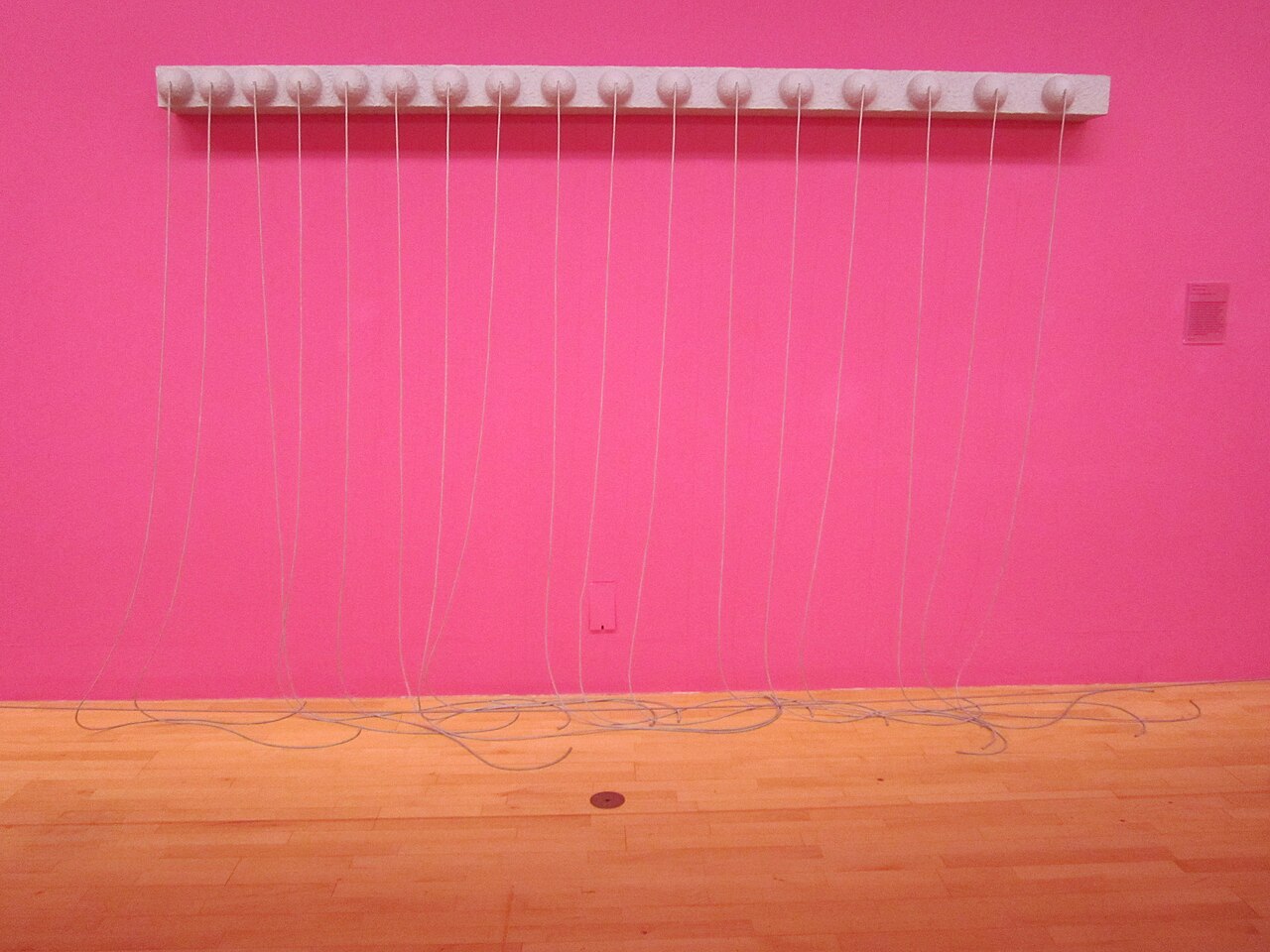
Hesse’s early work (1960–65) was mostly abstract drawings and paintings. Although she is better known for her sculptures, she considered her drawings a separate body of work, saying they were related because they were hers but did not complete one another. Her interest in latex came from its immediacy. Art critic John Keats noted that immediacy was a key reason she used it. Her first two latex works, *Schema* and *Sequel* (1967–68), used the material in unexpected ways. For *Untitled (Rope Piece)*, she brushed industrial latex in layers until it hardened, then hung it on the wall and ceiling with wire. She handled latex like house paint, building up a smooth yet irregular surface with ragged edges. Her work often grouped similar shapes in grids or clusters, blending minimalist forms and modularity with unconventional materials. *Contingent* (1968) is a prime example. Of her piece *Hang-Up*, she said it was the first time her idea of absurdity came through—a rigid, neat structure that she found both ridiculous and good.
Hesse is linked to the Postminimal art movement. Art critic Arthur Danto distinguished post-minimalism from minimalism by its “mirth and jokiness,” “unmistakable whiff of eroticism,” and “nonmechanical repetition.” Hesse worked alongside male post-minimalist artists in a mostly male-dominated field. Many feminist art historians have noted how her work successfully highlights women’s issues.
- born
- January 11, 1936, Hamburg, Germany
- died
- May 29, 1970, age 34
- field
- Sculpture, drawing, painting
- nationality
- German-born American
- known_for
- Pioneering use of latex, fiberglass, and plastics; postminimal art
Verified Timeline
Lore & Background
Eva Hesse was born into a family of observant Jews in Hamburg, Germany, on January 11, 1936. In December 1938, at age two, she and her older sister were sent to the Netherlands on one of the last Kindertransport trains. After nearly six months, the family reunited, moved to England, and then emigrated to New York City in 1939, settling in Manhattan's Washington Heights. Her parents separated in 1944; her father remarried in 1945, and her mother killed herself in 1946. Hesse married sculptor Tom Doyle in 1961; they divorced in 1966. In October 1969, she was diagnosed with a brain tumor, and she died on May 29, 1970, after three failed operations within a year.
Reader's Guide
Eva Hesse is significant for her role in the postminimal art movement, using unconventional materials like latex, fiberglass, and plastic to create sculptures that combined minimalism's modularity with eccentric, labor-intensive forms. Her work often employed repetition and simple shapes, yet conveyed absurdity, eroticism, and nonmechanical repetition. Hesse's career spanned only a decade but became highly influential. She worked in a male-dominated field and, while denying her work was strictly feminist, she acknowledged the disadvantages women faced in art, stating 'Excellence has no sex.' Her pieces, such as Contingent and Hang-Up, exemplify her approach. Preservation of her latex works remains challenging due to material aging, as seen with Sans III, which can no longer be exhibited. Her friendship with Sol LeWitt, who counseled her to 'Stop [thinking] and just DO!,' stimulated both artists' development.
Did You Know?
- At age two, Hesse and her older sister were sent to the Netherlands on one of the last Kindertransport trains in December 1938.
- Her mother killed herself in 1946, when Hesse was ten years old.
- Sol LeWitt famously counseled her in 1965 to 'Stop [thinking] and just DO!'
- Her first sculpture, Ringaround Arosie, was a relief made from cloth-covered cord, electrical wire, and masonite.
- Her latex work Sans III can no longer be exhibited because the boxes have curled in on themselves and crumbled.
A Childhood Shaped by Flight and Loss
Eva Hesse entered the world on January 11, 1936, in Hamburg, Germany, the second child of attorney Wilhelm Hesse and Ruth Marcus Hesse, a family of observant Jews. Her childhood was shattered almost immediately by the rise of Nazism. When she was barely two years old, in December 1938, her parents made the agonizing decision to send her and her older sister Helen aboard one of the final Kindertransport trains to the Netherlands, hoping to escape the regime. After nearly six months apart, the family was reunited and eventually made their way to England before emigrating to New York City in 1939, settling in Manhattan's Washington Heights neighborhood. The early years in America brought further devastation: her parents separated in 1944, her father remarried the following year, and in 1946 her mother took her own life. These compounded losses—displacement, separation, and the death of a parent before she turned ten—left an indelible mark on a young girl who would grow up to channel raw emotional intensity into her art.
A Restless Education and the Turn to Sculpture
Hesse's artistic education was restless and wide-ranging. She graduated from New York's School of Industrial Art at just sixteen, briefly attended Pratt Institute in 1952 before dropping out, interned at Seventeen magazine at eighteen, and took classes at the Art Students League. She went on to study at Cooper Union from 1954 to 1957 and earned her BA from Yale in 1959, where she studied under Josef Albers and absorbed the energy of Abstract Expressionism. Back in New York, she moved in circles with young minimalist artists including Sol LeWitt, Donald Judd, and Yayoi Kusama. LeWitt's 1965 exhortation to a doubting Hesse—'Stop [thinking] and just DO!'—encapsulated the mutual stimulation their friendship provided. A pivotal year came in 1965, when she and her then-husband Tom Doyle lived in an abandoned textile mill near Essen, Germany. The disused machinery there sparked her mechanical drawings, and she produced her first sculpture, Ringaround Arosie. Returning to New York that same year, she began experimenting with latex, fiberglass, and plastic, materials that would define her mature practice.
Latex, Repetition, and the Joy of the Ridiculous
By the mid-1960s, Hesse had shifted her primary focus from the abstract drawings and paintings of her earlier period to three-dimensional sculpture, though she insisted her drawings constituted a separate body of work rather than mere sketches for sculpture. Her breakthrough came in her relationship with industrial latex, a material she handled in ways its manufacturer never intended. In works like Schema and Sequel (1967–68) and Untitled (Rope Piece), she applied it with a brush, layer after layer, creating surfaces that felt both smooth and uneven, their edges rough and torn like the borders of handmade paper. The hardened forms were then suspended on walls and ceilings with wire. Art critic John Keats identified immediacy as a prime draw of the medium for her. Her compositions frequently organized multiple similar shapes into grids or clusters, retaining minimalism's modularity while injecting eccentricity and labor-intensive repetition. In Contingent (1968) and Hang-Up, she described capturing 'absurdity or extreme feeling,' calling the latter 'the most ridiculous structure that I ever made and that is why it is really good.'
Postminimalism, Feminist Resonance, and a Life Cut at Thirty-Four
Hesse's brief but ferocious career placed her squarely at the center of postminimalism, a movement that art critic Arthur Danto distinguished from its minimalist predecessor by its 'mirth and jokiness,' its 'unmistakable whiff of eroticism,' and its 'nonmechanical repetition.' Working and sometimes competing within a primarily male-dominated field, she nonetheless carved out a space that feminist art historians have recognized for illuminating women's experience without resorting to an overt political program. In a 1965 letter to Ethelyn Honig, she wrote candidly about the psychological toll of being a woman in art, noting that she lacked 'conviction that she has the "right" to achievement' and that 'a fantastic strength is necessary and courage.' Her life was cut brutally short: in October 1969 she was diagnosed with a brain tumor, and after three failed operations within a year, she died on May 29, 1970, at the age of thirty-four. The decade she had to make art proved more than enough to reshape the trajectory of American sculpture.
Gallery
More in Modern & Contemporary Artists 1-24
Spotted an error? Know more?
This is a living reference — every entry is fact-audited, and reader corrections feed straight into our audit queue. Suggest an edit · See this site's audit record