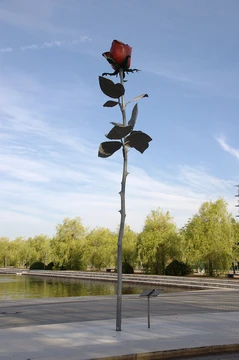
Yayoi Kusama
Japanese artist known for polka dots, infinity nets, soft sculptures, and happenings.

via Wikipedia: Yayoi Kusama · see source
Yayoi Kusama (22 March 1929 – 14 August 2026) was a Japanese artist known for sculpture, installation, painting, performance, video, fashion, poetry, and fiction. Her work draws on conceptual art and blends elements of feminism, minimalism, surrealism, art brut, pop art, and abstract expressionism, often exploring autobiographical, psychological, and sexual themes. She is considered one of Japan’s most significant artists, a top-selling female artist globally, and ranked 19th on Sotheby’s 2023 list of top artists. Her work influenced peers like Andy Warhol and Claes Oldenburg. Born in Matsumoto, Nagano, to a merchant family that ran a plant nursery, Kusama began drawing pumpkins in elementary school, inspired by hallucinations. Her mother was physically abusive and discouraged her art, while her father’s extramarital affairs—which she was sent to spy on—instilled a lifelong fear of sexuality. At age ten, she experienced vivid hallucinations of dots, flowers that spoke, and patterns that seemed to multiply and engulf her, a process she later called “self-obliteration.” She also recalled being fascinated by smooth white river stones near her home, another influence on her dot motifs. During the Pacific War, at 13, she worked in a military factory making parachutes, describing her adolescence as “closed darkness” amid air raids. She attended Arigasaki High School, then studied Nihonga painting at Kyoto Municipal School of Arts and Crafts for a year in 1948, but grew frustrated with the traditional style and turned to European and American avant-garde art. She held solo exhibitions in Matsumoto and Tokyo in the early 1950s. By 1950, she was creating abstract natural forms in watercolor, gouache, and oil on paper, and began covering surfaces—walls, floors, canvases, objects, and later naked assistants—with polka dots. Her first show was in Japan in 1952. The dots, which she called “infinity nets,” came directly from her hallucinations; the earliest known dot work was a 1939 drawing of her mother covered in spots. Her first large-scale *Infinity Nets* series, some over 30 feet long, featured nets and dots evoking hallucinatory visions. Inspired by American abstract expressionism, she moved to New York City in 1958 and joined the avant-garde scene, especially pop art. In the late 1960s, she gained public attention by staging happenings where naked participants were painted with bright polka dots, embracing the hippie counterculture. Her work was largely overlooked in the 1970s, but interest revived in the 1980s, and she continued creating art in museums worldwide from the 1950s onward. Kusama was open about her mental health and lived in a mental health facility from the 1970s until her death. She said art was her way to express her mental struggles: “I fight pain, anxiety, and fear every day, and the only method I have found that relieved my illness is to keep creating art.
- born
- 22 March 1929
- died
- 14 August 2026
- nationality
- Japanese
- known_for
- Polka dots, infinity nets, soft sculptures, happenings
Verified Timeline
Lore & Background
Yayoi Kusama was born on 22 March 1929 in Matsumoto, Nagano, into a family of merchants who owned a plant nursery and seed farm. She began drawing pictures of pumpkins in elementary school and created artwork from hallucinations. Her mother was physically abusive and unsupportive; Kusama would rush to finish her art because her mother would take it away. She remembered her father as 'the type who would play around, who would womanize a lot,' and said her mother sent her to spy on his extramarital affairs, instilling a lifelong contempt for sexuality. At age ten, she began experiencing vivid hallucinations—'flashes of light, auras, or dense fields of dots'—including flowers that spoke and patterns that multiplied and engulfed her, a process she called 'self-obliteration.' During the Pacific War, at 13, she was sent to work in a military factory making parachutes for the Imperial Japanese Army. She studied Nihonga painting at the Kyoto Municipal School of Arts and Crafts in 1948 but became frustrated with the style. In 1958, she moved to New York City and became part of the avant-garde scene, especially the pop-art movement. She created her Infinity Nets series—large canvases covered in nets and dots—and soft sculptures covering items like ladders, shoes, and chairs with white phallic protrusions. In the late 1960s, she organized happenings with naked participants painted with brightly colored polka dots. Her work was largely overlooked in the 1970s, but a revival in the 1980s brought her art back into public view. She resided in a mental health facility since the 1970s and said, 'I fight pain, anxiety, and fear every day, and the only method I have found that relieved my illness is to keep creating art.'
Reader's Guide
Yayoi Kusama's significance lies in her pioneering role in the avant-garde and pop-art movements, influencing contemporaries such as Andy Warhol and Claes Oldenburg. Her work, rooted in conceptual art and infused with autobiographical, psychological, and sexual content, also shows attributes of feminism, minimalism, surrealism, art brut, and abstract expressionism. She was ranked #19 in Sotheby's 2023 list of the top 50 artists and is acknowledged as one of the most important Japanese artists. Her use of polka dots and infinity nets, derived from her hallucinations, became her trademark and a means of expressing her mental health struggles. Despite a period of neglect in the 1970s, a revival in the 1980s cemented her legacy, and she continued creating art in museums worldwide from the 1950s onward. Her openness about her mental health and her statement that art was the only method that relieved her illness have made her a significant figure in discussions of art and mental health. In 1963, her soft sculpture couch covered with phallus-like protrusions was exhibited at the Green Gallery; Claes Oldenburg, who had not worked in soft sculpture, exhibited similar sewn pieces by September, and according to Fordham professor Midori Yamamura, Oldenburg likely was inspired by Kusama's work. A similar incident occurred when Kusama exhibited a boat covered in soft sculpture with photographs covering the walls—an innovation Andy Warhol later echoed with photos of a cow.
Did You Know?
- Kusama began drawing pumpkins in elementary school after visiting a seed-harvesting ground with her grandfather, saying she was 'enchanted by their charming and winsome form.'
- At age 10, she created her earliest recorded work incorporating polka dots: a drawing of a Japanese woman in a kimono covered and obliterated by spots.
- In 1961, she moved her studio into the same building as Donald Judd and sculptor Eva Hesse, who became a close friend.
- She was ranked #19 in Sotheby's 2023 list of the top 50 artists.
- Kusama said in 2012, 'I fight pain, anxiety, and fear every day, and the only method I have found that relieved my illness is to keep creating art.'
More in Modern & Contemporary Artists 1-24
Spotted an error? Know more?
This is a living reference — every entry is fact-audited, and reader corrections feed straight into our audit queue. Suggest an edit · See this site's audit record