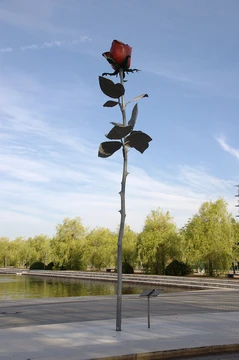
Jenny Holzer
American neo-conceptual artist known for text in public spaces.

Jenny Holzer (born July 29, 1950) is an American neo-conceptual artist who lives and works in Hoosick, New York. She is known for putting words and ideas into public spaces through large-scale installations, billboards, building projections, and electronic displays. Holzer is part of a feminist wave of artists that came to prominence around 1980. During that time, she was an active member of the artist collective Colab and took part in its landmark exhibition, The Times Square Show.
Holzer was born in Gallipolis, Ohio, and grew up in Lancaster, Ohio, where her father ran a Ford dealership. She originally wanted to be an abstract painter. She studied general art at Duke University from 1968 to 1970, then painting, printmaking, and drawing at the University of Chicago, before earning a BFA from Ohio University in 1972. After summer courses at the Rhode Island School of Design in 1974, she entered its MFA program in 1975. She moved to Manhattan in 1976, joined the Whitney Museum’s Independent Study Program, and began working with language, installation, and public art. She received her MFA from RISD in 1977. From 1977 to around 1981, she was an active Colab member. To support herself early on, she worked as a typesetter for *Laundry News*, a trade newspaper for laundromats—a job that influenced her art.
Holzer’s work is neo-conceptual and mostly public, using words and text art. The public setting is essential to her practice. Her large-scale works have included billboards, building projections, and illuminated electronic displays. LED signs have become her most recognizable medium, but she has also used street posters, painted signs, stone benches, paintings, photographs, sound, video, projections, the Internet, T-shirts for Willi Smith, and a BMW race car. Text-based light projections have been central to her work since 1996. Starting in 2010, her LED signs became more sculptural. In later years, she stopped writing her own texts and returned to painting. Her LED works are often time-based, with texts that scroll, flash, or repeat over long periods. This movement and repetition connect her work to news tickers and advertising, highlighting the relationship between language, technology, and public space. Scholars note that the temporary nature of these electronic texts changes how viewers encounter and interpret the messages, as phrases unfold gradually rather than all at once.
Holzer uses only capital letters and often italicizes words or phrases. She has said this is to “show some sense of urgency and to speak a bit loudly.” She belongs to the feminist branch of artists who emerged around 1980, seeking new ways to embed narrative or commentary in visual objects. Other female contemporaries include Barbara Kruger, Cindy Sherman, Sarah Charlesworth, and Louise Lawler. Her work often addresses feminism and sexism, including sexual assault against women. She has said she gravitates toward such subjects because of family dysfunction she experienced and because “we don’t need work on joy.”
Holzer’s first public works, *Truisms* (1977–79), are among her best-known. They first appeared as anonymous broadsheets printed in black italic capital letters on white paper, which she wheat-pasted to buildings, walls, and fences in and around Manhattan. She developed *Truisms* by condensing complex theoretical texts into brief statements, inviting viewers to question common ideas through simple but provocative phrases. These one-liners distilled an erudite reading list from the Whitney Independent Study Program. She later printed *Truisms* on posters, T-shirts, and stickers, and carved them into stone benches. In late 1980, her mail art and street leaflets were included in the exhibition *Social Strategies by Women Artists* at London’s Institute of Contemporary Arts, curated by Lucy Lippard.
In 1981, Holzer began the *Living* series, printed on aluminum and bronze plaques like those used in medical and government buildings. The series addressed daily necessities: eating, breathing, sleeping, and human relationships. Her bland, short instructions were accompanied by paintings by American artist Peter Nadin, whose portraits of men and women attached to metal posts further articulated the emptiness of life and message in the information age.
*Inflammatory Essays* was a series of posters Holzer created from 1979 to 1982 and put up throughout New York. The statements were influenced by political figures including Emma Goldman, Vladimir Lenin, and Mao Tse-tung. In 2018, an excerpt from that work was printed on a card stitched onto the back of a dress worn by Lorde.
Among her most notable honors are the Leone d’Oro (1990), the World Economic Forum’s Crystal Award (1996), the rank of Officier des Arts et des Lettres (2016), the U.S. State Department’s International Medal of Arts (2017), and the Time 100 Award (2024). She has also received honorary doctorates from Williams College, the Rhode Island School of Design, the New School, and Smith College.
- born
- July 29, 1950
- field
- Neo-conceptual art
- nationality
- American
- known_for
- Text-based public art, LED signs, Truisms, Living series, Inflammatory Essays
- notable_honors
- Leone d'Oro (1990), Crystal Award (1996), Officier des Arts et des Lettres (2016
Verified Timeline
Lore & Background
Holzer was born in Gallipolis, Ohio and grew up in Lancaster, Ohio, where her father owned a Ford Motor Company dealership. Originally aspiring to become an abstract painter, she took general art courses at Duke University (1968–70) and then studied painting, printmaking, and drawing at the University of Chicago before completing her BFA at Ohio University in 1972. After taking summer courses at the Rhode Island School of Design in 1974, she entered its MFA program in 1975. She moved to Manhattan in 1976, joined the Whitney Museum's Independent Study Program, and began her first work with language, installation and public art. She received her MFA from RISD in 1977 and was an active member of Colab from 1977 to around 1981, participating in The Times Square Show and other Colab projects. Holzer worked as a typesetter for Laundry News, a laundromat-industry trade newspaper, to pay the bills at the beginning of her career, and this work influenced her artistic practice. Holzer is known as a neo-conceptual artist. Most of her work is presented in public spaces and includes words and ideas, in the form of word art. The public dimension is integral to her work. Her large-scale installations have included advertising billboards, projections on buildings and other architectural structures, and illuminated electronic displays. LED signs have become her most visible medium, although her diverse practice incorporates a wide array of media including street posters, painted signs, stone benches, paintings, photographs, sound, video, projections, the Internet, t-shirts for Willi Smith, and a race car for BMW. Text-based light projections have been central to Holzer's practice since 1996. From 2010, her LED signs started becoming more sculptural. Holzer is no longer the author of her texts, and in the ensuing years, she returned to her roots by painting. Holzer’s LED works are often time-based, with texts programmed to scroll, flash, or repeat over extended durations. Holzer only uses capital letters in her work and frequently words or phrases are italicized. She has stated that this is because she wants to 'show some sense of urgency and to speak a bit loudly'.
Reader's Guide
Jenny Holzer's significance lies in her pioneering use of language as a visual medium in public spaces, challenging traditional boundaries between art and audience. Emerging around 1980 within a feminist generation of artists, her work consistently addresses themes of feminism, sexism, and sexual assault against women. Her early series, such as Truisms (1977–79), Living (1981), and Inflammatory Essays (1979–82), established her method of condensing complex ideas into provocative, often italicized capital-letter texts displayed on posters, plaques, and electronic signs. The 1982 installation of her first large electronic sign on the Spectacolor board in Times Square marked a turning point, using LED technology to reach broader audiences. Her later works, including the Survival series (1983–85), stone benches, and the 1989 Guggenheim Museum installation featuring a 163-meter-long LED sign, further integrated text with architecture. Holzer's practice evolved to include text-based light projections from 1996 and more sculptural LED signs from 2010. She has received numerous honors, including the Leone d'Oro (1990), the Crystal Award (1996), and the Time 100 Award (2024). Her legacy is defined by her ability to make language a public, urgent, and often unsettling presence, influencing how contemporary art engages with social and political commentary.
Did You Know?
- Holzer worked as a typesetter for Laundry News, a laundromat-industry trade newspaper, to pay the bills at the beginning of her career.
- In 1989, Holzer became the second female artist chosen to represent the United States at the Venice Biennale; Diane Arbus was the first, shown posthumously in 1972.
- Holzer's Lustmord series (1993) was created as a response to the Bosnian War, specifically the widespread rape and murder of women.
- In 2018, an excerpt from Holzer's Inflammatory Essays was printed on a card stitched onto the back of the dress Lorde wore to the Grammys.
- Holzer only uses capital letters in her work and frequently italicizes words or phrases to 'show some sense of urgency and to speak a bit loudly'.
More in Modern & Contemporary Artists 1-24
Spotted an error? Know more?
This is a living reference — every entry is fact-audited, and reader corrections feed straight into our audit queue. Suggest an edit · See this site's audit record