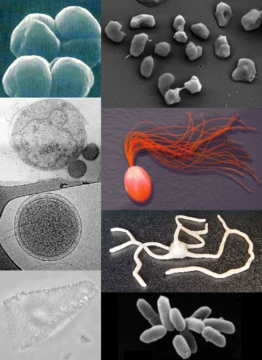
Thermus aquaticus
Thermophilic bacterium that enabled the polymerase chain reaction.

**Thermus aquaticus** (Latin for "hot water") is a heat-loving bacterium from the Deinococcota phylum. It is best known as the original source of Taq DNA polymerase, a heat-stable enzyme that became essential for the polymerase chain reaction (PCR), a technique that revolutionized molecular biology by allowing rapid DNA amplification.
**History**
In the 1960s, scientists studying hot springs assumed no bacteria could survive above about 55 °C. That assumption was quickly overturned as researchers found many bacteria thriving in even hotter waters. In 1969, Thomas D. Brock and Hudson Freeze of Indiana University described a new thermophilic species, *Thermus aquaticus*, first isolated from Mushroom Spring in Yellowstone National Park’s Lower Geyser Basin, near Great Fountain Geyser and White Dome Geyser. The bacterium has since been found in similar hot environments worldwide.
Decades later, this discovery proved pivotal. Biochemist Kary Mullis, working at Cetus Corporation, invented PCR, a technique that transformed DNA research and earned him the 1993 Nobel Prize in Chemistry. PCR enabled major advances in medical diagnostics, genetics, and other fields. After Mullis’s discovery, Cetus awarded him $10,000. However, Cetus later sold the PCR patent to F. Hoffmann-La Roche for $300 million—a deal Mullis felt cheated by for the rest of his life. Roche has since generated enormous revenue from PCR, with annual sales reaching $5.4 billion in 2022. Despite these profits, neither the National Park Service, Yellowstone National Park, nor the state of Wyoming received any share. Recognizing the scientific and commercial potential of Yellowstone’s extremophiles, biotechnology companies like Diversa signed bioprospecting agreements with the Park Service, leading to further exploration and applications, though not without environmental concerns. Brock’s original discovery in Yellowstone’s hot springs ultimately drove major scientific breakthroughs, highlighting how basic research can fuel innovation.
**Biology**
*T. aquaticus* grows best at 65–70 °C but can survive between 50 °C and 80 °C. It primarily obtains food by scavenging proteins from its surroundings, as shown by its many extracellular and intracellular proteases, peptidases, and transport proteins for amino acids and oligopeptides. It is a chemotroph, performing chemosynthesis, but because its temperature range overlaps with that of photosynthetic cyanobacteria, it sometimes lives alongside them, using energy from their photosynthesis. Normally aerobic, one strain (*T. aquaticus* Y51MC23) can also grow anaerobically. Its genome consists of one chromosome and four plasmids, and sequencing revealed two complete and two partial prophages, plus numerous CRISPR loci.
**Morphology**
*T. aquaticus* is generally cylindrical, 0.5–0.8 μm in diameter. Shorter rods are 5–10 μm long; longer filaments can exceed 200 μm. It can appear as rods or short filaments in different cultures. Rod-shaped cells tend to aggregate, sometimes forming spherical bodies 10–20 μm across, called rotund bodies. These are not made of cell envelope or outer membrane, as once thought, but from remodeled peptidoglycan cell wall. Their exact role is unknown, but they may store food or nucleotides, or help with colony attachment and organization. *T. aquaticus* is a typical gram-negative bacterium, with less peptidoglycan than gram-positive species. In sunlight, it can appear yellow, pink, or red—colors visible in hot springs. It may have flagella for movement or be immotile.
**Enzymes from *T. aquaticus***
The bacterium is famous for its thermostable enzymes, especially Taq DNA polymerase.
**Aldolase** – In 1970, Freeze and Brock described a heat-stable aldolase from *T. aquaticus*, part of early efforts to understand how enzymes work at high temperatures.
**RNA polymerase** – In 1974, Alice Chien Chang and colleagues isolated the first polymerase from *T. aquaticus*: a DNA-dependent RNA polymerase involved in transcription.
**Taq I restriction enzyme** – Most molecular biologists likely first encountered *T. aquaticus* in the late 1970s or early 1980s, when useful restriction endonucleases were isolated from it. The shorthand “Taq” came from the convention of naming restriction enzymes after the genus and species of the source organism.
**DNA polymerase (“Taq pol”)** – DNA polymerase was first isolated from *T. aquaticus*.
- field
- Microbiology, Molecular Biology
- known_for
- Source of Taq DNA polymerase, enabling PCR
- discovered_by
- Thomas D. Brock and Hudson Freeze
- type
- Thermophilic bacterium
Lore & Background
When studies of biological organisms in hot springs began in the 1960s, scientists thought that the life of thermophilic bacteria could not be sustained in temperatures above about 55 °C. Soon, however, it was discovered that many bacteria in different springs not only survived, but also thrived in higher temperatures. Brock and Hudson Freeze of Indiana University reported a new species of thermophilic bacteria which they named Thermus aquaticus. The bacterium was first isolated from Mushroom Spring in the Lower Geyser Basin of Yellowstone National Park, which is near the major Great Fountain Geyser and White Dome Geyser, and has since been found in similar thermal habitats around the world. T. aquaticus shows best growth at 65–70 °C, but can survive at temperatures of 50–80 °C. It primarily scavenges for protein from its environment, as evidenced by the large number of extracellular and intracellular proteases and peptidases. This bacterium is a chemotroph—it performs chemosynthesis to obtain food. However, since its range of temperature overlaps somewhat with that of photosynthetic cyanobacteria, it is sometimes found living jointly with its neighbors, obtaining energy for growth from their photosynthesis. The genetic material of T. aquaticus consists of one chromosome and four plasmids, and its complete genome sequencing revealed that it contains two full and two partial prophages, as well as numerous CRISPR loci.
Reader's Guide
PCR facilitated advancements in medical diagnostics, genetics, and other fields. The heat-resistant Taq DNA polymerase, isolated from T. aquaticus, eliminated the need to add E. coli polymerase enzymes after every cycle of thermal denaturation of the DNA. The commercial use of enzymes from T. aquaticus has not been without controversy. After Brock's studies, samples of the organism were deposited in the American Type Culture Collection, a public repository. As the commercial potential of Taq polymerase became apparent in the 1990s, the National Park Service labeled its use as the 'Great Taq Rip-off'. Researchers working in National Parks are now required to sign 'benefits sharing' agreements that would send a portion of later profits back to the Park Service. Overall, Brock's initial discovery in Yellowstone's hot springs paved the way for significant scientific breakthroughs, demonstrating the importance of basic research in driving innovation and technological advancements.
Did You Know?
- The bacterium can survive at temperatures of 50–80 °C and shows best growth at 65–70 °C.
- The National Park Service labeled the commercial use of Taq polymerase without compensation as the 'Great Taq Rip-off'.
Frequently Asked Questions
Who is Thermus aquaticus?
A thermophilic bacterium in the Deinococcota phylum whose Latin name simply means 'hot water.' It thrives in scalding environments where most other microbes would perish.
What is Thermus aquaticus's signature contribution to science?
It produces Taq DNA polymerase, a heat-stable enzyme that became the backbone of the polymerase chain reaction (PCR). Without this single enzyme, modern DNA amplification techniques simply would not exist.
Why does Thermus aquaticus matter in the broader story of science?
By donating the Taq polymerase enzyme, this tiny bacterium unlocked PCR, a technique now central to forensics, medicine, genetics, and countless other fields. It is arguably the single most impactful microbial discovery of the late twentieth century.
More in Microbial Groups And Extremophiles 1-17
Spotted an error? Know more?
This is a living reference — every entry is fact-audited, and reader corrections feed straight into our audit queue. Suggest an edit · See this site's audit record