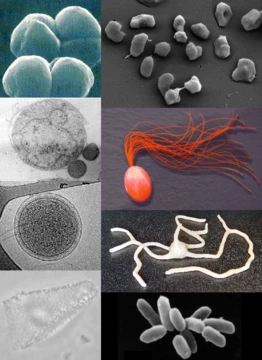
Prokaryote
Single-celled organisms without a nucleus, foundational to life on Earth.
Last updated

Mariana Ruiz Villarreal, LadyofHats translated in gujarati by User:Sushant_savla · CC0
A prokaryote is a cellular organism that lacks a distinct cell nucleus and other membrane-bound organelles.[1] In the three-domain system based on molecular phylogenetics, prokaryotes are divided into the domains Bacteria and Archaea.[1]
Key facts and history
In 1977, Carl Woese proposed dividing prokaryotes into Bacteria and Archaea due to major differences in structure and genetics.[2] Sedimentary rocks 3.5 billion years old contain what appear to be fossil stromatolites formed by photosynthetic bacteria.[3] Bacterial cells have various shapes including spherical cocci, cylindrical bacilli, spiral bacteria, or comma-shaped forms.[4] Microbiologists Roger Stanier and C. B. van Niel formally differentiated prokaryotes from eukaryotes in their 1962 publication "The concept of a bacterium", where they used the spelling "procaryote" and "eucaryote".[5]
Prokaryotes rank among Earth's earliest life forms, descending from a pre-cellular first universal common ancestor, with major diversification occurring between 3.72 and 4.18 billion years ago.[6] Fossil evidence indicates that the earliest prokaryotes were deposited roughly 3.5 billion years in the past.[7] Prokaryotic cells do not contain mitochondria or chloroplasts; instead, energy processes such as oxidative phosphorylation occur across their cell membrane.[8] A prokaryote's genetic material resides in a nucleoid within the cytosol, a region that is not enclosed by a nuclear membrane.[9]
What the cited sources add
Molecular phylogeneticists tell us that the two primary lines of descent lead to eubacteria and a second lineage that subsequently divided to form archaea and eukaryotes.[3] The best guesses for when eukaryotes evolved range from just below 2.0 billion years to around 3.5 billion years before the present.[3] Work by Gonzalo Vidal indicates that single-celled planktonic eukaryotes date back to 1.7 billion years and very likely to at least 2.2 billion years.[3] Three prokaryotic components can be traced by comparing molecules in extant prokaryotes and eukaryotes.[3]
The last universal common ancestor (LUCA) of all life likely carried an early form of ATP synthase, an enzyme that is necessarily embedded in a membrane.[10]
References
- Wikipedia, "Prokaryote" (CC BY-SA 4.0), which cites: ; ; "Prokaryotes: Single-celled Organisms", North Carolina State University (original not read by us) en.wikipedia.org
- Wikipedia, "Prokaryote" (CC BY-SA 4.0), which cites: "There must be a prokaryote somewhere: microbiology's search for itself", Microbiological Reviews, March 1994, p. 1–9; "The prokaryote-eukaryote dichotomy: meanings and mythology", Microbiology and Molecular Biology Reviews, June 2005, p. 292–305 (original not read by us) en.wikipedia.org
- Carl Woese, J Peter Gogarten, "When did eukaryotic cells (cells with nuclei and other internal organelles) first evolve? What do we know about how they evolved . facts only, no text reused. scientificamerican.com
- Wikipedia, "Prokaryote" (CC BY-SA 4.0), which cites: "Microbiology", Pearson Benjamin Cummings, 2006; "Walsby's square bacterium: fine structure of an orthogonal procaryote", Journal of Bacteriology, October 1981, p. 352–60 (original not read by us) en.wikipedia.org
- Wikipedia, "Prokaryote" (CC BY-SA 4.0), which cites: "The concept of a bacterium", Archiv für Mikrobiologie, 1962, p. 17–35; Chatton, "Titres Et Travaux Scientifiques (1906-1937) De Edouard Chatton", Impr. E. Sottano, 1937; Sapp, "The Prokaryote-Eukaryote Dichotomy: Meanings and Mythology", Microbiology and Molecular Biology Reviews, 2005, p. 292–305; "The concept of a bacterium", Archiv für Mikrobiologie, 1962, p. 17–35 (original not read by us) en.wikipedia.org
- Wikipedia, "Prokaryote" (CC BY-SA 4.0), which cites: Marin, "The Timetree of Prokaryotes: New Insights into Their Evolution and Speciation", Molecular Biology and Evolution, 2016-12-13, p. 437–446; Moody, "The nature of the last universal common ancestor and its impact on the early Earth system", Nature Ecology & Evolution, 2024-07-12, p. 1654–1666 (original not read by us) en.wikipedia.org
- Wikipedia, "Prokaryote" (CC BY-SA 4.0), which cites: Carl Woese, J Peter Gogarten, "When did eukaryotic cells (cells with nuclei and other internal organelles) first evolve? What do we know about how they evolved (we also read that source) en.wikipedia.org
- Wikipedia, "Prokaryote" (CC BY-SA 4.0), which cites: "Conservation and transformation of energy by bacterial membranes", Bacteriological Reviews, June 1972, p. 172–230; "The bacterial cytoskeleton", Microbiology and Molecular Biology Reviews, September 2006, p. 729–754; "Dynamic filaments of the bacterial cytoskeleton", Annual Review of Biochemistry, 2006, p. 467–92; "Intracellular compartmentation in planctomycetes", Annual Review of Microbiology, 2005, p. 299–328; "Three-dimensional reconstruction of bacteria with a complex endomembrane system", PLOS Biology, 2013 (original not read by us) en.wikipedia.org
- Wikipedia, "Prokaryote" (CC BY-SA 4.0), which cites: "The bacterial nucleoid: a highly organized and dynamic structure", Journal of Cellular Biochemistry, October 2005, p. 506–21; "A Brief History of Plasmids", EcoSal Plus, December 2022, p. eESP00282021; "Natural genetic transformation generates a population of merodiploids in Streptococcus pneumoniae", PLOS Genetics, 2013 (original not read by us) en.wikipedia.org
- Wikipedia, "Prokaryote" (CC BY-SA 4.0), which cites: "The Vital Question", W. W. Norton, 2015, p. 77 (we also read that source) en.wikipedia.org
Each numbered sentence above was checked against the source it cites before publication. Sentences citing Wikipedia adapt text from the English Wikipedia article Prokaryote (contributors), used under CC BY-SA 4.0; this entry is available under the same licence. Other sources were used for facts only; no text or images are copied from them.
More in Microbial Groups And Extremophiles
Sources
Compiled from Wikipedia and the sources listed below. Text from Wikipedia is available under CC BY-SA 4.0; this entry is adapted from it.
- Wikipedia: Prokaryote (CC BY-SA 4.0).
- Word definitions: the , each quoted from its Wikipedia article.
Spotted an error? Know more?
Reader corrections go straight into our review queue. Suggest an edit · How this site is sourced