Radiolaria
Unicellular protists with intricate silica skeletons, key microfossils.

dedree drees · CC BY 2.0
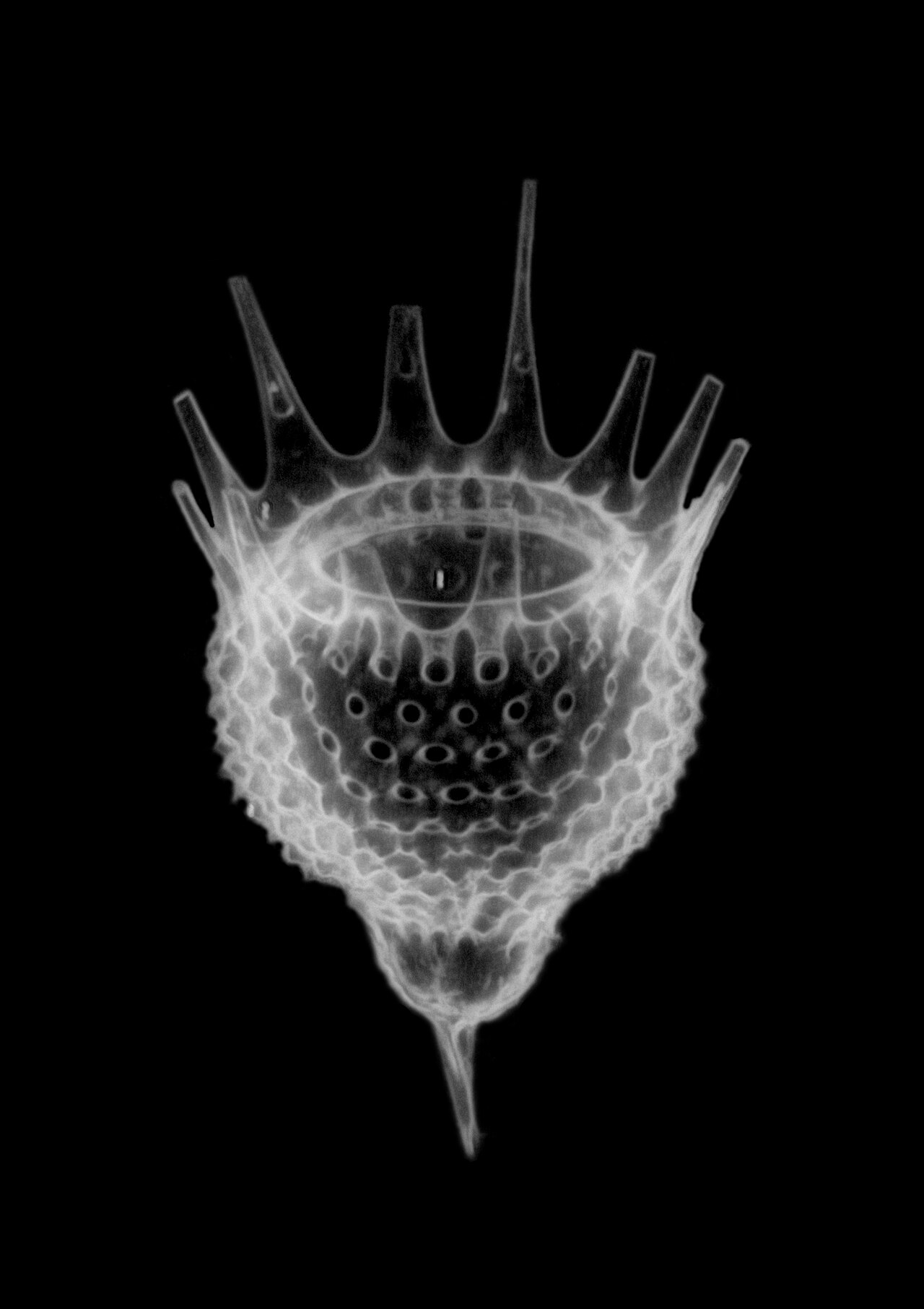
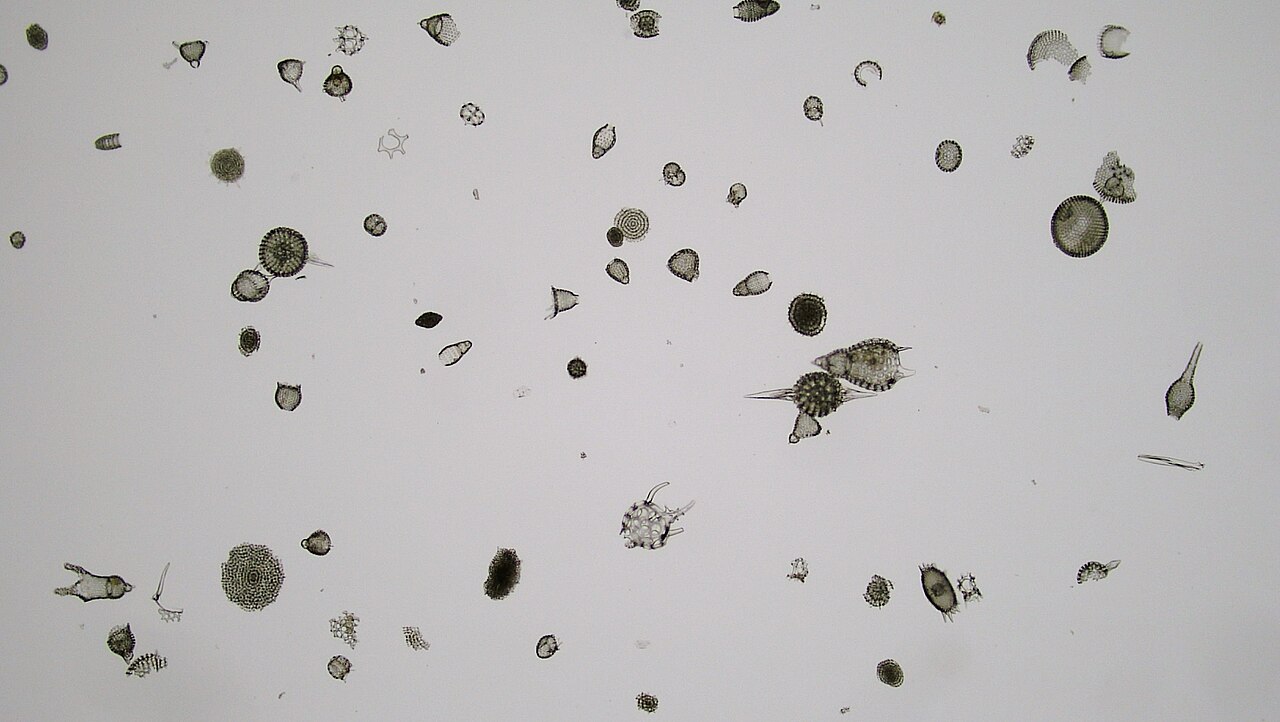
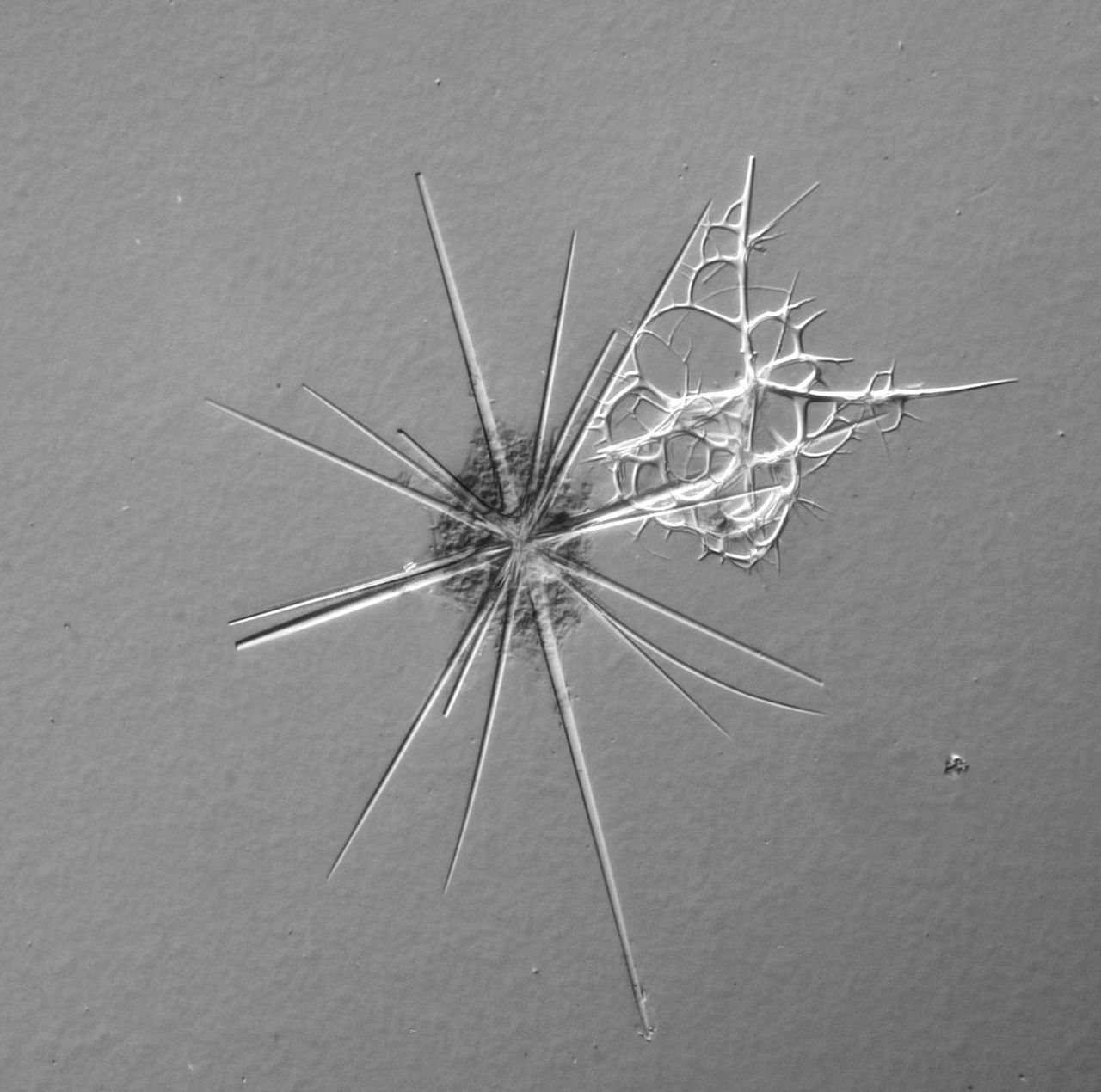
Radiolarians, also known as Radiozoa, are single-celled eukaryotes that build intricate mineral skeletons, usually from silica. A central capsule splits the cell into an inner endoplasm and an outer ectoplasm. These organisms drift as zooplankton across the world’s oceans. Though mostly heterotrophic, many host photosynthetic endosymbionts, making them mixotrophs. When they die, their silica skeletons can accumulate on the seafloor as siliceous ooze. Because radiolarian species evolve quickly and have complex shells, they are key diagnostic fossils from the Cambrian period onward.
The cell’s nucleus and most organelles sit in the endoplasm, while the ectoplasm is packed with frothy vacuoles and lipid droplets that help keep the cell afloat. Numerous needle-like pseudopods, supported by microtubule bundles, also aid buoyancy. Many radiolarians contain symbiotic algae, especially zooxanthellae, which supply most of the cell’s energy. Similar organization appears in heliozoa, but those lack a central capsule and produce only simple scales and spines. Some radiolarians, like *Circogonia icosahedra*, are notable for resembling regular polyhedra, such as an icosahedron.
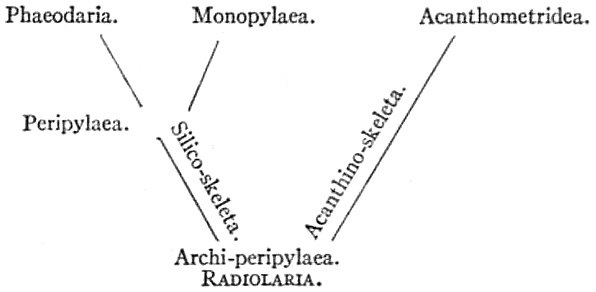
Taxonomically, radiolarians belong to the supergroup Rhizaria, alongside Cercozoa and Foraminifera. Traditionally split into four groups—Acantharea, Nassellaria, Spumellaria, and Phaeodarea—Phaeodarea is now considered a cercozoan. Nassellaria and Spumellaria both make silica skeletons and are grouped as Polycystina, a classification supported by molecular data. Acantharea produce skeletons from strontium sulfate and are closely related to the genus *Sticholonche* (Taxopodida), which lacks an internal skeleton and was long mistaken for a heliozoan. Thus, Radiolaria divide into two main lineages: Polycystina (Spumellaria + Nassellaria) and Spasmaria (Acantharia + Taxopodida). Molecular analyses of environmental samples have revealed several higher-order groups linked to Acantharia and Spumellaria, but these are entirely unknown in form and function, suggesting radiolarian diversity is much greater than currently recognized. The relationship between Foraminifera and Radiolaria remains debated; molecular trees show a close grouping called Retaria, but whether they are sister lineages or Foraminifera should be included within Radiolaria is unclear.
Radiolarian biogeography is shaped by water mass temperature and circulation. High-latitude water masses sink beneath warm, stratified waters at lower latitudes, so radiolarian species occupy habitats at multiple latitudes and depths worldwide. Tropical marine sediments thus contain a mix of vertically stacked faunal assemblages, some matching higher-latitude surface communities. Sediments under polar waters include both cosmopolitan deep-water radiolarians and high-latitude endemic surface species. Some species vanished from high latitudes but survived in the tropics during the late Neogene, either by migrating or restricting their range. With modern global warming, Southern Ocean species may not escape environmental stress because their cold-water habitats are disappearing, while tropical endemic species could expand toward midlatitudes.
Radiolarians are predatory protists encased in elaborate, hole-pierced globular shells, usually silica. Their name comes from the Latin for “radius.” They catch prey by extending parts of their body through the shell’s holes. When they die, their shells sink and become microfossils in ocean sediment, offering valuable clues about past ocean conditions.
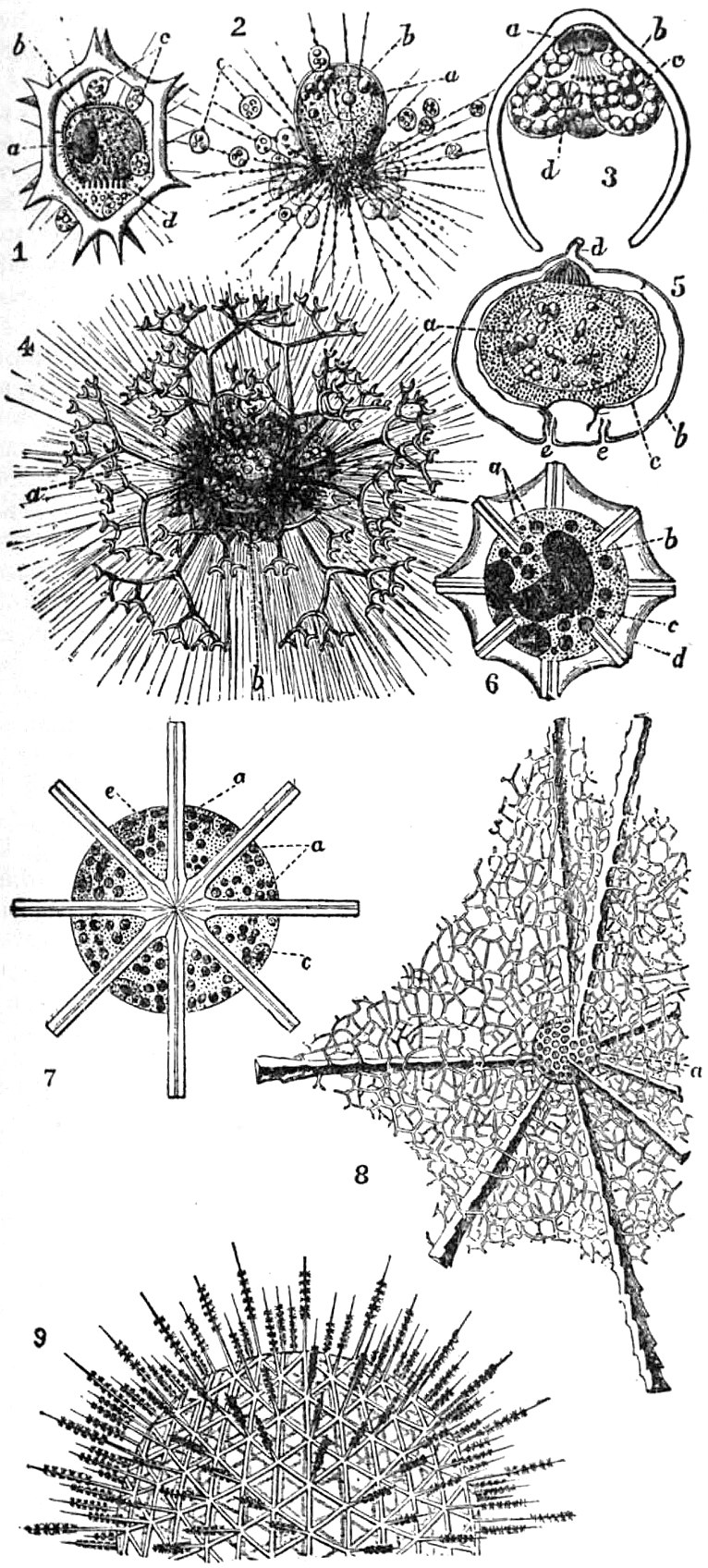
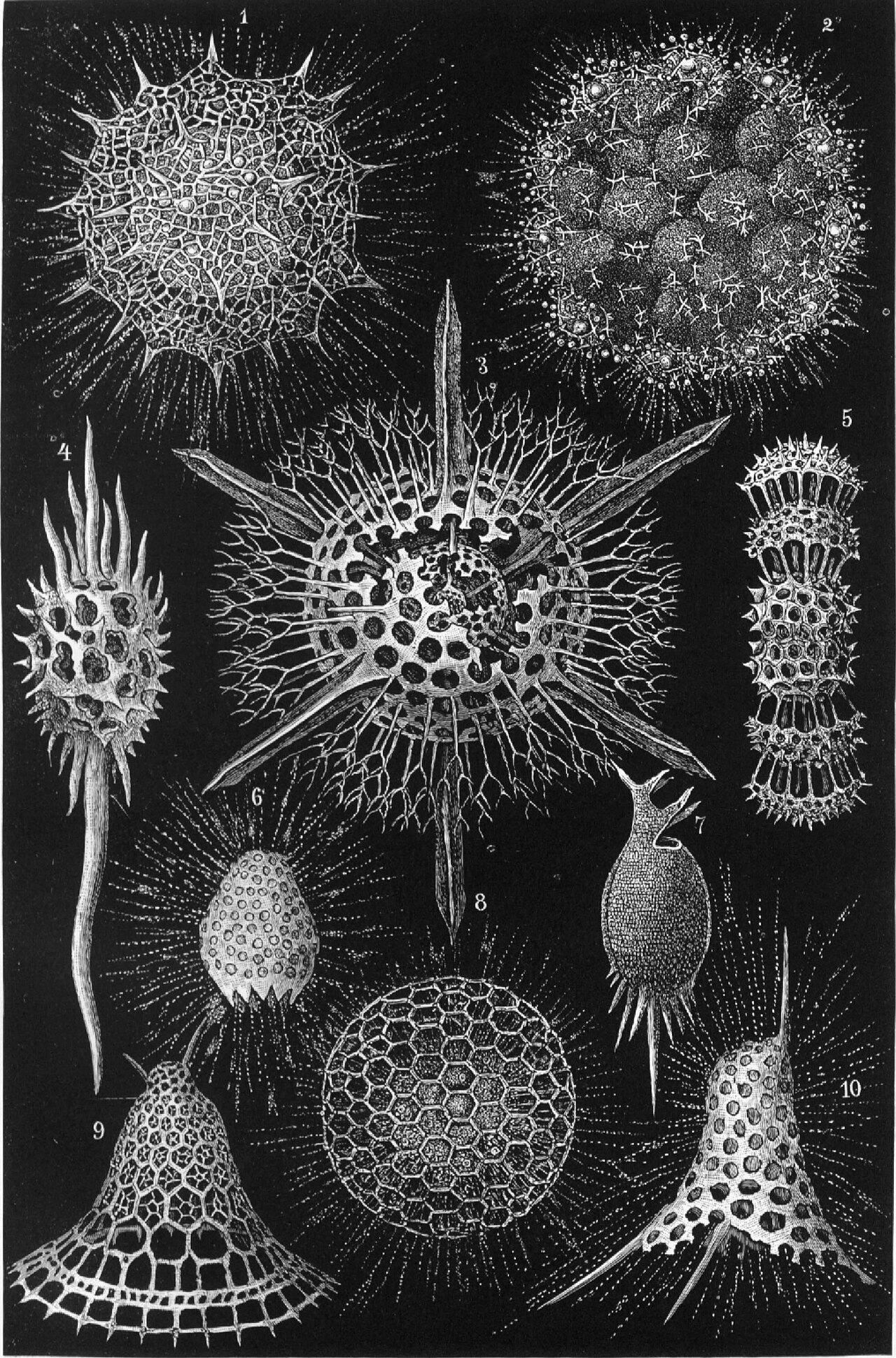
Bernard Richards, one of Alan Turing’s last students at Manchester, helped validate Turing’s theory of morphogenesis. Turing was keen to advance the work D’Arcy Thompson published in *On Growth and Form* (1917). Images of radiolarians from Ernst Haeckel’s 1887 drawings illustrate this diversity.
- field
- Marine biology, paleontology
- known_for
- Intricate silica skeletons, important microfossils for geological dating
- habitat
- Global ocean as zooplankton
- size
- 0.1–0.2 mm diameter (smaller species); many reach up to 0.5 mm or more
- first_appearance
- Ordovician period
Lore & Background
Radiolarians have many needle-like pseudopods supported by bundles of microtubules, which aid in buoyancy. The cell nucleus and most other organelles are in the endoplasm, while the ectoplasm is filled with frothy vacuoles and lipid droplets, keeping them buoyant. Many radiolarians contain symbiotic algae, especially zooxanthellae, which provide most of the cell's energy. Some radiolarians are known for their resemblance to regular polyhedra, such as the icosahedron-shaped Circogonia icosahedra. Taxonomically, radiolarians belong to the supergroup Rhizaria together with Cercozoa and Foraminifera. Traditionally divided into four groups—Acantharea, Nassellaria, Spumellaria, and Phaeodarea—Phaeodaria is now considered a cercozoan. Nassellaria and Spumellaria produce siliceous skeletons and are grouped as Polycystina. The Acantharea produce skeletons of strontium sulfate and are closely related to Sticholonche (Taxopodida). Radiolaria can be divided into two major lineages: Polycystina and Spasmaria. Molecular analyses have detected several higher-order groups related to Acantharia and Spumellaria that are completely unknown morphologically, suggesting radiolarian diversity is much higher than currently known. The relationship between Foraminifera and Radiolaria is well-supported by molecular phylogenetics, which groups them together as Retaria; the remaining debate concerns whether they are sister lineages or whether Foraminifera should be included within Radiolaria.
Reader's Guide
Radiolarians are significant as both living zooplankton and as microfossils. Their siliceous skeletons accumulate on the ocean floor as siliceous ooze, and because they evolved rapidly and have intricate skeletons, they serve as important diagnostic fossils from the Cambrian onwards. About ninety percent of known radiolarian species are extinct, and their tests are used in geological dating, including for oil exploration and determination of ancient climates. Biogeographic data show that some species were extirpated from high latitudes but persisted in the tropics during the late Neogene, either by migration or range restriction. With predicted global warming, modern Southern Ocean species will not be able to use migration or range contraction to escape environmental stressors because their preferred cold-water habitats are disappearing. However, tropical endemic species may expand their ranges toward midlatitudes. The study of radiolarian morphogenesis was advanced by Bernard Richards, who worked under Alan Turing at Manchester, helping to validate Turing's theory of morphogenesis. Their diversity is likely much higher than currently known, with many groups detected only through environmental DNA.
Did You Know?
- Radiolarians have needle-like pseudopods supported by microtubules that aid in buoyancy.
- Some radiolarians, like Circogonia icosahedra, resemble regular polyhedra such as an icosahedron.
- The earliest widely accepted radiolarian fossils date to the Ordovician period.
- About ninety percent of known radiolarian species are extinct.
Taxonomic Home Within Rhizaria
Radiolaria occupy a specific niche within the broader protist world, classified under the supergroup Rhizaria alongside Amoebozoa. Together, these two lineages house the majority of amoeboid organisms known to science, a category that also includes testate amoebae and foraminifers. What unites radiolaria with their rhizarian neighbors is their amoeboid mode of life, a form of locomotion and body plan that distinguishes them from the flagellates, ciliates, and thick-walled microalgae that populate other protist supergroups. Importantly, radiolaria, like all protists, are eukaryotic organisms that fall outside the three traditional higher kingdoms of animals, land plants, and fungi. This means they belong to a paraphyletic assemblage rather than a single natural clade. The discovery through molecular phylogenetics that some protists are more closely related to animals or plants than to one another has repeatedly reshaped how we understand these groupings, and radiolaria's placement within Rhizaria reflects the modern consensus that emerged from such revisions.
Defined by Exclusion: The Protist Umbrella
The very identity of radiolaria as a group is shaped by what they are not. In modern biological taxonomy, protists are defined by exclusion: they are all eukaryotes that are neither animals, land plants, nor fungi. Because this definition carves out a paraphyletic slice of the eukaryote tree of life, no single shared trait cleanly separates radiolaria and their protist relatives from the higher kingdoms. Historically, organisms like radiolaria were lumped into broad categories such as protozoa or algae depending on their apparent lifestyle, and the boundaries between these groupings were notoriously blurry before genetic analysis entered the picture. The advent of molecular phylogenetics and electron microscopy revealed that seemingly unrelated forms could be evolutionarily close, while organisms that looked alike might belong to entirely different lineages. For radiolaria, this meant being sorted alongside foraminifers and testate amoebae within Rhizaria, a grouping that reflects genuine evolutionary kinship rather than superficial resemblance.
Siliceous Shells and the Deep Fossil Record
Among the many protist lineages that have left traces in the geological record, those bearing siliceous and calcareous shells stand out for their durability and abundance. Radiolaria, as members of the amoeboid assemblage within Rhizaria, contribute to this extensive fossil legacy that spans the Phanerozoic era. The broader story of protist fossils is one of long silence followed by gradual emergence: eukaryotes split from archaea roughly three billion years ago, and the last eukaryotic common ancestor acquired essential features such as mitochondria and a complex endomembrane system during the Paleo- or Mesoproterozoic eras. Yet the fossil abundance of protists remained low until the Neoproterozoic, when the first fossils of opisthokonts, amoebae, and multicellular algae finally appear. Throughout the Phanerozoic, protists evolved into the forms that dominate ecosystems today, and their siliceous and calcareous shells became a prominent part of the geological archive.
The Unseen Majority of Eukaryotic Life
Although the number of formally described protist species remains comparatively low, environmental DNA studies indicate that protists actually compose the majority of eukaryotic diversity on Earth, with most species still undescribed. Radiolaria, as one thread within this vast and largely uncharacterized web, exist alongside an enormous array of single-celled and multicellular organisms that collectively exhibit a diversity of life cycles, trophic strategies, modes of locomotion, and cellular structures that dwarfs what is seen in animals, plants, or fungi. Protists are abundantly present in all ecosystems, including extreme habitats, and serve as critical components of biogeochemical cycles and trophic webs. As producers, they drive a large portion of global primary production and carbon fixation; as consumers and decomposers, they regulate fungal and bacterial populations and release nutrients upward through food chains. Radiolaria, nestled within this ecological machinery as amoeboid members of Rhizaria, participate in the same fundamental biogeochemical processes that make protists indispensable to planetary life, even as their full ecological roles remain only partially understood.
Gallery
Frequently Asked Questions
What are Radiolaria?
Radiolaria (also called Radiozoa) are single-celled eukaryotic organisms that build elaborate mineral skeletons, typically composed of silica. Their cell is divided by a central capsule into an inner region called the endoplasm and an outer region called the ectoplasm.
How big are Radiolaria?
Most radiolarians measure roughly 0.1 to 0.2 millimeters in diameter, though many species grow to half a millimeter or larger. Despite their tiny size, their skeletal structures are remarkably detailed and geometrically complex.
Where can you find Radiolaria?
Radiolarians drift as zooplankton throughout the world's oceans, making them a truly global group. On the seafloor, the accumulated skeletal remains of certain species form extensive deposits known as siliceous ooze.
How do Radiolaria get their food?
As zooplankton, radiolarians are primarily heterotrophic, consuming other organisms in the water column. However, many species harbor photosynthetic endosymbionts, which allows them to also generate energy from sunlight and classify them as mixotrophs.
Why are Radiolaria important to paleontology?
Because their intricate silica skeletons fossilize well and evolve rapidly, radiolarian remains serve as critical microfossils for dating geological strata. Their first appearance in the fossil record dates back to the Ordovician period, making them key markers in marine geological history.
More in Microbial Groups And Extremophiles 1-17
Spotted an error? Know more?
This is a living reference — every entry is fact-audited, and reader corrections feed straight into our audit queue. Suggest an edit · See this site's audit record