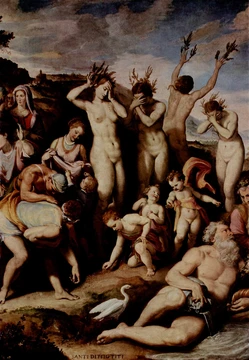
Phyllis (mythology)
Thracian princess who became a tree after her husband's departure.
Phyllis is a figure from Greek mythology, the daughter of a Thracian king. She married Demophon, King of Athens and son of Theseus, when he stopped in Thrace on his journey home from the Trojan War. Her name, derived from the Ancient Greek word for 'leaves, foliage,' is associated with a metamorphosis into a tree.
Quick Facts
- Meaning
- leaves, foliage
- Spouse
- Demophon (also spelled Demophoon)
- King of Athens
- son of Theseus
Facts from the source article.
Mythology
Phyllis was left behind when Demophon, bound by duty to Greece, returned home to aid his father. Before he left, she gave him a casket, claiming it held a sacrament of Rhea, and instructed him to open it only if he abandoned all hope of coming back to her. The myth then splits into two paths. In one, Phyllis, realizing he would never return, hanged herself from a tree. An almond tree grew from her burial site, and it bloomed when Demophon finally did come back. In the other version, Demophon opened the casket, was horrified by its contents, and fled so recklessly that his horse tripped, causing him to fall onto his own sword and die.
There is some disagreement over which nut tree she became, since hazelnuts were long called nux Phyllidos and are still sometimes referred to as filberts. The name Phyllis, or Phillis, remains a common female given name, with variants like Phillida and Phyllida. The story appears in the second poem of Ovid’s Heroides and in Callimachus’s Aitia. The term “The Nine Ways” comes from the tale that Phyllis returned nine times to the shore, waiting for Demophon.
Phyllis is also referenced in Thomas Morley’s song “I love, alas, I love thee,” where she is compared to Amaryllis. When Amaryllis dies, a flower grows from her blood spilled on the ground, and the song considers Amaryllis more lovely because her death yields a striking flower, while Phyllis’s death only produces a nut tree. The Dutch composer Jacob van Eyck wrote recorder pieces referring to Philis, such as “Philis schooner Herderin” and “Philis quam Philander tegen.”
More in Metamorphoses Into Trees in Greek Mythology
Spotted an error? Know more?
Reader corrections go straight into our review queue. Suggest an edit · How this site is sourced