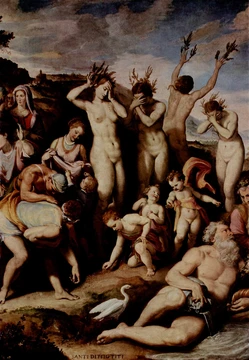
Phaethusa
Daughter of Helios who guarded sacred flocks on Thrinacia.
Phaethusa, meaning “radiance,” was one of Helios the sun god’s daughters. Along with her sister Lampetia, she looked after their father’s sacred cattle and sheep on the island of Thrinacia. Phaethusa used a silver crook to tend the sheep.
Quick Facts
- Deity of
- Shepherdess of Helios' Sacred Sheep
- Abode
- Thrinacia (Sicily)
- Father
- Helios
- Mother
- Neaera or Clymene
- Siblings
- Lampetia
- Merope
- Helie
- Aegle
- Phoebe
- Aetherie
- and Dioxippe
Facts from the source article.
Family
Phaethusa is most often described as a daughter of Helios and Neaera, a minor goddess or nymph, making Lampetia her only biological sister and giving her many half-siblings through her father. In that version she would have had up to seven sisters—Merope, Helie, Aegle, Phoebe, Aetherie, Lampetia, and Dioxippe—and a brother, Phaethon, who died after failing to drive Helios' chariot.
Mythology
As young children, Phaethusa and Lampetia were sent by Neaera to Thrinacia, identified as Sicily or Malta, to guard Helios' prized herds of cattle and sheep, which had white coats and golden horns and did not age or breed. In Homer's Odyssey, Odysseus and his crew landed on Thrinacia and, trapped by a storm sent by Zeus, ran out of supplies. While Odysseus prayed, his men killed and ate some sacred cattle; Phaethusa and Lampetia reported this to Helios, who demanded punishment. Zeus later struck the crew's ship with lightning, killing all but Odysseus. In versions where Phaethusa is a Heliad, she and Lampetia were transformed into poplar or alder trees while mourning Phaethon, their tears crystallizing into amber. However, in the Argonautica, which occurs after Phaethon's death, both sisters are still alive and tending the herds.
More in Metamorphoses Into Trees in Greek Mythology
Spotted an error? Know more?
Reader corrections go straight into our review queue. Suggest an edit · How this site is sourced