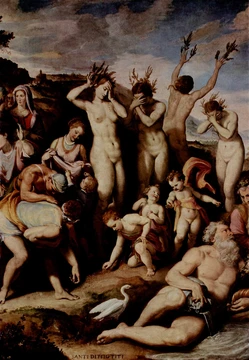
Cyparissus
A boy transformed into a cypress tree by grief.
Cyparissus is a figure from ancient Greek and Roman mythology, a boy whose grief over accidentally killing his beloved stag led to his transformation into a cypress tree. The myth serves as an aetiological tale explaining the cypress's classical association with mourning. It is primarily known from Latin literature and frescoes from Pompeii, with no identified Greek hero cult devoted to him.
Quick Facts
- Name
- Cyparissus (Κυπάρισσος)
- Mythological role
- Boy beloved by Apollo (or other deities)
- Transformation
- Into a cypress tree
- Associated deity (ovid)
- Apollo
- Associated deity (servius)
- Silvanus
- Associated deity (nonnus)
- Zephyrus
- Father (servius)
- Telephus
Facts from the source article.
Did You Know?
- According to Servius, Cyparissus was the son of Telephus, and thus the grandson of Heracles.
- A different tradition names a Cyparissus as the son of Minyas and mythical founder of the town Cyparissus in Phocis, later called Anticyra.
- The cypress was associated with the underworld because they do not grow back when pruned too severely, or because in Attica households in mourning were garlanded with cypress.
Mythology
In Ovid's account, Cyparissus was a handsome youth from Ceos loved by Apollo, who cared for a sacred stag with golden antlers. While hunting one summer day, Cyparissus accidentally pierced the stag with his spear, killing it. Overwhelmed with grief, he asked Apollo to let his tears fall forever. Despite the god's attempts to console him, the boy's sorrow persisted, and Apollo turned him into a cypress tree, whose sap forms droplets like tears on the trunk.
Ovid places this tale within the story of Orpheus, where the cypress appears at the end of a cavalcade of trees moved by Orpheus's music, prompting the metamorphosis narrative. According to one of the Vatican Mythographers, another Roman tradition makes the woodland god Silvanus the lover. Servius, commenting on Virgil, recounts that Silvanus loved a boy named Cyparissus who had a tame deer; when Silvanus unintentionally killed the deer, the boy was consumed by sorrow, and the god turned him into the tree that bears his name, which Silvanus is said to carry as a consolation.
Servius also mentions a version where the lover was Zephyrus, the god of the West Wind. Nonnus wrote that Zephyrus found solace in the arms of Cyparissus after the death of Hyacinthus.
Background
The story of Cyparissus, like that of Hyacinthus, is often seen as a reflection of ancient Greek pederastic customs, where the boy serves as Apollo's beloved. These myths portray a beloved's symbolic death and transformation as part of his initiation into adult male life. Apollo's gift of a stag to Cyparissus mirrors the Archaic Greek practice of an older man giving an animal to his young lover, a scene common in vase paintings. Within this initiatory framework, the hunt acts as a supervised training for warfare and a test of character, with the stag representing the hunter's offering. The myth also explains why the cypress tree is linked to grief, though scholar Forbes-Irving argued that this association was mostly Roman, with little Greek evidence. It is possible that an earlier Greek version of the tale was quite different and originally connected the cypress specifically to Apollo.
More in Metamorphoses Into Trees in Greek Mythology
Spotted an error? Know more?
Reader corrections go straight into our review queue. Suggest an edit · How this site is sourced