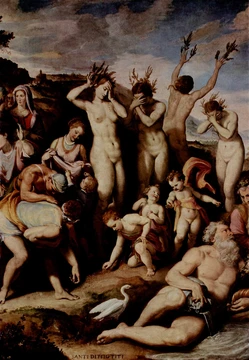
Apollo and Daphne
A nymph's transformation into a laurel tree to escape Apollo.
Apollo and Daphne is an Ancient Greek transformation myth, likely Hellenistic in origin, that explains the origin of the laurel tree and its connection to Apollo. The beautiful nymph Daphne rejects the love of Apollo and is turned into a tree. No written or artistic versions survive from ancient Greek mythology, and the story was retold by Roman authors as an amorous vignette.
Quick Facts
- Primary figures
- Apollo (Phoebus)
- Eros (Cupid, Amor)
- Daphne
- Daphne's typical parentage
- Mother: Creusa or Gaia; Father: river god Peneus or Ladon
- Most well-known telling
- Ovid
- Metamorphoses (I.438–567)
- first written in 8 CE
- Associated plant
- Laurel tree
- Associated games
- Pythian Games
Facts from the source article.
Did You Know?
- Apollo's priestess employed laurel leaves at Delphi, and laurel wreaths were given to victors of the Pythian Games.
- The earliest known source of the myth is Parthenius, a Greek poet of the 1st century BCE.
- Ovid's Metamorphoses, the most well-known telling, was first written in 8 CE.
Mythos
The story involves three main figures: Apollo, the Greek god of healing, archery, music and arts, sunlight, knowledge, and patron of Delphi; Eros, the god of love and sex, often depicted as a winged boy; and Daphne, a naiad or huntress of Artemis whose parentage varies. Ovid, writing as a Roman, called the gods by their Roman names but switched between calling Apollo by his Greek name and Phoebus, an epithet possibly referring to his role as sun god.
Ovid broke the myth into five parts, beginning with Apollo slaying the Python. After piercing the great snake with a thousand arrows, Apollo founded the sanctuary of Delphi atop its body. This sanctuary became home to the oracle Pythia, and the sacred Pythian Games were held to celebrate his victory. Winners were initially honored with oak wreaths, as the laurel did not yet exist. The myth then proceeds to Apollo's pursuit of Daphne and her transformation.
Apollo and Daphne in art
Two stone dishes from present-day Pakistan, associated with the Apollo and Daphne myth and dated controversially to the 1st century BC, do not depict the full transformational image familiar from later art, reflecting earlier sources. Surviving Roman frescoes showing Apollo serenading a woman suggest a lost version where Apollo first wooed the maiden with song. Ovid's version is the earliest to include Cupid and the arrow that makes Daphne despise Apollo; pre-Ovidian versions may have used a substitution where Daphne was swallowed by the earth.
The Daphne Ewer, a gilded glass vessel from about 175–225, has Greek letters identifying the protagonists, pointing to an Eastern literary source. A 5th–6th century ivory relief from Egypt features a musical Apollo serenading Daphne, reflecting the lost literary account and also serving as a Christianized version. Renaissance artists such as Antonio del Pollaiuolo and his brother Piero drew inspiration from the myth; Piero's painting shows both protagonists in Renaissance garments, again Christianizing the story.
The Mannerist artist Andrea Meldolla made an etching where one of Daphne's legs sprouts roots from her father's body, and a small painting where both feet rest on her father's body.
More in Metamorphoses Into Trees in Greek Mythology
Spotted an error? Know more?
Reader corrections go straight into our review queue. Suggest an edit · How this site is sourced