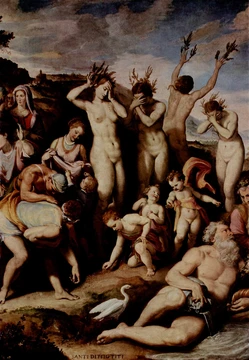
Leucothoe (daughter of Orchamus)
Babylonian princess transformed into a frankincense tree by Helios.
Leucothoe was a Babylonian princess in Greek mythology, daughter of Orchamus, a king of Persia. She was either a lover or a victim of the sun god Helios, and her story is best known from Ovid's Metamorphoses. After her death, Helios transformed her body into a frankincense tree.
Quick Facts
- Abode
- Persia, Boeotia or Andros
- Children
- Thersanon
- Consort
- Helios
- Siblings
- Clytie (one version)
- Parents
- Orchamus and Eurynome
Facts from the source article.
Did You Know?
- The myth may explain the use of frankincense in the god's worship, similar to Daphne's transformation into a laurel tree.
- Leucothoe's death by burial at the hands of her male guardian resembles Antigone's fate.
- Some scholars suggest the story might denote archaic cult practices involving human sacrifice in tree-related worship.
Mythology
Aphrodite cursed Helios to fall in love with Leucothoe as punishment for informing Hephaestus of her affair with Ares. Helios became so enamored that he lingered in the sky, rising earlier and setting later to watch her, lengthening winter days. He forgot previous lovers including Rhodos, Clymene, Perse, and Clytie. Disguised as her mother Eurynome, Helios entered Leucothoe's chambers, dismissed her servants, and revealed himself.
According to Ovid, she was conquered and suffered his force, or in other accounts he had sex with her. Clytie, still in love with Helios and jealous, reported the affair to Orchamus. He punished his defiled daughter by burying her alive despite her pleas. Leucothoe died before Helios could save her.
Grieving, he sprinkled her body with fragrant nectar and turned her into a frankincense tree so she would still breathe air. Clytie, scorned by Helios, sat pining away without food or drink, constantly turning her face toward the Sun, until she became the heliotrope whose purple flowers follow the Sun daily. Lactantius Placidus attributed the myth to Hesiod, though some scholars doubt this; his abridged version follows Ovid's but contains differences, and neither clarifies how Clytie knew of the affair or how Helios knew Clytie informed the king.
More in Metamorphoses Into Trees in Greek Mythology
Spotted an error? Know more?
Reader corrections go straight into our review queue. Suggest an edit · How this site is sourced