Gerana
Pygmy queen turned into a crane by Hera.
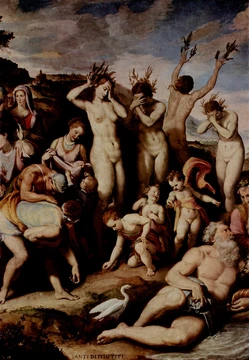
Gerana, also called Oenoe, was a queen of the Pygmies in Greek mythology who was transformed into a crane by Hera. Her story explains the enmity between Pygmies and cranes and serves as a caution against hubris. It parallels the tales of Lamia and Antigone, who also suffered Hera's wrath.
Quick Facts
- Also known as
- Oenoe
- Species after transformation
- Crane
- Spouse
- Nicodamas
- Attested by
- Antoninus Liberalis
- Athenaeus
- Aelian
- Ovid
Facts from the source article.
Did You Know?
- The name Gerana derives from the Ancient Greek word for crane, γέρανος, and is cognate with the English word 'crane'.
- The name may be attested in Mycenaean Greek as the dative plural gerenai, though Beekes expressed doubt.
Mythology
Antoninus Liberalis, drawing on Boeus's lost poem Ornithogony, relates that Gerana was a Pygmy woman of great beauty but lacking grace, who refused to honor Hera and Artemis. She married the virtuous Nicodamas and bore a son, Mopsus. When the Pygmies brought gifts for the infant, Hera, angered by Gerana's neglect of worship, elongated her neck and changed her into a crane. As a crane, Gerana flew from roof to roof to stay near her child, but the Pygmies drove her away with weapons, starting the lasting conflict between Pygmies and cranes. Athenaeus, also citing Boeus, adds that Gerana was worshipped as a goddess by her people while she herself despised Artemis and Hera; Hera therefore turned her into a crane, considered a very ugly bird, and made the Pygmies hate cranes. Athenaeus further notes that Gerana and Nicodamas also became parents of a tortoise. Ovid recounts that Gerana considered herself equal to the heavens, so Hera bested her in a contest and transformed her into a crane, forcing her to war against her own people; possibly Gerana boasted of surpassing Hera in beauty. Athena wove Gerana's fate into her tapestry during the contest with Arachne as a warning, but Arachne ignored it and suffered similarly. Antoninus Liberalis calls the woman Oenoe, while Ovid leaves her nameless; Athenaeus and Aelian name her Gerana. Aelian states that the Pygmies worshipped Gerana as a goddess with honors beyond human measure, and that she claimed to surpass Hera, Artemis, Athena, and Aphrodite in beauty, so Hera punished her by turning her into a hideous crane.
Ancient culture
The opening lines of Iliad book 3 may imply that some version of Gerana's tale was known as early as Homer. All three variations of Gerana's story may trace back to Boeus's Ornithogony. Joseph Fontenrose identifies Gerana with Lamia, another beautiful queen punished by Hera and transformed into a beast, deprived of her child. Boeus's version may have influenced Ovid's account of Antigone, who compared herself to Hera and was turned into a stork, a bird often grouped with cranes.
More in Metamorphoses Into Birds in Greek Mythology
Spotted an error? Know more?
Reader corrections go straight into our review queue. Suggest an edit · How this site is sourced