Arne Sithonis
A Thracian princess turned into a gold-loving jackdaw.
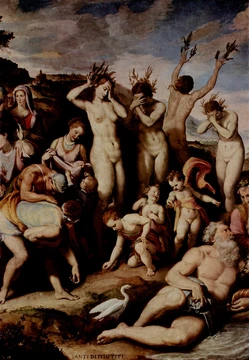
Arne Sithonis is a mythologized princess of an ancient Greek island, who according to legend betrayed her motherland after the legendary king Minos had bribed her with gold into supporting Crete. After she had accepted the bribe that "her greed demanded", Minos' troops attacked the island. For this misdeed the gods punished her by turning her into a black-footed, black-winged jackdaw, and she would be forever attracted to golden and shining objects. The only source on Arne's story is Ovid's mythological poem Metamorphoses from 8 BC, where—depending on the manuscript—her name is given as Arne Sithonis or Arne Sithon.
Quick Facts
- Also known as
- Arne Sithon
- Transformation
- Black-footed, black-winged jackdaw
- Associated king
- Minos
Facts from the source article.
Localization and chronology
The only surviving account of Arne's story appears in Ovid's Metamorphoses, where her name is given as Arne Sithonis or Arne Sithon, meaning "the Thracian Arne." Attempts to identify her island as Siphnos have been made based on paleographical similarities, but no independent legend connects an Arne to Siphnos or any other Cycladic island. The term Sithonis was long doubted because Thracians were not believed to have reached the Cyclades, but Huxley (1984) showed that Sithonis here refers to inhabitants of Naxos. This origin was first proposed by Franz Börner, as Naxos, the largest Cycladic island, was missing from Ovid's extensive island catalog. Greek sources confirm that Thracians settled Naxos for roughly two hundred years before being replaced by Karian immigrants after a drought, two generations before the time of Theseus and Minos. Further evidence comes from the lost Naxiaka of Andriskos, which told of two Thracian plunderers from Naxos, Skellis and Agassamenos, who raided the Peloponnese and Thessaly, seizing Iphimede and her daughter Pankrato. Huxley suggests that Arne Sithonis may have been a descendant of women kidnapped by these plunderers and taken to Naxos, or that the name indicates a Thracian place of origin. In all probability, she was a survivor of the Thracian population of Naxos among the Karians. Alternatively, Ovid may have followed a version where Thracians still ruled Naxos in Minos's time. Huxley suggests Parthenius as a possible source, as the Greek poet mentioned the Thracians of Naxos. The fact that "Thracian [of Naxos]" hides behind Sithonis indicates that Minos also captured Naxos, probably after visiting Paros.
More in Metamorphoses Into Birds in Greek Mythology
Spotted an error? Know more?
Reader corrections go straight into our review queue. Suggest an edit · How this site is sourced