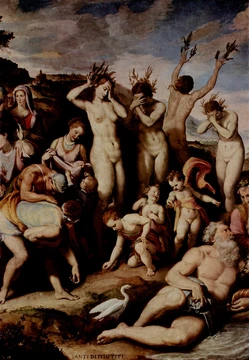
Alcyone and Ceyx
Thessalian royals transformed into kingfishers after divine wrath.
Alcyone and Ceyx were a Thessalian royal couple whose story is best known for their transformation into birds. Their myth is notable for its connection to the term 'halcyon days' and for the varying accounts of the divine punishment that led to their metamorphosis.
Quick Facts
- Alcyone's father
- King Aeolus of Aeolia
- Alcyone's mother
- Enarete or Aegiale
- Ceyx's father
- Eosphorus (Lucifer)
- Kingdom
- Trachis
- Bird form (alcyone)
- halcyon bird (common kingfisher)
- Duration of halcyon days
- fourteen days each year
Facts from the source article.
Mythology
Alcyone was a Thessalian princess, daughter of King Aeolus of Aeolia by either Enarete or Aegiale, and sister to Salmoneus, Athamas, Sisyphus, Cretheus, Perieres, Deioneus, Magnes, Calyce, Canace, Pisidice, and Perimede. She became queen of Trachis after marrying King Ceyx, son of Eosphorus. The couple were very happy together. According to Pseudo-Apollodorus, they sacrilegiously called each other 'Zeus' and 'Hera', angering Zeus, who killed Ceyx with a thunderbolt while he was at sea. Morpheus, disguised as Ceyx, appeared to Alcyone in a dream to tell her of his fate; she then threw herself into the sea. The gods changed them both into halcyon birds (common kingfishers), named after her, though Apollodorus says Ceyx became a gannet. Ovid and Hyginus recount the metamorphosis after Ceyx's loss in a storm, omitting the 'Zeus' and 'Hera' insult; Ovid adds that Alcyone saw his body washed ashore before her suicide. Pseudo-Probus notes Ovid followed Nicander's version rather than Theodorus's. Virgil alludes to the myth without reference to Zeus's anger. The earlier myth may have been simpler, with Alcyone mourning an unnamed husband; Ceyx was likely added later.
Etymology
Alkyóne derives from alkyón, a term for a sea-bird with a mournful song or a kingfisher. Its meaning is uncertain as alkyón is considered pre-Greek, but folk etymology linked it to háls ('sea, salt') and kyéo ('I conceive'). The original smooth breathing mark gave way to a rough breathing mark, leading to the misspellings halkyón and Halkyóne, and the English genus name Halcyon. Another speculation connects Alkyóne to alké ('prowess, battle, guard') and onéo ('to help, to please'). Kéyx, referring to a sea-bird, appears related to kaúax, a ravenous sea-bird, suggesting Ceyx may have been turned into a sea mew or a tern.
Halcyon days
Ovid and Hyginus make the metamorphosis the origin of the term 'halcyon days', the seven days in winter when storms never occur. They state these were originally fourteen days each year (seven days on either side of the shortest day) during which Alcyone, as a kingfisher, made her nest on the beach and laid her eggs while her father Aeolus, god of the winds, restrained the winds and calmed the waves. The phrase has come to refer to any peaceful time, but its proper meaning is a lucky break or bright interval set in adversity. Kingfishers do not live by the sea, so Ovid's tale refers to a mythical bird later identified with the kingfisher. The expression ἀλκῠονίδες ἡμέραι first occurs in Aristophanes' The Birds, then in Aristotle, Philochorus, and Lucian; in Latin it appears as alcyonides dies in Pliny the Elder, alcyonei dies in Columella and Varro, alcyonia in Hyginus, and alcedonia in Plautus and Frontinus.
General and cited references
Hesiod, Catalogue of Women from Homeric Hymns, Epic Cycle, Homerica translated by Evelyn-White, H G. Loeb Classical Library Volume 57. London: William Heinemann, 1914. Hyginus, Fabulae from The Myths of Hyginus translated and edited by Mary Grant. University of Kansas Publications in Humanistic Studies. Pausanias, Graeciae Descriptio. 3 vols. Leipzig, Teubner. 1903. Pseudo-Apollodorus, The Library with an English Translation by Sir James George Frazer, F.B.A., F.R.S. in 2 Volumes, Cambridge, MA, Harvard University Press; London, William Heinemann Ltd. 1921. Publius Ovidius Naso, Metamorphoses translated by Brookes More. Boston, Cornhill Publishing Co. 1922. Publius Ovidius Naso, Metamorphoses. Hugo Magnus. Gotha (Germany). Friedr. Andr. Perthes. 1892. Publius Vergilius Maro, Bucolics, Aeneid, and Georgics of Vergil. J. B. Greenough. Boston. Ginn & Co. 1900.
More in Metamorphoses Into Birds in Greek Mythology
Spotted an error? Know more?
Reader corrections go straight into our review queue. Suggest an edit · How this site is sourced