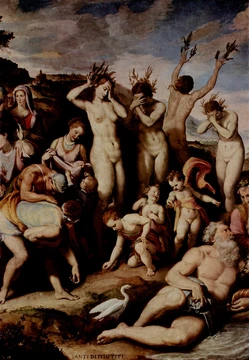
Asteria
Titan goddess who became the island of Delos.
Asteria is a Titan goddess in Greek mythology, daughter of the Titans Phoebe and Coeus and sister of Leto. She is notable for escaping the amorous pursuit of Zeus by transforming into a bird and then into a wandering island, which later became the sacred island of Delos. Her daughter Hecate, the goddess of witchcraft, is her most prominent offspring.
Quick Facts
- Abode
- Delos
- Consort
- Perses
- Parents
- Coeus and Phoebe
- Siblings
- Leto
- Children
- Hecate
Facts from the source article.
Did You Know?
- Asteria's name derives from the Greek word for 'star'.
- In one version, Asteria was mother of the fourth Heracles by Zeus.
Family
Asteria is consistently described as the daughter of the Titans Phoebe and Coeus, and the younger sister of Leto. According to Hesiod, she married her first cousin Perses before the dethronement of Cronus, and bore him a single daughter, Hecate. In an account attributed to Musaeus, Asteria was also the mother of Hecate by Zeus, who kept her as a paramour before handing her over to Perses.
Mythology
After the Titanomachy, Asteria lived on Olympus. Zeus, having already impregnated her sister Leto, pursued Asteria, who rejected him. To escape his advances, Zeus chased her in the form of an eagle, and Asteria transformed herself into a quail and flung herself into the Aegean Sea. There she metamorphosed into the island Asteria, also called Ortygia (quail island), which was described as floating or hidden beneath the sea, small and barren. This island later became identified with Delos. According to Hyginus, Leto was borne by the north wind Boreas at Zeus's command to the floating island, where she gave birth to Apollo and Artemis while clinging to an olive. After the birth, Delos became visible and fixed to the sea bed, no longer floating. Hera, though enraged that Asteria had defied her, did no harm to Asteria, respecting her for preferring the sea over Zeus and thus not further defiling Hera's marriage. Asteria's ability to withstand Hera's threats likely stemmed from her Titan parentage.
Origins
Asteria appears as early as the eighth century BC in Hesiod's Theogony, where she is listed among the genealogies of the gods, but Hesiod does not connect her with Delos or the story of Hera pursuing Leto. The earliest account of Leto's travels and Apollo's birth is the sixth-century BC Homeric Hymn to Apollo, which does not indicate that the island Delos had a past as Asteria, nor does it explicitly make Hera the cause of Leto's difficulties. The identification of Asteria as the origin of Delos seems to have been introduced by Pindar in the fifth century BC, who in a fragmentary paean writes that Zeus pursued Asteria and she was flung into the sea, becoming the floating island Ortygia, which Pindar elsewhere identifies as Delos; however, he also calls Ortygia the sister of Delos, possibly referring to the nearby islet Rhenia. Later, the Hellenistic poet Callimachus used Pindar as a source for his Hymn to Delos, shifting focus to the island and giving Asteria more agency: she actively chose the sea over Zeus and later ignored Hera's orders. Neither Pindar nor Callimachus mention the quail metamorphosis, which is first alluded to later. Neither the Homeric Hymn nor Callimachus allude to the kinship between Leto and Asteria, though Hesiod records them as sisters. In Greek mythology, transformation into an island was a fate that befell lovers of the gods, and islands were often personified as minor goddesses or heroes.
More in Metamorphoses Into Birds in Greek Mythology
Spotted an error? Know more?
Reader corrections go straight into our review queue. Suggest an edit · How this site is sourced