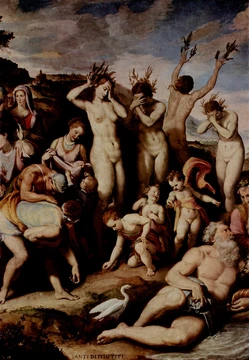
Cycnus (son of Ares)
A cruel host slain by Heracles, later turned into a swan.
Cycnus, whose name means 'swan' in Ancient Greek, was a bloodthirsty and cruel man dwelling either in Pagasae, Thessaly or by the river Echedorus in Macedonia. He is notable for his violent practice of killing all his guests and for his eventual death at the hands of Heracles.
Quick Facts
- Name
- Cycnus (also Cygnus)
- Meaning
- Swan
- Dwelling
- Pagasae, Thessaly or by the river Echedorus in Macedonia
- Father
- Ares
- Killed by
- Heracles
- Mother
- Pelopia (Thessalian) or Pyrene (Macedonian)
Facts from the source article.
Mythology
Cycnus, a son of Ares, had a habit of murdering everyone who came to stay with him, until Heracles finally put a stop to it. The writer Pausanias records that one of Cycnus's victims was a man named Lycus of Thrace. The author Pseudo-Apollodorus describes two different figures named Cycnus whom Heracles faced, treating them as separate events. One was Cycnus of Thessaly, son of Pelopia, who challenged Heracles to a one-on-one fight and was killed; the historian Diodorus tells the same story. The other was Cycnus of Macedonia, son of Pyrene, who also challenged Heracles. In that version, Ares tried to get revenge for his son, but Zeus threw a thunderbolt between the fighters and forced them apart.
In the poem known as the Shield of Heracles, Heracles and his nephew Iolaus are traveling through Thessaly toward Trachis when they come across Cycnus and Ares, both riding in chariots. Heracles is on his way to the court of King Ceyx. The god Apollo, whose sanctuary at Pagasae was near the meeting place, is said to have urged Heracles to attack Cycnus. Heracles accepts the challenge, and as he arms himself, Athena appears. She warns him that if he kills Cycnus, he must not take the armor as a prize, but instead be ready for Ares, who will surely try to avenge his son.
Heracles and Cycnus fight. Cycnus throws his spear at Heracles's shield but fails to pierce it. Heracles then drives his own spear through Cycnus's neck, killing him. Ares, furious, moves to kill Heracles, but Athena appears again and tells him to calm down and stop. Ares refuses, charges at Heracles, and hurls his spear at the hero's shield, but Athena deflects it. Ares then draws his sword and leaps at Heracles, who sees an opening and stabs Ares in the thigh with his spear, knocking the god to the ground. Ares's twin sons, Phobos and Deimos, come to rescue him and carry him back to Mount Olympus.
Heracles strips Cycnus of his armor, then he and Iolaus continue to Trachis. Cycnus is buried by his father-in-law Ceyx and the people of nearby towns. But Apollo, still angry over Cycnus's crimes, causes the river Anaurus to flood and wash away the tomb. According to the playwright Euripides, Heracles killed Cycnus with arrows, and the fight happened at Amphanae near the Anaurus. The scholar Eustathius of Thessalonica says that Ares turned Cycnus into a swan rather than let him die at Heracles's hands.
General and cited references
Diodorus Siculus, The Library of History translated by Charles Henry Oldfather. Twelve volumes. Loeb Classical Library. Cambridge, Massachusetts: Harvard University Press; London: William Heinemann, Ltd. 1989. Vol. 3. Books 4.59–8. Online version at Bill Thayer's Web Site. Diodorus Siculus, Bibliotheca Historica. Vol 1-2. Immanel Bekker. Ludwig Dindorf. Friedrich Vogel. in aedibus B. G. Teubneri. Leipzig. 1890. Greek text available at the Perseus Digital Library. Euripides, The Complete Greek Drama edited by Whitney J. Oates and Eugene O'Neill Jr. in two volumes. 1. Heracles, translated by E. P. Coleridge. New York. Random House. 1938. Online version at the Perseus Digital Library. Euripides, Euripidis Fabulae. vol. 2. Gilbert Murray. Oxford. Clarendon Press, Oxford. 1913. Greek text available at the Perseus Digital Library. Gaius Julius Hyginus, Fabulae from The Myths of Hyginus translated and edited by Mary Grant. University of Kansas Publications in Humanistic Studies. Online version at the Topos Text Project. Hesiod, Shield of Heracles from The Homeric Hymns and Homerica with an English Translation by Hugh G. Evelyn-White, Cambridge, MA., Harvard University Press; London, William Heinemann Ltd. 1914. Online version at the Perseus Digital Library. Greek text available from the same website. Pausanias, Description of Greece with an English Translation by W. H. S. Jones, Litt.D., and H. A. Ormerod, M.A., in 4 Volumes. Cambridge, MA, Harvard University Press; London, William Heinemann Ltd. 1918. Online version at the Perseus Digital Library. Pausanias, Graeciae Descriptio. 3 vols. Leipzig, Teubner. 1903. Greek text available at the Perseus Digital Library. Pseudo-Apollodorus, The Library with an English Translation by Sir James George Frazer, F.B.A., F.R.S. in 2 Volumes, Cambridge, MA, Harvard University Press; London, William Heinemann Ltd. 1921. Online version at the Perseus Digital Library. Greek text available from the same website.
More in Metamorphoses Into Birds in Greek Mythology
Spotted an error? Know more?
Reader corrections go straight into our review queue. Suggest an edit · How this site is sourced