Messier 53
A metal-poor globular cluster with unique tidal features.

Messier 53 (also cataloged as M53 and NGC 5024) is a globular cluster located in the constellation Coma Berenices. Discovered by Johann Elert Bode in 1775, it lies about 58,000 light-years from the Solar System and roughly 60,000 light-years from the Galactic Center, with a diameter of approximately 12 parsecs. The cluster is metal-poor and was once considered the most metal-poor globular cluster in the Milky Way. Most of its red giant branch stars are first-generation, meaning they did not form from gas recycled by earlier stars, unlike the majority of globular clusters, which are dominated by second-generation stars. In M53, second-generation stars are more concentrated toward the core. Overall, the cluster’s stellar composition resembles that of the Milky Way’s halo.
The cluster exhibits tidal features such as clumps, ripples, and tails extending east–west along its orbit. A tidal bridge-like structure appears to connect M53 with the nearby globular cluster NGC 5053, and an envelope surrounds both clusters. These features suggest a dynamic tidal interaction between the two, a situation possibly unique within the Milky Way. M53 is also a candidate member of the Sagittarius dwarf galaxy tidal stream. Among its variable stars are 55 RR Lyrae variables, at least three SX Phoenicis variables, and one semi-regular red giant.
- Designations
- M53, NGC 5024
- Constellation
- Coma Berenices
- Discoverer
- Johann Elert Bode
- Year discovered
- 1775
- Distance from solar system
- about 58,000 light-years (17.9 kpc)
- Distance from galactic center
- about 60,000 light-years (18.4 kpc)
- Diameter
- about 12 parsecs
Lore & Background
Messier 53 was discovered by Johann Elert Bode in 1775. It lies about 60,000 light-years from the Galactic Center and roughly 58,000 light-years from the Solar System, with a diameter of about 12 parsecs. The cluster is metal-poor and was at one time thought to be the most metal-poor cluster in the Milky Way. Most of its red giant branch stars are first-generation stars, meaning they did not form from recycled gas from previous generations, unlike the majority of globular clusters which are dominated by second-generation stars. The second-generation stars in NGC 5024 tend to be more concentrated in the core region. Overall, the stellar composition of cluster members is similar to members of the Milky Way halo.
The cluster displays tidal features including clumps, ripples, and tails along its orbit in an east–west direction. A tidal bridge-like structure appears to connect M53 with the globular cluster NGC 5053, and an envelope surrounds both clusters. These may indicate that a dynamic tidal interaction has occurred between the two clusters, a situation that may be unique within the Milky Way. In addition, M53 is a candidate member of the Sagittarius dwarf galaxy tidal stream.
Among the variable star population in the cluster, there are 55 RR Lyrae variables, at least three variables of type SX Phe, and a semi-regular red giant.
Reader's Guide
Messier 53 is significant as a metal-poor globular cluster that was once considered the most metal-poor in the Milky Way, highlighting its unusual stellar population dominated by first-generation red giant branch stars. This contrasts with most globular clusters, which are more dominated by second-generation stars. Its tidal features—including clumps, ripples, and tails—along with a bridge-like structure connecting it to NGC 5053 and a surrounding envelope, suggest a dynamic tidal interaction between the two clusters, a situation that may be unique within the Milky Way. Additionally, M53 is a candidate member of the Sagittarius dwarf galaxy tidal stream, linking it to broader galactic structure. The cluster's variable star population, including 55 RR Lyrae variables, at least three SX Phe variables, and a semi-regular red giant, provides further data for stellar evolution studies. Its legacy lies in offering insights into cluster formation, chemical enrichment, and tidal dynamics in the Milky Way's halo.
A Number in an Ever-Growing List
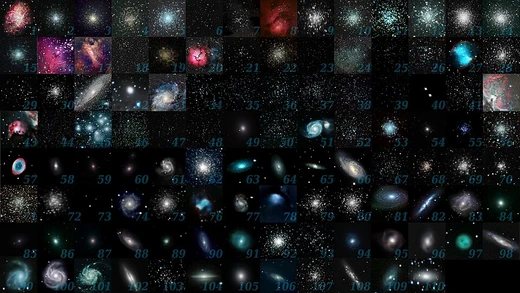
M53 occupies a place within the Messier catalogue, a collection of 110 deep-sky objects that has become one of the most widely referenced lists in all of astronomy. The catalogue did not arrive fully formed. A preliminary version appeared in 1774 in the Memoirs of the French Academy of Sciences, listing just 45 unnumbered objects. By 1780 the count had swelled to 70, and the definitive edition of 103 objects was published in 1781 in the Connaissance des Temps. Because M53 carries a number well below 103, it belongs to the core set that Messier and his assistant Pierre Méchain compiled during their careers. Yet the list never truly stopped growing. In 1921, Nicolas Camille Flammarion added M104 after spotting a marginal note in a copy of the 1781 edition. Helen Sawyer Hogg contributed M105 through M107 in 1947, Owen Gingerich added M108 and M109 in 1960, and Kenneth Glyn Jones included M110 in 1967. Today, astronomers still routinely identify objects like M53 by their Messier number rather than by any other designation, a testament to how deeply this humble catalogue is woven into the language of the sky.
Born from a Comet Hunter's Frustration
Few catalogues in the history of science were conceived with such a pragmatic, almost grudging motivation. Charles Messier was not primarily interested in mapping the heavens for their own sake; his true passion was tracking comets. Every time his telescope swept across a patch of sky and revealed a fuzzy nebula, a tight globular cluster, or a distant spiral galaxy instead of the faint tail he was searching for, he noted the object down so he would not waste time on it again. M53 is one of those objects that originally stood in the way of a comet search. Working alongside his assistant Pierre Méchain, Messier assembled what began as a simple avoidance list into one of the most celebrated compilations in astronomy. The first edition, published in 1774, contained 45 objects. The final version, appearing in 1781 in the Connaissance des Temps pour l'Année 1784, held 103. What started as a personal frustration list for a comet hunter has endured for over two centuries as a foundational reference, with its entries still cited by their M-numbers in both professional and amateur literature alike.
A Target for the Backyard Astronomer
Because Messier compiled his list from the vantage point of Paris, the catalogue naturally skews toward objects visible from the Northern Hemisphere, spanning the sky from the north celestial pole down to a celestial latitude of roughly minus 35.7 degrees. M53 falls comfortably within that observable window, which is why it remains a favorite among amateur astronomers who point modest telescopes at the spring sky. The objects in the catalogue are among the brightest and most visually striking examples of their respective deep-sky classes, and many can be resolved with a refracting telescope of only about 100 millimeters in aperture—the same scale of instrument Messier himself used from downtown Paris. Today, hobbyists with larger-aperture equipment can study fine structural details that would have been invisible to an 18th-century observer. In early spring, dedicated stargazers even organize so-called Messier marathons, attempting to view every single object in the catalogue over the course of one long night. M53, sitting in the northern sky, is a natural waypoint on that ambitious journey.
The Workshop at the Hôtel de Cluny
Messier conducted his observational work from the Hôtel de Cluny in Paris, a building that today houses the Musée national du Moyen Âge. From this urban vantage point, he and Méchain could sweep the sky with a relatively modest refracting telescope of approximately four inches in aperture. The practical limitation of working from a single northern-latitude site shaped the catalogue's scope: it includes only objects visible between the north celestial pole and a celestial latitude of about minus 35.7 degrees. Brilliant southern-sky targets such as the Large and Small Magellanic Clouds were simply beyond reach and never made the list. The objects that did make it—spanning diffuse nebulae, planetary nebulae, open clusters, globular clusters, and galaxies—represent nearly all of the most spectacular examples of each type visible from European latitudes. M53 is one such object, a member of a catalogue that, by virtue of its Northern Hemisphere focus and its emphasis on bright, nearby examples, has become the default starting point for anyone wishing to explore the deep sky with their own eyes.
Frequently Asked Questions
What is Messier 53?
Messier 53 is a dense globular cluster of ancient stars located in the constellation Coma Berenices, also cataloged as NGC 5024. It packs its stellar members into a roughly 12-parsec-wide sphere orbiting a shared gravitational center.
Who discovered Messier 53 and when?
German astronomer Johann Elert Bode first identified this cluster in 1775, adding it to the growing list of deep-sky objects known at the time. It later received its familiar M53 label through the Messier catalog system.
What makes Messier 53 unusual among globular clusters?
M53 stands out because most of its red giant branch stars are first-generation, having condensed directly from pristine primordial gas rather than from material recycled by earlier stellar deaths. It was long regarded as the most metal-poor globular cluster in the Milky Way and also displays distinctive tidal features in its outer halo.
How far away is Messier 53?
The cluster sits roughly 58,000 light-years from our Solar System, placing it well beyond the visible disk of the Milky Way. Measured from the Galactic Center, it lies approximately 60,000 light-years distant.
How big is Messier 53?
The cluster spans roughly 12 parsecs in diameter, making it a compact but substantial collection of stars. At its distance it appears as a faint roundish smudge in small telescopes, though larger instruments can resolve the dense inner star field.
More in Messier Objects, Part 2 1-24
Spotted an error? Know more?
Reader corrections go straight into our review queue. Suggest an edit · How this site is sourced