Messier Objects, Part 2
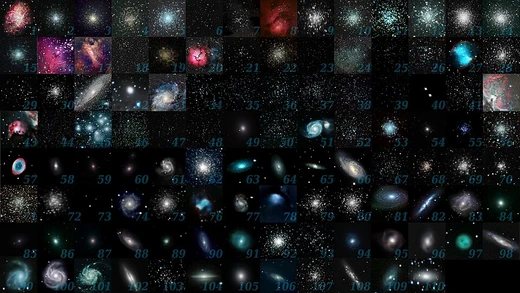
21 entries in the Messier Objects, Part 2 compendium.
Messier 41An open cluster near Sirius, resembling the Beehive Cluster.Orion NebulaThe closest massive star-forming region to Earth.Messier 43A star-forming H II region separated from the Orion Nebula by a dark lane.PleiadesAn open star cluster nearest to Earth and visible to the naked eye.Messier 46Open cluster in Puppis with a superimposed planetary nebula.Messier 47An open cluster once lost, rediscovered by coordinate sign swap.Messier 48An open cluster with a five-degree discovery error by Messier.Messier 49First discovered member of the Virgo Cluster, a luminous elliptical galaxy.Whirlpool GalaxyFirst galaxy classified as spiral, interacting with NGC 5195.Messier 52An open cluster in Cassiopeia discovered by Charles Messier in 1774.Messier 53A metal-poor globular cluster with unique tidal features.Messier 54A globular cluster reassigned to extragalactic status in 1994.Messier 55A low-metallicity globular cluster in southern Sagittarius.Messier 56A globular cluster in Lyra with a possible dwarf galaxy origin.Ring NebulaA planetary nebula in Lyra, discovered by Charles Messier in 1779.Messier 58A barred spiral galaxy and one of the brightest in the Virgo Cluster.Messier 59Elliptical galaxy in Virgo with a counter-rotating supermassive black hole.Messier 60A giant elliptical galaxy with a massive inactive black hole.Messier 61A starburst spiral galaxy with eight observed supernovae.Messier 62A massive globular cluster with two star generations and many variables.Messier 63A flocculent spiral galaxy in Canes Venatici.
Browse Messier Objects, Part 2 in the interactive codex →