Messier 46
Open cluster in Puppis with a superimposed planetary nebula.

Messier 46 (M46), also known as NGC 2437, is an open cluster of stars in the slightly southern constellation of Puppis. Discovered by Charles Messier in 1771, it is described as 'very bright, very rich, very large' and lies about 5,000 light-years away. The cluster contains an estimated 500 stars with a combined mass of 453 solar masses and is thought to be about 251.2 million years old.
- Designations
- M46, NGC 2437
- Constellation
- Puppis
- Distance
- 5,000 light-years
- Age
- 251.2 million years
- Number of stars
- 500
- Combined mass
- 453 M☉
- Tidal radius
- 37.8 ± 4.6 ly
- Core radius
- 8.5 ± 1.3 ly
Lore & Background
Messier 46 was discovered by Charles Messier in 1771. Dreyer described it as 'very bright, very rich, very large.' The cluster has a tidal radius of 37.8 ± 4.6 light-years and a core radius of 8.5 ± 1.3 light-years. It has a greater spatial extent in infrared than in visible light, suggesting mass segregation, with fainter redder stars migrating to a coma or tail region. Fainter stars extending to the south and west may form a tidal tail due to a past interaction.
The planetary nebula NGC 2438 appears to lie within the cluster near its northern edge, but it is most likely unrelated since it does not share the cluster's radial velocity. This makes for superimposed objects of interest, another instance perhaps being NGC 2818. On the other hand, the illuminating star of the bipolar Calabash Nebula shares the radial velocity and proper motion of Messier 46 and is at the same distance, so it is a bona fide member of the open cluster.
M46 is located close by to another open cluster, Messier 47, about a degree east of M47 in the sky, so the two fit well in a binocular or wide-angle telescope field.
Reader's Guide
Messier 46 is notable as a rich open cluster with an estimated 500 stars and a combined mass of 453 solar masses, located about 5,000 light-years away in Puppis. Its significance is enhanced by the superimposed planetary nebula NGC 2438, which appears near the cluster's northern edge but is likely unrelated due to differing radial velocities. This superposition creates a striking visual contrast between young cluster stars and an older nebula. Additionally, the illuminating star of the bipolar Calabash Nebula is a genuine member of M46, sharing its radial velocity, proper motion, and distance. The cluster's infrared extent suggests ongoing mass segregation, with fainter redder stars forming a tidal tail possibly from a past interaction. Its proximity to Messier 47, about a degree away, makes it a popular binocular or wide-field telescope target. The cluster's discovery by Charles Messier in 1771 and its description by Dreyer as 'very bright, very rich, very large' underscore its historical importance as a deep-sky object.
Did You Know?
- The planetary nebula NGC 2438 appears within M46 but is likely unrelated due to different radial velocities.
- The illuminating star of the Calabash Nebula is a bona fide member of M46.
- M46 is located about one degree east of the open cluster Messier 47.
A Place in the Grand Catalogue
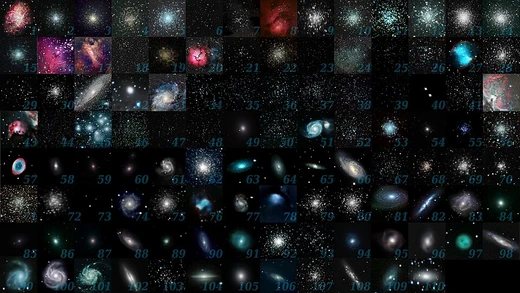
Messier 46 occupies a numbered slot within one of the most celebrated inventories of the night sky ever assembled. The Messier catalogue, compiled by French astronomer Charles Messier alongside his assistant Pierre Méchain, ultimately encompasses 110 astronomical objects spanning a remarkable diversity of deep-sky phenomena. Originally born from a practical frustration—Messier was hunting comets and kept losing time to bright, non-comet objects that mimicked their appearance—the list grew from an unnumbered set of 45 entries in 1774 to a final 103-object publication in 1781, before later astronomers added the remaining entries through notes buried in Messier's and Méchain's manuscripts. M46, like its numbered neighbours, belongs to a collection that now serves as a shorthand reference system still in active use by astronomers worldwide. Rather than being defined by a modern discovery date, it carries the weight of an eighteenth-century designation that has outlasted the very instruments that first recorded it.
Observed from the Heart of Paris
The objects in the Messier catalogue, including M46, were identified using a modest refracting telescope of roughly 100-millimetre aperture, operated from the premises of the Hôtel de Cluny in Paris—today home to the Musée national du Moyen Âge. Messier's working sky was bounded by the north celestial pole down to a celestial latitude of approximately −35.7 degrees, a constraint that naturally excluded southern-hemisphere wonders such as the Magellanic Clouds. The fact that M46 and its catalogue companions could be resolved with such a small instrument from a city centre speaks to their intrinsic brightness and visual prominence. They represent, in their respective categories, some of the nearest and most spectacular examples of deep-sky objects visible from European latitudes. Today, professional-class telescopes can tease out fine structural details in these same targets that were invisible to an eighteenth-century observer peering through a four-inch glass, yet the fundamental appeal that drew Messier's eye remains unchanged.
A Target for the Backyard Astronomer
For the modern amateur astronomer, objects like M46 occupy a special place as accessible, rewarding targets that require nothing more than a modest telescope and a dark enough sky. The Messier catalogue was never designed as a recreational list; it was a practical tool to help a comet hunter avoid wasting hours on stationary objects. Yet the very qualities that made these objects frustrating for Messier—their brightness, their visual distinctiveness, their relative proximity—have made them the backbone of visual astronomy and astrophotography for nearly three centuries. Enthusiasts gather each early spring for Messier marathons, attempting to sweep through the entire catalogue in a single night, and M46 slots into that seasonal sequence. Larger-aperture equipment available to hobbyists today reveals far more detail than Messier's 100-millimetre refractor ever could, transforming what was once a faint smudge in a Parisian sky into a richly structured spectacle.
The Living Legacy of a Comet Hunter's List
What began as a working note to keep a comet search on track has evolved into one of the most enduring reference systems in all of astronomy. The Messier catalogue's numbering scheme—M1, M2, M3, and so on through M110—has become so deeply embedded in the language of the field that objects are routinely identified by their Messier designation rather than by their formal catalogue names. The list itself has a layered history: Messier's 1781 publication in the Connaissance des Temps contained 103 entries, but marginalia in his and Méchain's texts prompted later scholars to append additional objects. Flammarion added M104 in 1921, Helen Sawyer Hogg contributed M105 through M107 in 1947, Owen Gingerich added M108 and M109 in 1960, and Kenneth Glyn Jones included M110 in 1967. M46, sitting comfortably within the original numbered sequence, benefits from this stability. Its identity as a Messier object guarantees that it will continue to be referenced, studied, and admired long after the specific telescopic technology of any single era has passed.
Frequently Asked Questions
What is Messier 46?
M46 is an open star cluster catalogued by Charles Messier in 1771, also designated NGC 2437. It sits roughly 5,000 light-years from Earth in the southern constellation Puppis.
How old is Messier 46?
Astronomers estimate the cluster is approximately 251.2 million years old. That makes it a relatively mature open cluster compared to younger, tighter groupings.
How many stars does Messier 46 contain?
The cluster holds an estimated 500 stars whose combined mass works out to about 453 times that of our Sun. Messier himself described it as very bright, very rich, and very large.
What makes Messier 46 unique among open clusters?
A planetary nebula happens to lie directly in front of the cluster from our vantage point, creating a striking superimposed appearance in telescope images. This alignment is purely a line-of-sight coincidence rather than a physical connection.
Who discovered Messier 46?
French astronomer Charles Messier identified the cluster in 1771 while compiling his catalogue of deep-sky objects to help comet hunters avoid confusing them with nebulae. It was later cross-referenced as NGC 2437 in the New General Catalogue.
More in Messier Objects, Part 2 1-24
Spotted an error? Know more?
Reader corrections go straight into our review queue. Suggest an edit · How this site is sourced