Messier 52
An open cluster in Cassiopeia discovered by Charles Messier in 1774.

Messier 52 (M52), also known as NGC 7654 or the Scorpion Cluster, is an open cluster of stars in the highly northern constellation of Cassiopeia. It was discovered by Charles Messier in 1774 and can be seen from Earth under a good night sky with binoculars. The cluster's brightness is influenced by extinction, which is stronger in its southern half.
- Designations
- M52, NGC 7654, Scorpion Cluster
- Constellation
- Cassiopeia
- Discovered by
- Charles Messier
- Discovery year
- 1774
- Apparent magnitude
- Not stated
- Distance
- Not stated
- Age
- 158.5 million years
- Mass
- 1,200 M☉
- Metallicity
- [Fe/H] = −0.05 ± 0.01
- Core radius
- 2.97 ± 0.46 ly (0.91 ± 0.14 pc)
Lore & Background
R. J. Trumpler originally classified the cluster appearance as II2r, indicating a rich cluster with little central concentration and a medium range in the brightness of the stars. This classification was later revised to I2r, denoting a dense core. The cluster has a core radius of 2.97 ± 0.46 ly and a tidal radius of 42.7 ± 7.2 ly. Its estimated age is 158.5 million years and its mass is 1,200 solar masses.
The metallicity of M52 is somewhat below that of the Sun, estimated at [Fe/H] = −0.05 ± 0.01. The magnitude 8.3 supergiant star BD +60°2532 is a probable member of the cluster, along with 18 candidate slowly pulsating B stars, one being a Delta Scuti variable, and three candidate Gamma Doradus variables. There may also be three Be stars. The core of the cluster shows a lack of interstellar matter, which may be due to supernovae explosions early in the cluster's history.
Reader's Guide
Messier 52 is notable as an open cluster discovered by Charles Messier in 1774, located in the northern constellation Cassiopeia. Its brightness is affected by extinction, particularly in the southern half. The cluster's classification was revised from II2r to I2r, indicating a dense core. Its age of 158.5 million years and mass of 1,200 solar masses provide context for its stellar population. The cluster contains a probable supergiant member, BD +60°2532, and several variable star candidates, including slowly pulsating B stars, a Delta Scuti variable, and Gamma Doradus variables, as well as possible Be stars. The lack of interstellar matter in the core suggests past supernova activity. These features make M52 a useful object for studying stellar evolution and cluster dynamics, though its southern half's extinction complicates observations. Its visibility with binoculars under good conditions makes it accessible to amateur astronomers.
Did You Know?
- Its metallicity is slightly below that of the Sun, at [Fe/H] = −0.05 ± 0.01.
- The cluster's core radius is 2.97 ± 0.46 light-years and its tidal radius is 42.7 ± 7.2 light-years.
- The core of M52 shows a lack of interstellar matter, possibly due to early supernova explosions.
A Comet Hunter's List
The Messier catalogue, of which M52 is a member, was born from an unexpected frustration. Charles Messier, a French astronomer, was primarily obsessed with tracking comets across the sky. But every time he spotted a fuzzy patch of light that might be a new comet, it turned out to be a nebula or star cluster. To spare himself and future comet seekers the same wasted effort, he began compiling a list of these non-comet objects that kept derailing his search. He worked alongside his assistant Pierre Méchain on this project. The result became one of the most celebrated lists in all of astronomy. M52 sits among these entries as one of the deep-sky targets that originally confused a comet hunter. The catalogue's fame endures to this day, with objects still routinely identified by their Messier designations in both professional and amateur astronomical discourse.
From Forty-Five to One-Hundred-Ten
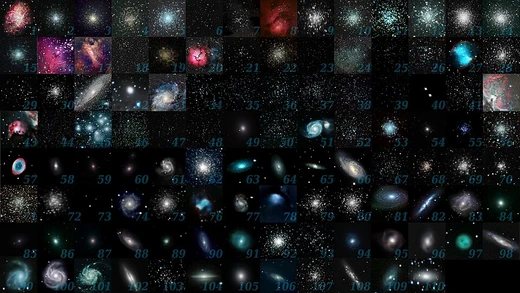
The catalogue that houses M52 did not arrive in its final form overnight. A preliminary edition appeared in 1774 within the Memoirs of the French Academy of Sciences, listing just 45 objects that carried no numerical labels. Of those initial entries, eighteen were Messier's own discoveries while the remainder had been spotted earlier by other observers. By 1780 the count had swelled to 70, and the definitive 103-object version was published in 1781 in the Connaissance des Temps. Yet the story did not end there. Marginalia and side notes left by Messier and Méchain hinted at additional objects they had known about. Over the following decades, other astronomers pieced together these clues: Flammarion added M104 in 1921, Helen Sawyer Hogg contributed M105 through M107 in 1947, Owen Gingerich appended M108 and M109 in 1960, and Kenneth Glyn Jones included M110 in 1967. The total now stands at 110, with M52 occupying a stable position in the original core of the list.
A Night of Deep-Sky Wonders
M52 belongs to a catalogue that encompasses nearly every spectacular example of the five major deep-sky categories—diffuse nebulae, planetary nebulae, open clusters, globular clusters, and galaxies—visible from European latitudes. What makes these objects particularly compelling is that almost all of them rank among the nearest members of their respective classes, meaning modern professional instruments can resolve fine structural details that were invisible to Messier's era. For the casual stargazer, the appeal is equally strong. Messier himself studied the sky using a modest refracting telescope of roughly 100 millimeters in aperture, yet these targets remained bright enough to reward his small instrument. Today, amateur astronomers with larger equipment find them irresistible subjects for visual observation and astrophotography. In early spring, dedicated observers even organize Messier marathons, attempting to sweep through the entire list in a single night, with M52 serving as one link in that celestial chain.
Working from the Hôtel de Cluny
Messier conducted his observations from the Hôtel de Cluny in Paris, a building that today houses the Musée national du Moyen Âge. His vantage point in the French capital imposed a natural boundary on what he could catalog: his list covers only the sky stretching from the north celestial pole down to a celestial latitude of roughly minus 35.7 degrees. Objects visible exclusively from much farther south, such as the Large and Small Magellanic Clouds, simply fell outside his operational range and were never entered into the catalogue. This geographic limitation shaped the character of the entire list, including M52, which sits comfortably within the northern hemisphere's observable sky. The catalogue was ultimately published in the Connaissance des Temps pour l'Année 1784, the French official yearly almanac of astronomical ephemerides, lending it an institutional authority that has kept it in continuous use for over two centuries.
Frequently Asked Questions
What is Messier 52?
M52 is an open cluster of stars situated in the northern constellation of Cassiopeia. It is also catalogued as NGC 7654 and nicknamed the Scorpion Cluster.
Who discovered Messier 52 and when?
Charles Messier identified the cluster in 1774 while compiling his famous catalogue of deep-sky objects. It received the number 52 in that list, giving it the designation M52.
Can you see Messier 52 from Earth?
Yes, the cluster is visible through binoculars on a clear, dark night. Because it lies in a highly northern region of the sky, it is a straightforward target for observers in the Northern Hemisphere.
What constellation does Messier 52 belong to?
The Scorpion Cluster sits within Cassiopeia, one of the most recognizable constellations in the northern sky. Its bright, W-shaped asterism makes locating M52 relatively easy for amateur astronomers.
What is unusual about Messier 52's appearance?
Interstellar extinction dims the cluster's southern half more strongly than its northern half, producing an uneven brightness across the group. This makes M52 a useful example for studying how dust along the line of sight affects observed starlight.
More in Messier Objects, Part 2 1-24
Spotted an error? Know more?
Reader corrections go straight into our review queue. Suggest an edit · How this site is sourced