Dwight D. Eisenhower
34th president and Supreme Allied Commander who led D-Day and built the Interstate Highway System.

via Wikipedia: Dwight D. Eisenhower · see source
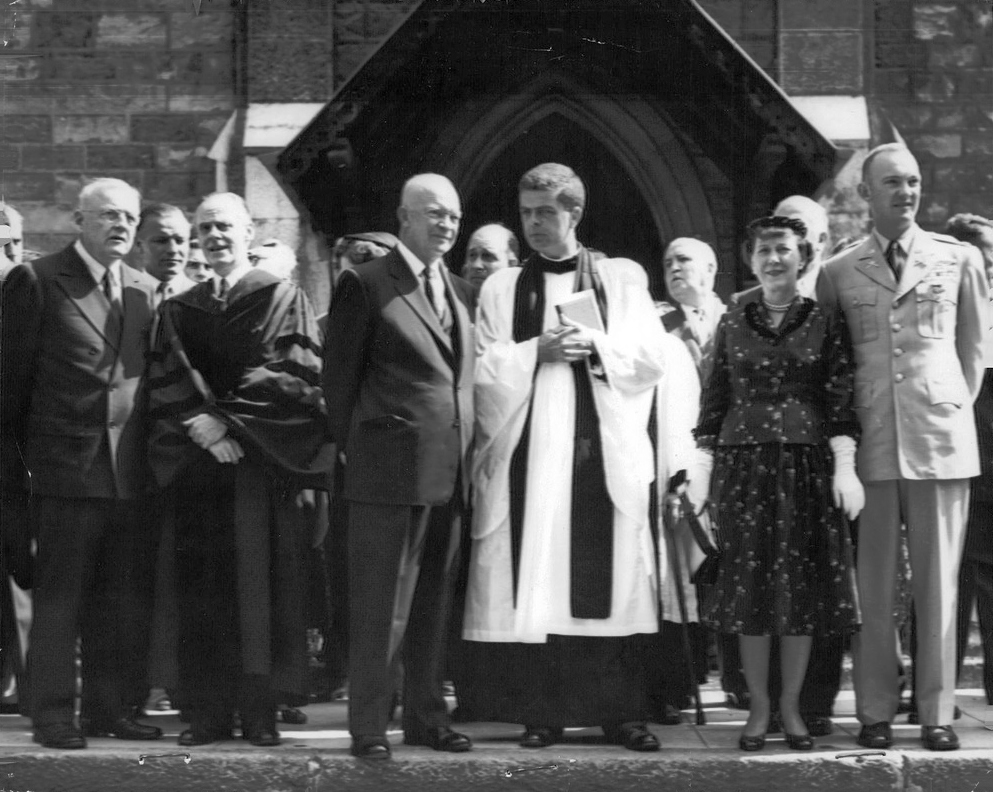
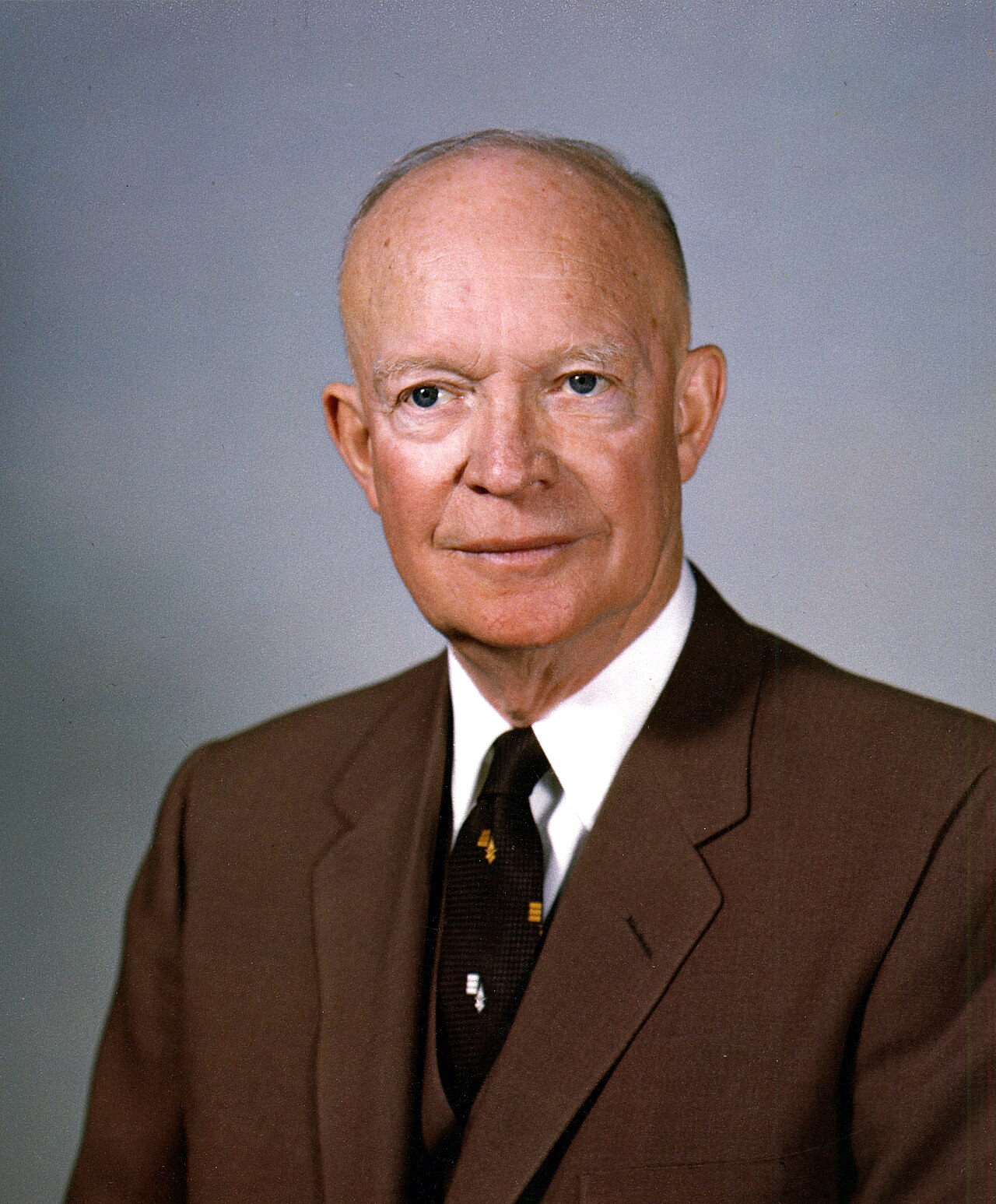
Dwight David 'Ike' Eisenhower (born David Dwight Eisenhower; October 14, 1890 – March 28, 1969) was the 34th president of the United States, serving from 1953 to 1961. In his previous military career, he commanded the Allied Expeditionary Force during World War II, including in Operation Torch in North Africa and Operation Overlord on D-Day in Normandy. For his 37 years of service in the U.S. Army, Eisenhower was honored with the five-star rank of General of the Army in 1944.
Quick Facts
- Order
- 34th
- Office
- President of the United States
- Vice president
- Richard Nixon
- Took office
- January 20, 1953
- Left office
- January 20, 1961
- Predecessor
- Harry S. Truman
- Successor
- John F. Kennedy
- Birth name
- David Dwight Eisenhower
Lore & Background
Eisenhower graduated from West Point in 1915. During World War I, he was denied a request to serve in Europe and instead commanded a unit that trained tank crews. Between the wars he served in staff positions in the US and the Philippines, reaching the rank of brigadier general shortly before the entry of the US into World War II in 1941. After further promotion Eisenhower oversaw the Allied invasions of North Africa and Sicily before supervising the invasions of France and Germany. After the war ended in Europe, he served as military governor of the American-occupied zone of Germany (1945), as Army Chief of Staff (1945–1948), president of Columbia University (1948–1953), and as the first supreme commander of NATO (1951–1952). In 1952, Eisenhower entered the presidential race as a Republican, in part to block the presidential prospects of Senator Robert A. Taft, who opposed NATO and sought to undo the New Deal. Eisenhower won that year's election and the 1956 election in landslides, both times defeating Adlai Stevenson II. Eisenhower's main goals in office were to contain the spread of communism and reduce federal deficits. In 1953, Eisenhower considered using nuclear weapons to end the Korean War and may have threatened China with nuclear attack if an armistice was not reached quickly. China did agree and an armistice resulted, which remains in effect. His New Look policy of nuclear deterrence prioritized 'inexpensive' nuclear weapons while reducing funding for expensive Army divisions. He continued Harry S. Truman's policy of recognizing Taiwan as the legitimate government of China, and he won congressional approval of the Formosa Resolution. His administration provided aid to help the French try to fight Vietnamese Communists in the First Indochina War. After the French left, he gave strong financial support to the new state of South Vietnam. Eisenhower supported regime-changing military coups in Iran and Guatemala orchestrated by his own administration. During the Suez Crisis of 1956, he condemned the Israeli, British, and French invasion of Egypt, and he forced them to withdraw. He also condemned the Soviet invasion during the Hungarian Revolution of 1956 but took no action. He deployed 15,000 soldiers during the 1958 Lebanon crisis.
Reader's Guide
Eisenhower was born David Dwight Eisenhower in Denison, Texas, the third of seven sons. Soon after his birth, his mother reversed his two forenames to 'Dwight David' to avoid the confusion of having two Davids in the family. He was named Dwight after the evangelist Dwight L. Moody. All of the boys were nicknamed 'Ike', such as 'Big Ike' (Edgar) and 'Little Ike' (Dwight); the nickname was intended as an abbreviation of their last name. By World War II, only Dwight was still called 'Ike'. In 1892, the family moved to Abilene, Kansas, which Eisenhower considered his hometown. As a child, he was involved in an accident that cost his younger brother Earl an eye, for which he was remorseful for the remainder of his life. Eisenhower developed a keen and enduring interest in exploring the outdoors. He learned about hunting and fishing, cooking, and card playing from a man named Bob Davis who camped on the Smoky Hill River. While his mother was against war, it was her collection of history books that first sparked Eisenhower's interest in military history. He became a voracious reader on the subject. Other favorite subjects early in his education were arithmetic and spelling. Eisenhower's parents set aside specific times at breakfast and at dinner for daily family Bible reading. Chores were regularly assigned and rotated among all the children, and misbehavior was met with unequivocal discipline, usually from David. His mother, previously a member (with David) of the River Brethren (Brethren in Christ Church) sect of the Mennonites, joined the International Bible Students Association, later known as Jehovah's Witnesses. The Eisenhower home served as the local meeting hall from 1896 to 1915, though Dwight never joined. His later decision to attend West Point saddened his mother, who felt that warfare was 'rather wicked', but she did not overrule his decision. Speaking of himself in 1948, Eisenhower said he was 'one of the most deeply religious men I know' though unattached to any 'sect or organization'. He was baptized in the Presbyterian Church in 1953. Eisenhower attended Abilene High School and graduated in 1909. As a freshman, he injured his knee and developed a leg infection that extended into his groin, which his doctor diagnosed as life-threatening.
Did You Know?
- He injured his knee playing football at West Point and later said not making the baseball team was one of his greatest disappointments.
- Eisenhower's West Point graduating class of 1915 is called 'the class the stars fell on' because 59 members became generals.
Gallery
Frequently Asked Questions
Who is Dwight D. Eisenhower in the game?
Dwight D. Eisenhower appears as a historical figure representing the leadership of the Allied Forces during World War II. Within the game, he acts as a narrative anchor who outlines the broader strategic goals for the player's unit.
Is Dwight D. Eisenhower playable?
Players cannot select or control Dwight D. Eisenhower at any point during gameplay sessions. He exists strictly as a non-playable character used to deliver mission briefings and context.
What is Dwight D. Eisenhower's role in the campaign?
His role is defined by his position as the Supreme Allied Commander overseeing major military operations in Europe. This connection helps frame individual missions within the larger scope of the liberation campaign.
Which operations does Dwight D. Eisenhower oversee?
He is specifically associated with high-profile events such as the Normandy landings where strategic planning was crucial. His presence signals that the player is participating in historically significant battles.
More in Characters & Units
Elsewhere in Medal of Honor
Spotted an error? Know more?
Reader corrections go straight into our review queue. Suggest an edit · How this site is sourced