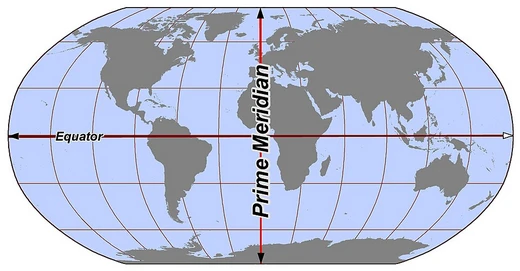
Northern Hemisphere
The Northern Hemisphere contains most of the world's continents and major landmasses.
Last updated

Sean Baker ( Marvin01 | talk ) · via Wikipedia: Northern Hemisphere · CC BY 2.0
As of 2015, about 6.4 billion people, or 87.0% of Earth's human population, lived in the Northern Hemisphere.[1] Earth's division north of the equator is termed the Northern Hemisphere.[2] Water covers 60.7% of the Northern Hemisphere's surface, while the Southern Hemisphere is 80.9% water; 67.3% of the planet's landmass is located in the Northern Hemisphere.[3]
Quick Facts
- Surface water percentage
- 60.7%
- Land percentage
- 67.3% of Earth's land
- Key climate zones
- Arctic
- Northern temperate
- Tropical
- Major ocean currents
- clockwise-turning gyres in North Atlantic and North Pacific
Facts from the source article.
Key facts and history
During the Pleistocene, cold glacial phases occurred at intervals of approximately 40,000 to 100,000 years.[4] High pressure weather cells in the Northern Hemisphere exhibit clockwise air circulation.[5] North America, the main body of Eurasia, roughly two-thirds of Africa, and a minor portion of South America are all situated in the Northern Hemisphere.[3] Warmer interglacial periods, each lasting between 10,000 and 15,000 years, separated the extended glacial phases.[4]
The current interglacial epoch, known as the Holocene, is the period Earth is experiencing now.[4] Due to the Coriolis effect, any object moving across or above the Northern Hemisphere's surface is deflected toward the right.[6] Consequently, large-scale air and water flows in the Northern Hemisphere typically rotate in a clockwise direction, forming gyres.[6] In the Northern Hemisphere, tropical storms and hurricanes, which are massive low-pressure systems, rotate in a counterclockwise direction.[5]
An observer in the Northern Hemisphere sees the Moon oriented upside-down relative to how it appears to someone in the Southern Hemisphere.[7]
What the cited sources add
The National Geographic Society account explains that trade winds blow from east to west just above the equator, pulling surface water into currents.[8] The NOAA Ocean Exploration source states that major current systems typically flow clockwise in the northern hemisphere in circular patterns that often trace coastlines.[9] The US Department of Commerce notes that the Coriolis effect deflects major surface ocean currents to the right in the Northern Hemisphere in a clockwise spiral.[10] The "Quaternary Period" source reports that by 800,000 years ago, ice ages lasted about 100,000 years followed by warmer interglacials of 10,000 to 15,000 years.[11]
The EPOD service explains that observers in the Southern Hemisphere see celestial bodies upside-down compared to how they appear in the Northern Hemisphere.[12] At roughly 30°N latitude, westerly winds drive these currents eastward, completing a clockwise loop.[8]
References
- Wikipedia, "Northern Hemisphere" (CC BY-SA 4.0), which cites: Calculated from World Population Yearbook 2019(in thousands) World total population: 7,359,970 Northern Hemisphere population: 6,405,030 87.0% Southern Hemisphe; "90% Of People Live In The Northern Hemisphere – Business Insider", Business Insider, 4 May 2012; "GIC – Article", galegroup.com (original not read by us) en.wikipedia.org
- Wikipedia, "Northern Hemisphere" (CC BY-SA 4.0), which cites: Archinal, "Report of the IAU Working Group on Cartographic Coordinates and Rotational Elements: 2009", Celestial Mechanics and Dynamical Astronomy, 2010, p. 101–135 (original not read by us) en.wikipedia.org
- Wikipedia, "Northern Hemisphere" (CC BY-SA 4.0), which cites: "Life on Earth: A – G.. 1", ABC-CLIO, 2002, p. 528 (we also read that source) en.wikipedia.org
- Wikipedia, "Northern Hemisphere" (CC BY-SA 4.0), which cites: "Quaternary Period", 2017-01-06; "How long can we expect the present Interglacial period to last?", U.S. Department of the Interior (we also read that source) en.wikipedia.org
- Wikipedia, "Northern Hemisphere" (CC BY-SA 4.0), which cites: "Hurricanes: Science and Society: Primary Circulation", www.hurricanescience.org (original not read by us) en.wikipedia.org
- Wikipedia, "Northern Hemisphere" (CC BY-SA 4.0), which cites: US Department of Commerce, "Boundary Currents – Currents: NOAA's National Ocean Service Education", oceanservice.noaa.gov; US Department of Commerce, "Boundary Currents – Currents: NOAA's National Ocean Service Education", oceanservice.noaa.gov; "How does the ocean affect climate and weather on land?", NOAA Ocean Exploration (we also read that source) en.wikipedia.org
- Wikipedia, "Northern Hemisphere" (CC BY-SA 4.0), which cites: Laura Spitler, "Does the Moon look different in the northern and southern hemispheres? (Beginner) – Curious About Astronomy? Ask an Astronomer", cornell.edu; "Perspective of the Moon from the Northern and Southern Hemispheres" (we also read that source) en.wikipedia.org
- "Ocean Currents", National Geographic Society, 2019-07-01. facts only, no text reused. education.nationalgeographic.org
- "How does the ocean affect climate and weather on land?", NOAA Ocean Exploration. facts only, no text reused. oceanexplorer.noaa.gov
- US Department of Commerce, "Boundary Currents – Currents: NOAA's National Ocean Service Education", oceanservice.noaa.gov. facts only, no text reused. oceanservice.noaa.gov
- "Quaternary Period", 2017-01-06. facts only, no text reused. nationalgeographic.com
- "Perspective of the Moon from the Northern and Southern Hemispheres". facts only, no text reused. epod.usra.edu
Each numbered sentence above was checked against the source it cites before publication. Sentences citing Wikipedia adapt text from the English Wikipedia article Northern Hemisphere (contributors), used under CC BY-SA 4.0; this entry is available under the same licence. Other sources were used for facts only; no text or images are copied from them.
Also in the Codexery
More in Lines & Hemispheres
Related in Lines & Hemispheres
Links follow this subject's own source article.
Sources
Compiled from Wikipedia and the sources listed below. Text from Wikipedia is available under CC BY-SA 4.0; this entry is adapted from it.
- Wikipedia: Northern Hemisphere (CC BY-SA 4.0).
- Word definitions: the , each quoted from its Wikipedia article.
Spotted an error? Know more?
Reader corrections go straight into our review queue. Suggest an edit · How this site is sourced